An automatic pH and chlorine control system continuously measures your pool’s water values and doses the right amount of chemicals on its own. The system uses sensors for pH (glass electrode) and disinfection (ORP/Redox in mV or free chlorine in ppm), connected to dosing pumps or an electrolysis cell. The result: stable water chemistry without daily manual checks.
What does the system actually measure?
An automatic controller measures at least two parameters continuously, day and night, as long as the pump is running.
pH electrode (glass electrode): The glass electrode is the most widely used element for pH measurement. A sensitive glass membrane responds to the concentration of hydrogen ions in the water and produces a millivolt signal that is converted to a pH value (0 to 14). Accuracy: 0.01 pH with a properly calibrated sensor.
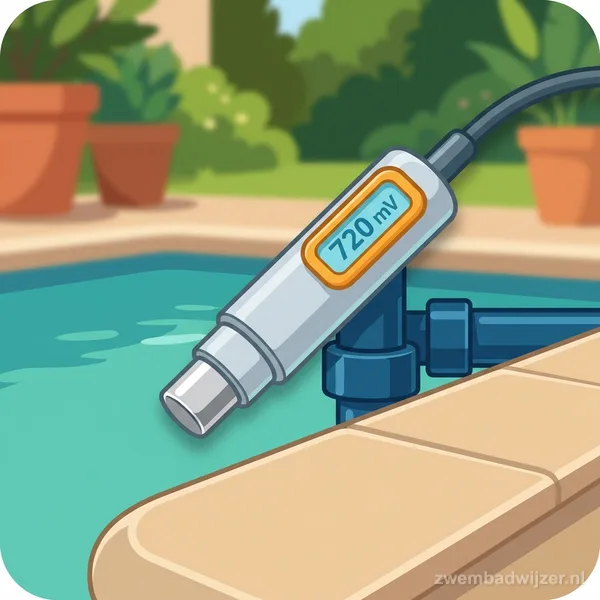
ORP/Redox probe (mV measurement): The ORP electrode (Oxidation-Reduction Potential) measures the disinfecting capacity of the water in millivolts. A platinum electrode measures the electrochemical potential relative to a reference electrode. The reading in mV directly indicates the oxidising power of the water, regardless of which disinfectant you use. Learn more at pool ORP and redox value .
Free chlorine (ppm measurement): Some systems also measure free chlorine directly in ppm via an amperometric sensor alongside ORP. This is more precise than ORP alone, but the sensor is more expensive and more sensitive to fouling. In practice, ORP is sufficient for most private pools.
How does automatic dosing work?
The controller continuously compares the measured pH and ORP values with the set points (target values). As soon as the measured value falls outside the set hysteresis, the dosing pump starts.
Peristaltic dosing pumps: The standard dosing pump in pool automation is peristaltic. A rotating head squeezes a flexible tube, pushing small volumes of liquid forward, typically adjustable from 0.5 to 5 litres per hour. This type is self-priming, resistant to aggressive chemicals, and requires little maintenance.
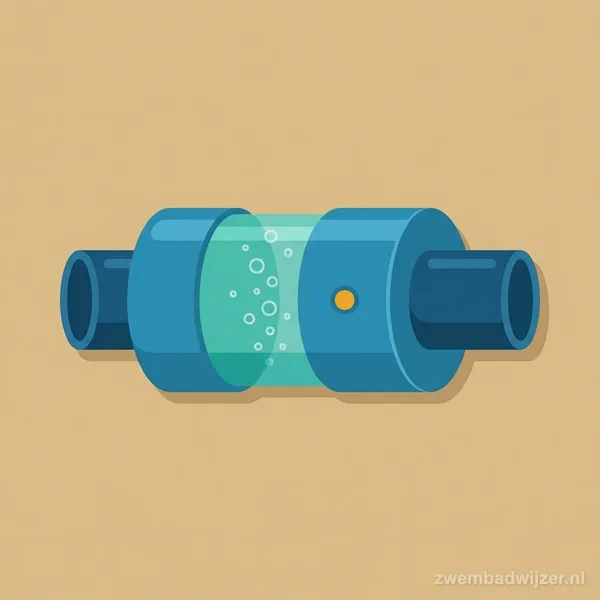
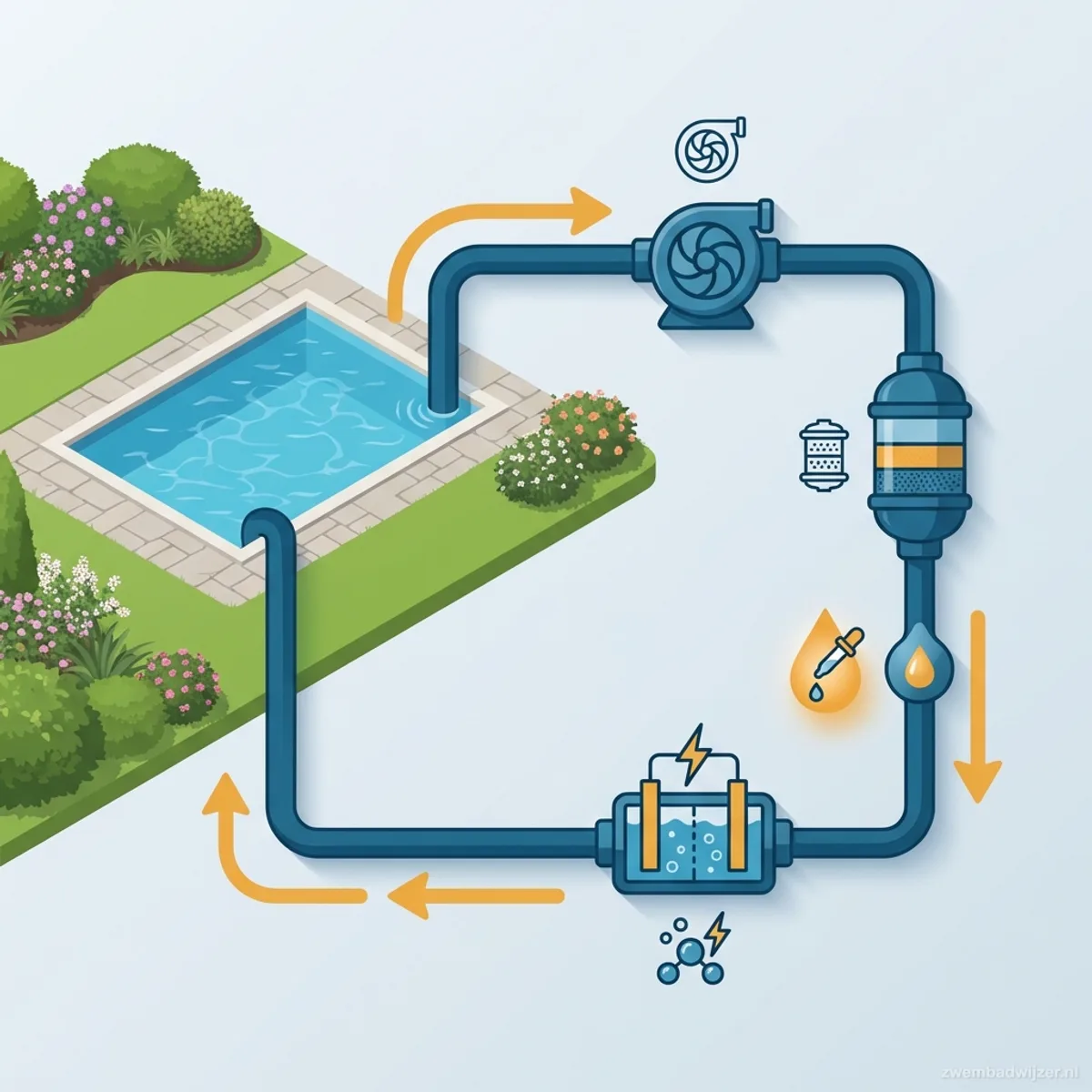
Injection point for chemicals: The pH-minus injection point is always before the electrolysis cell in the return line. The acid lowers the pH of the water before it flows through the titanium plates of the cell. Injecting acid directly onto the cell significantly shortens the lifespan of the plates.
Chlorine solution (when using liquid chlorine) is injected after the filter on the return line, so the chlorine reaches the pool as quickly as possible without running unnecessarily long through the pipework.
Safety features every pool owner should understand
A well-designed system has four essential safety layers:
Flow switch: dosing only when water is flowing
The flow switch detects whether water is moving through the pipework. If the pump is off, the flow switch blocks the dosing command. Without this protection, the dosing pump would inject concentrated acids or chlorine into a standing pipe, creating extreme local concentrations and corroding the PVC pipework.
Pump stop timer: protection against sensor failures
The stop timer limits how long the dosing pump can run continuously: adjustable from 1 to 120 minutes. If the pH sensor becomes fouled and reports a falsely high value, without a timer the dosing pump would keep injecting pH-minus indefinitely until the water becomes dangerously acidic. With the timer, the pump stops after the set time and the controller raises an alarm.
Intelligent dosing mode: portion by portion
Modern controllers dose in small portions with a re-measurement after each portion. For example: set point is pH 7.2, measured value is 7.6. The pump runs for 2 minutes, stops, waits 10 minutes for the dosed chemical to distribute evenly, measures again, and then decides whether another portion is needed. This prevents the “overshoot” where pH drops too far after a large dose.
Level sensors on chemical tanks
Float sensors or optical sensors on the pH-minus and chlorine tanks trigger an alarm when the liquid drops below the minimum fill level. You do not need to check the tanks daily; the system alerts you via the display or your smartphone.
What you see on the display
The display of the control unit shows measured values and the set parameters. Here are the terms you will encounter as an owner:
Set point: the target value you want, for example pH 7.2 or ORP 700 mV. You set this yourself based on your pool type and the disinfectant used.
Measured value: the current sensor reading. If this deviates from the set point by more than the hysteresis, the dosing pump starts.
Hysteresis band: the permitted deviation around the set point within which no action is taken. With a set point of pH 7.2 and a hysteresis of 0.2, the system tolerates values of 7.0 to 7.4 without dosing. This prevents the pumps from switching on and off constantly.
Alarm indicator: red light or text message for faults: empty tank, sensor out of range, stop timer reached, flow switch not active.
Remote control via your smartphone
Most modern automation units include wifi or LAN connectivity for remote control via an app. What you can do from the app:
- View current pH and ORP values in real time
- Adjust set points from anywhere
- Set pump and filter schedules
- Receive push notifications for alarms (empty tank, sensor fault)
- Review a historical graph of pH and ORP over the past 30 days
One example of such an app is PoolStation from certain manufacturers, but comparable apps exist for virtually all brands in the mid-to-high range. When buying, check whether the app is available in English and whether the cloud service incurs costs after the warranty period.
Integration with variable-speed pumps
A fully automated pool combines the water treatment unit with a variable-speed pump. The control unit drives the pump speed via a relay contact or digital protocol (RS-485).
Typical programme settings:
- Low speed (30 to 40%): filtration at night and during low bather load, energy-efficient
- Medium speed (60 to 70%): standard daytime filtration
- High speed (100%): during automatic backwash or after heavy bather load
A variable-speed pump running at 50% speed uses only 12.5% of the power of full speed (cube law). For a 1 kW pump running at 40% at night, this saves around 350 euros per year at an electricity rate of 0.30 euros/kWh for a pool filtering 14 hours per day.
The pool filter pump is the most energy-intensive component of your pool. Automation delivers the fastest return on investment here.
Additional automation features
Modern controllers offer more than just pH and chlorine:
Pump schedules: set up to 9 filtration periods per day (P1 to P9), each with start and stop time and speed setting. This fully replaces the analogue time clock.
Automatic backwash: set the interval (1 to 99 days) and duration (15 to 240 seconds). The controller operates the multiport valve and pump automatically. You no longer have to think about it.
Cover detection: connect your motorised pool cover sensor to the controller. The electrolysis cell automatically reduces chlorine production by an adjustable percentage (typically 30 to 60%) when the cover is closed, since UV breakdown is eliminated.
Freeze protection: when water temperature drops below 5°C, the filter pump starts automatically to prevent the pipework from freezing.
Lighting and water features: free relay contacts let you control pool lighting, waterfalls, or fountains, integrated into the same schedules as filtration.
Maintenance you do yourself
As the pool owner, you handle the following tasks:
- Weekly: verification measurement with test strips or a digital tester to cross-check sensor readings. A sensor that deviates 0.3 or more from your manual reading needs attention.
- Monthly: refill the pH-minus tank (depending on consumption), refill the chlorine solution, check salt levels (with salt electrolysis).
- Season start: visual check of hose connections, injection needles, and sensors for calcium deposits or damage.
- Annually: rinse sensor electrodes with cleaning solution, visual calibration verification.
Maintenance for the installer
The following tasks are reserved for a certified installer:
- Sensor calibration with buffer solutions: calibrating the pH sensor with certified buffer solutions at pH 4.01 and pH 7.01. Incorrect calibration leads directly to systematic over- or under-dosing.
- Cell inspection for salt electrolysis: removal and visual assessment of the titanium plates.
- Electrical verification: testing the residual current device and safety relays.
Have the installer visit annually or at the start of the season after winter. Costs are typically 80 to 150 euros for a maintenance call.
Cost overview: three levels of automation
| Level | What it includes | Purchase price | Annual costs |
|---|---|---|---|
| Basic pH only | pH sensor + 1 pH-minus dosing pump | 300 to 600 euros | 50 to 100 euros (sensor + chemicals) |
| Mid-range pH + ORP | pH + ORP sensor, 2 pumps, wifi | 800 to 1,500 euros | 80 to 150 euros |
| Full | pH + ORP, pump control, backwash, frost protection, app | 1,500 to 3,500 euros | 100 to 200 euros |
Comparison: no, basic, and full automation
| Feature | No automation | Basic pH control | Full control |
|---|---|---|---|
| What is measured/controlled | Nothing | pH | pH, ORP, pump speed, backwash |
| Owner labour required | 3 to 5 hours/week | 1 to 2 hours/week | 15 to 30 minutes/week |
| Water quality consistency | Variable | Good for pH | Excellent |
| Energy savings | None | None | 200 to 400 euros/year |
| Costs in year 1 | 50 to 200 euros (manual) | 400 to 700 euros | 1,600 to 3,700 euros |
| Cumulative costs by year 5 | 500 to 1,000 euros | 800 to 1,200 euros | 2,000 to 4,500 euros |
For a 50,000-litre pool used actively for 5 months per year, full automation becomes attractive when you factor in the time savings and the contribution of pump automation. Even basic pH control alone is a major improvement for most owners.
Frequently asked questions
Can I install an automatic dosing system myself?
Mounting the dosing pumps and sensors is technically feasible for a competent DIY person. The 230V electrical connection and sensor calibration are best left to a certified installer. Incorrect wiring or a poorly calibrated pH sensor can cause over- or under-dosing of chemicals.
Which chemicals do I still need with automatic control?
You still need pH-minus (sodium bisulphate or hydrochloric acid) and a chlorine solution or salt (for electrolysis). The system only automates the dosing. You also need calibration buffer solutions annually for sensor verification, and occasional shock chlorination after heavy bather loads.
What happens if the sensor breaks or gets fouled?
A fouled pH sensor reports a constant or sluggish value. The dosing pump then fails to respond or overdoses. Modern controllers include a maximum pump stop timer (1 to 120 minutes, adjustable) that cuts the dosing pump if the measured value does not improve within the set time. Replace sensors annually as a preventive measure.
How often do I need to calibrate the sensors?
Calibrate the pH sensor at the start and end of the swimming season, at least twice a year. Calibrate the ORP sensor once a year. Use certified calibration buffer solutions: pH 4.01 and pH 7.01 for the pH sensor, and an ORP reference solution of 468 mV for the ORP sensor.
Is the system compatible with my existing filter pump?
Most automation units work with any pump type via relay contacts (230V). Variable-speed pumps require a compatible communication protocol: check whether your pump supports RS-485 or a manufacturer-specific signal. Consult the technical datasheet of both the automation system and the pump before purchasing.
Which chlorine type works with automatic control?
Any chlorine type can in principle be automated: liquid chlorine (sodium hypochlorite 12 to 15%) via a dosing pump, salt electrolysis via an electrolysis cell with adjustable output, or UV systems with chlorine as backup. Chlorine tablets in a floater or dispenser are not automatically controllable and pair poorly with automation.
Conclusion
An automatic pH and chlorine control system takes water balance off your hands and delivers consistently better water than manual dosing. Even basic pH automation (300 to 600 euros) saves you several hours per week and prevents the pH spikes that cause eye irritation and disinfection problems.
Combine the system with salt electrolysis and you have a fully automated pool requiring minimal manual intervention. For a better understanding of what the ORP value on your display actually means, read the guide on pool ORP and redox value .