The best pool cover for heat retention is a solar cover of at least 400 micron. For winter protection, use a winter tarp rated 400 to 650 g/m2. Child safety requires a certified safety cover rated for a minimum load of 100 kg per m2. The right choice depends on your primary goal: keeping heat in, protecting the pool off-season, or preventing accidental entry.
A pool without a cover loses up to 75 percent of its heat through evaporation. On a breezy evening at 18 degrees Celsius, an uncovered 25 m2 pool can drop 2 to 4 degrees overnight. A basic solar cover costing around €80 brings that loss down to under 1 degree. That makes a pool cover one of the highest-return investments any pool owner can make.
Which type of pool cover do you need?
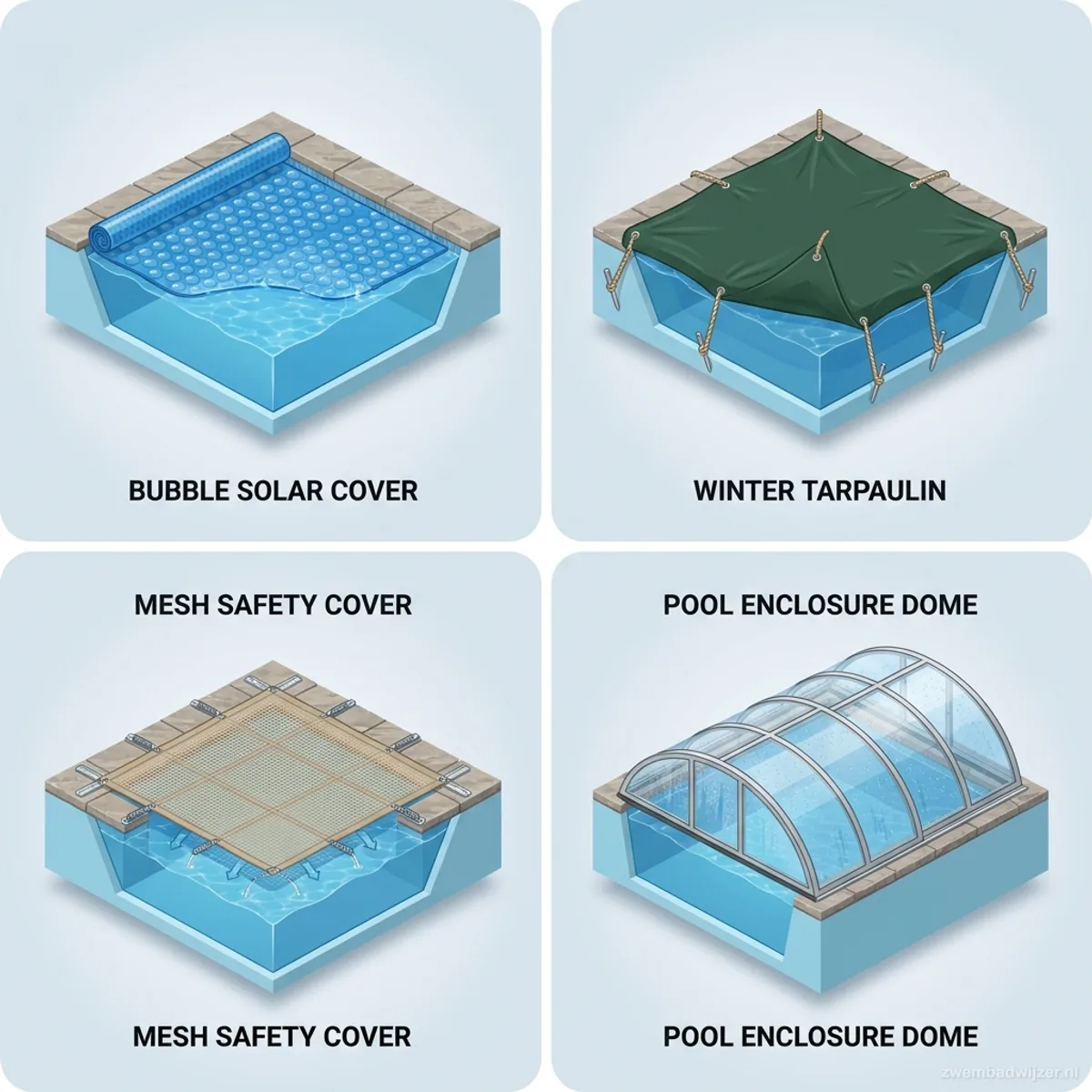
There are four main types: the solar cover for in-season heat retention, the winter tarp for off-season protection, the safety cover for households with young children or pets, and the pool enclosure for a year-round all-in-one solution. Each type has its own price range, ease of use, and lifespan.
The choice starts with your primary goal. Want to extend the swimming season and cut heating costs? Go with a solar cover. Want to protect the pool through winter without draining it? Choose a winter tarp. Have small children or pets with access to the pool area? Get a safety cover. Want to swim even in cool or rainy weather? A pool enclosure is the answer.
Solar cover (bubble film): keeping heat in during the swimming season
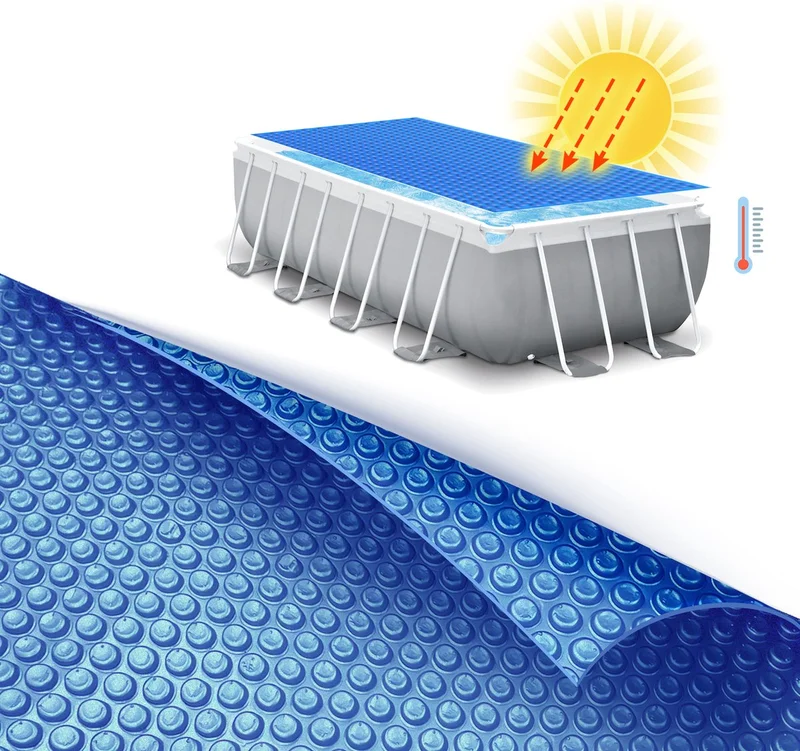
A solar cover is a layer of bubble film that floats on the water surface. The air pockets act as insulation: they reduce evaporation by 70 to 95 percent and can raise the water temperature by 2 to 8 degrees Celsius, depending on sun hours and the thickness of the film.
The solar cover works two ways at once. During the day it lets sunlight through to the water while trapping the heat the water absorbs. At night and on cloudy days it forms a thermal barrier that limits heat loss through evaporation and radiation. On a sunny day, a 30 m2 pool with a 500 micron solar cover can capture up to 2 kWh of solar energy per hour.
A good solar cover pays for itself within 1 to 2 seasons in lower heating bills. Paired with a heat pump averaging €0.80 per kWh, a solar cover can extend the heated swimming season by 4 to 6 weeks at no extra running cost. Read more about combining heat retention and heating in our article on pool heat pumps .
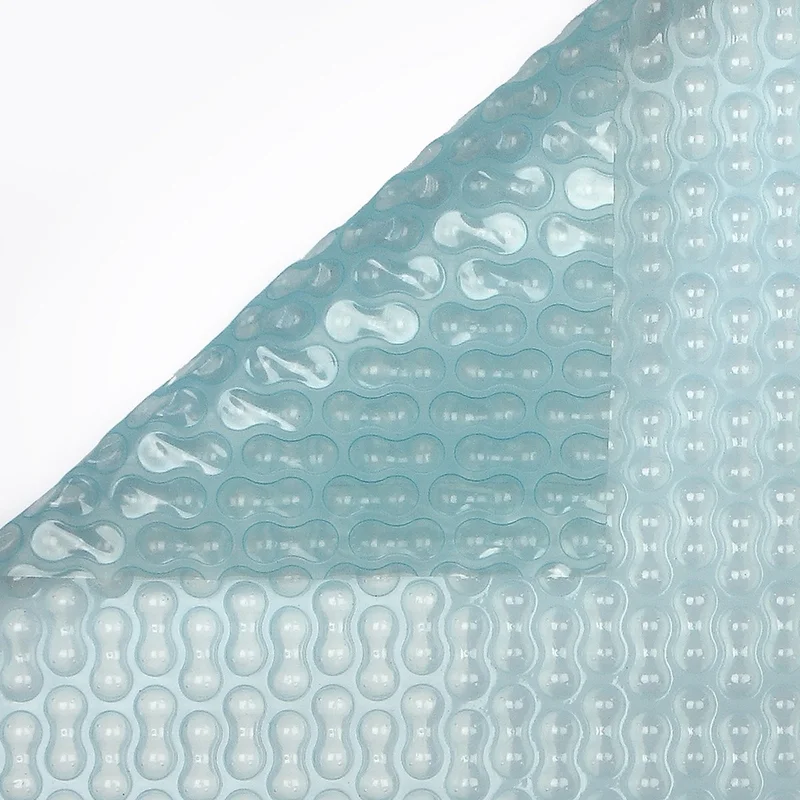
GeoBubble SolGuard Solar Cover 500μm (5×6m)
GeoBubbleProfessional-grade 500-micron solar bubble cover for rectangular pools up to 5 × 6 metres. Warms the water by up to 8 °C and cuts evaporation by 70 percent.
- 500μm meets professional standards
- Up to 8 °C extra water temperature
- 5 to 7 year lifespan
- GeoBubble pattern insulates better than standard film
- Premium price
- Fixed rectangular sizes only
- Heavy — roller recommended
Comfortpool Solar Cover 549 × 274 cm (160μm)
ComfortpoolEntry-level 160-micron solar bubble cover for rectangular pools up to 549 × 274 cm. Warms water and cuts evaporation at a low price point.
- Low price per square metre
- Large 549 × 274 size
- Easy to trim to fit
- No-fuss entry option
- Only 160μm — short lifespan (2 to 3 years)
- Not suited for winter use
- Tears more easily at corners
Winter tarp: protecting the pool through the cold months
A winter tarp is heavier and tougher than a solar cover. The goal is not heat retention but protection: leaves, debris, rain and frost should not be able to damage the pool shell or foul the water. A good winter tarp weighs 400 to 650 g/m2 and can handle wind load, fallen leaves, and the weight of light snowfall.
Winter tarps are secured with bungee cords or a tension cable around the pool rim. They come in round, oval and rectangular sizes in polyethylene or PVC with a reinforced edge. A tarp below 300 g/m2 sinks under pooled rainwater or a thin layer of snow, which causes more damage than no cover at all.
Always store the winter tarp rolled up and dry, never folded. Fold lines weaken the material and cause tears along those creases after 1 to 2 seasons. A well-maintained winter tarp lasts 5 to 10 years.
Intex Winter Pool Cover for Above-Ground Pools
IntexDurable winter cover that protects the pool from debris, UV damage and algae growth during the off-season. Includes a securing cable for a tight fit.
- Keeps leaves and debris out all winter
- UV-resistant material
- Securing cable included
- Extends liner lifespan
- Rainwater pools on top, use a cover pump to remove it
- Check size carefully before ordering
Safety cover: preventing accidents for children and pets
A safety cover is certified to hold a minimum load of 100 kg per m2. That means a child can step or fall onto it without breaking through and without entering the water. Safety covers come as mesh nets (mesh safety covers) and as rigid aluminium panel systems.
A mesh safety cover is woven polyester that lets rainwater through but holds back people and animals. Rain drains through the mesh into the pool, so no dangerous puddle forms on top of the cover. For a residential pool of 6 by 12 metres, prices range from €500 to €2,000 depending on quality and the anchoring system.
Rigid aluminium safety covers offer the highest protection but cost more: €3,000 to €8,000 for a typical residential pool. They mount on a rail around the pool perimeter and double as a winter cover. A safety cover does not replace adult supervision but significantly reduces risk when the pool is unattended.
Pool enclosure: the all-in-one solution
A pool enclosure seals the pool completely from the outdoor environment and combines the functions of solar cover, winter tarp and safety cover in a single system. There are three height categories: low enclosures (0.6 to 1.2 m) that cover only the water surface, mid-height enclosures (1.2 to 2 m) where you can stand at the pool edge, and full-height enclosures (2 to 4 m) that let you walk in and swim regardless of the weather.
A low enclosure costs €1,500 to €5,000 and extends the swimming season by 4 to 6 weeks. A full-height enclosure with heating costs €5,000 to €30,000 and makes year-round swimming possible. Read a full breakdown of types and prices in our article on pool enclosures .
Comparison: all four types side by side
| Type | Heat retention | Winter protection | Child safety | Price |
|---|---|---|---|---|
| Solar cover 160 micron | Good (2-4°C) | Not suitable | None | €50-100 |
| Solar cover 400-500 micron | Excellent (5-8°C) | Not suitable | None | €100-300 |
| Winter tarp 400 g/m2 | Moderate | Excellent | None | €80-250 |
| Safety cover (mesh) | Moderate | Good | Excellent | €500-2,000 |
| Safety cover (aluminium) | Good | Excellent | Excellent | €3,000-8,000 |
| Pool enclosure | Excellent | Excellent | Good | €1,500-30,000 |
Most residential pool owners use two covers: a solar cover during the season (April to September) and a winter tarp for the cold months (October to March). That combination costs €150 to €500 for a standard above-ground pool and covers both main needs without overlap.
Thickness and material: what does 160 to 500 micron mean?
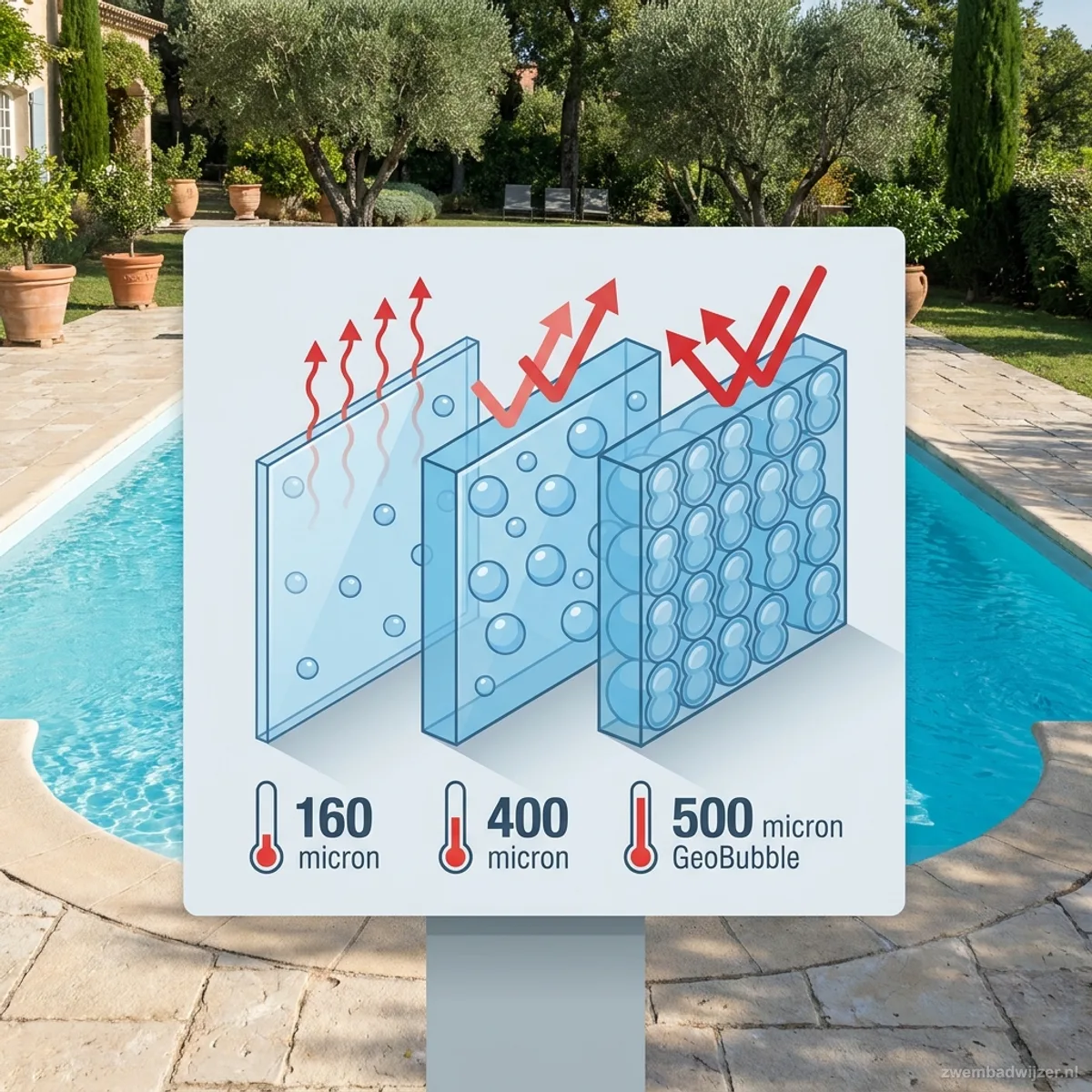
The thickness of a solar cover determines its insulating value and its lifespan. A 160 micron film is the thinnest option: light, inexpensive, and adequate in warm climates. In temperate northern European climates, where nights can drop to 10 to 15 degrees even in summer, a 160 micron film loses significantly more heat than a thicker one.
A film of 400 to 500 micron has larger air pockets and thicker outer walls. That extra thickness delivers two benefits: better insulation and longer life. UV radiation is the primary cause of degradation in solar covers. A thin film fades and becomes brittle after 2 to 3 years; a 500 micron film holds up for 5 to 7 years.
GeoBubble is a patented bubble shape where the joints between bubbles form a figure-eight profile. This distributes UV stress more evenly across the film and reduces cracking. GeoBubble SolGuard at 500 micron is approximately 30 percent more durable than a standard round-bubble film of the same thickness.
Roller systems: making the cover easy to handle
A solar cover for a 6 by 12 metre pool weighs 12 to 18 kg depending on thickness. That is difficult for one person to manage without a tool. A roller system solves this: the film rolls onto an aluminium or plastic tube, and a wheeled trolley moves it on and off the pool in a minute.
Roller systems come in freestanding and recessed versions. A freestanding reel trolley sits behind the pool and costs €80 to €250. A recessed reel is built into the pool surround and costs €300 to €800 for materials and installation. A freestanding trolley fits almost any above-ground pool. For in-ground pools, a recessed system is more convenient but needs to be planned into the surround construction.
Always store the solar cover rolled, never folded. Folded film wears faster along the crease lines and is harder to pull flat across the water.
Costs and payback
| Product | Purchase cost | Lifespan | Estimated annual cost |
|---|---|---|---|
| Solar cover 160 micron | €50-100 | 2-3 years | €25-50 per year |
| Solar cover 400-500 micron | €120-300 | 5-7 years | €20-45 per year |
| Winter tarp | €80-250 | 5-10 years | €15-30 per year |
| Safety cover (mesh) | €500-2,000 | 10-15 years | €40-150 per year |
A 400 micron solar cover for an 8 by 4 metre pool costs around €150. A heat pump averaging €0.80 per kWh can save 200 to 400 kWh per season with a well-insulating cover, which is €160 to €320 per year in energy savings. The solar cover pays for itself in the first season.
For a detailed product comparison of solar covers and winter tarps by brand and model, see our article on pool covers: solar and winter options .