A pool enclosure extends your swimming season by 4 to 10 weeks per year and protects the water from leaves, rain, and UV exposure. A low telescopic enclosure costs €2,000 to €6,000. A high walk-in enclosure that lets you use the pool year-round costs €10,000 to €25,000 or more.
Why a pool enclosure makes sense
An enclosure reduces heat evaporation by 50 to 70 percent compared to an open pool. Combined with a heat pump or solar heating, this means significantly lower energy use across the season. At the same time, a covered pool stays cleaner: fewer leaves, pollen, and insects in the water translates to 20 to 40 percent less chemical consumption.
Safety is another benefit. A closed enclosure prevents unsupervised access by children and pets. For families with young children this is an important consideration, either alongside or instead of a floating safety cover.
Pool enclosure types: overview
There are four main enclosure types, each with a different profile, price range, and use case.
Low telescopic enclosure
A low enclosure has a maximum height of 80 to 120 centimeters above the water surface. It consists of two or three polycarbonate sections that slide over each other. Advantages: low price (€2,000 to €6,000), wind and rain protection, good insulation. Disadvantage: you cannot stand upright inside it, so the pool can only be entered when the enclosure is fully open.
Low enclosures are well-suited to keeping water warm and reducing cleaning effort when the main goal is not year-round swimming.
Mid-height sliding enclosure
A mid-height enclosure stands 120 to 180 centimeters tall, allowing crouched or half-upright movement inside. Price: €4,000 to €10,000. Most have 3 to 4 sliding sections that can be pushed fully open for outdoor swimming.
This type is a popular compromise: more functional than a low enclosure, more space inside, and still relatively affordable.
High walk-in enclosure
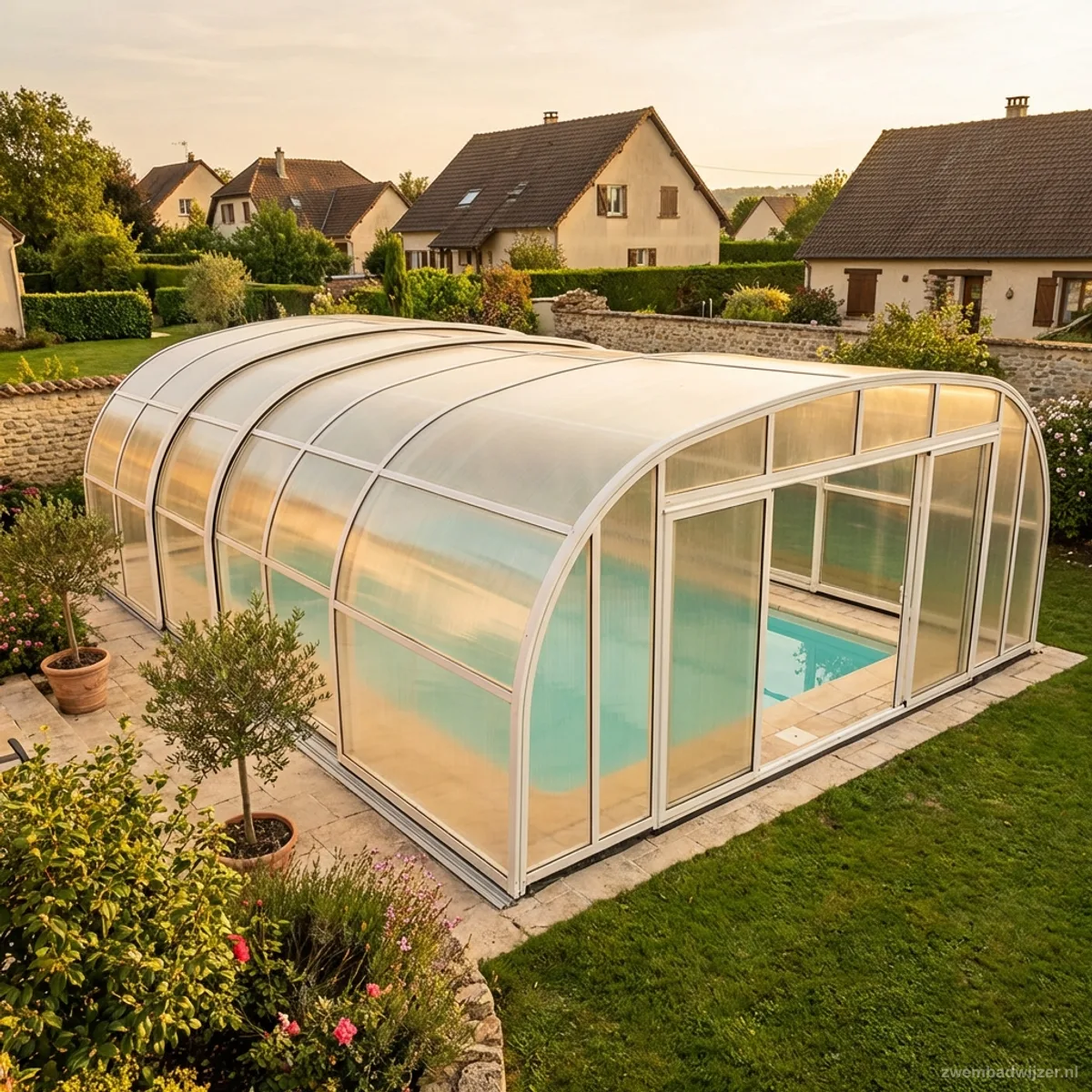
A high pool enclosure has a minimum center height of 200 centimeters, allowing full upright movement. The arched or pitched-roof design sheds water and snow efficiently. Prices range from €8,000 to €18,000 for standard models and €15,000 to €30,000 for custom builds.
A high enclosure makes year-round swimming possible. Pair it with heating (heat pump or solar), ventilation, and a dehumidifier for the best results.
Round pool enclosures and dome covers
Round pools require round or dome-shaped enclosures. These are available as fixed domes or telescopic round enclosures. Prices range from €1,500 (simple dome for an above-ground pool) to €8,000 (telescopic round enclosure for an in-ground pool).
Materials: polycarbonate, glass, and aluminum
The two most common materials are polycarbonate panels and aluminum framing.
Polycarbonate is the standard panel material for pool enclosures. It is 200 times more impact-resistant than glass, weighs six times less, and is UV-stable. A 16 mm twin-wall polycarbonate panel has a thermal transmittance (U-value) of around 2.6 W/m²K. A 25 mm triple-wall panel reaches around 1.8 W/m²K, comparable to double-glazed glass.
Tempered glass is available as an option in premium enclosures for maximum clarity and a more luxurious appearance. Downsides are the higher weight and higher cost. A glass panel weighs 4 to 5 times more than an equivalent polycarbonate panel.
Aluminum framing is corrosion-resistant, strong, and maintenance-free. Choose anodized or powder-coated aluminum for the best longevity. Profile wall thickness (1.5 to 3 mm) determines how well the structure handles snow loads.
Pool enclosure cost breakdown
| Type | Height | Standard price | Custom price | Lifespan |
|---|---|---|---|---|
| Low enclosure | up to 120 cm | €2,000-€4,000 | €3,500-€6,000 | 15-25 years |
| Mid-height enclosure | 120-180 cm | €4,000-€7,000 | €6,000-€12,000 | 15-25 years |
| High walk-in | 200+ cm | €8,000-€15,000 | €12,000-€25,000 | 20-30 years |
| Round dome (above-ground) | 80-150 cm | €1,500-€3,500 | €2,500-€6,000 | 10-20 years |
| Automated system | 200+ cm | €15,000-€25,000 | €20,000-€40,000+ | 25-30 years |
Prices exclude installation (€500 to €2,500 depending on type) and any foundation work required. A pool enclosure works best in combination with a heat pump for your pool for maximum season extension.
Permits and planning regulations
Whether a pool enclosure requires a building permit depends on three factors: height, footprint area, and the nature of the structure.
Usually no permit required: low enclosures under 1 meter in height, footprint under 50 m², located more than 1 meter from the property boundary.
Permit required: enclosures taller than 1 meter, permanent structures, or any structure that may be counted as an extension of the main dwelling.
Rules vary significantly by municipality and local planning frameworks. Always get written confirmation from your local council before placing an order.
Maintaining a pool enclosure
An aluminum and polycarbonate enclosure needs minimal maintenance. Clean the panels 1 to 2 times per year with warm water and a soft cloth. Never use abrasive cleaners or solvents on polycarbonate.
Lubricate the sliding rails and latches once a year with silicone spray. Check the rubber seals for cracks after each winter. A well-maintained enclosure will last 20 to 30 years.
Combine your enclosure with a consistent approach to pool maintenance costs to get the full return on your investment.
Combining pool and enclosure from the start
If you are still choosing a pool, it pays to plan the enclosure at the same time. Foundation anchors for an enclosure should ideally be placed before or during pool construction. Drilling into an existing concrete pool surround afterward is more expensive and disruptive. Read our pool buying guide to understand which pool types pair best with enclosures.
Frequently asked questions
How much does a pool enclosure cost?
A low telescopic pool enclosure costs €2,000 to €6,000. A mid-height sliding enclosure runs €5,000 to €12,000. A high walk-in enclosure for year-round use costs €10,000 to €25,000 or more. The final price depends on the size, material, and the type of sliding system.
Do I need a building permit for a pool enclosure?
In most cases yes. A pool enclosure is classed as a building structure and usually falls under planning regulations. Rules vary by municipality. As a rule of thumb, a permit is required for enclosures taller than 1 meter or permanently installed structures. Always check with your local council before ordering.
How many extra months can I swim with a pool enclosure?
A well-insulated high walk-in enclosure extends the swimming season from the average 4-5 months (June to September in Northern Europe) to 8-10 months, or year-round when combined with heating. A low enclosure extends the season by 4 to 6 weeks.
What material is best for a pool enclosure?
Polycarbonate is the most popular panel material: lightweight, impact-resistant, UV-stable, and a good insulator. A 16 mm twin-wall polycarbonate panel has a U-value of around 2.6 W/m²K. Aluminum framing is corrosion-resistant and maintenance-free. Tempered glass is available for premium clarity but costs more and weighs significantly more.
Can I install a pool enclosure myself?
Low telescopic enclosures can be installed by a competent DIYer in 1 to 3 days with two people. High walk-in enclosures and automated sliding systems require professional installation because of the foundation requirements, tight tolerances, and weight involved. Most manufacturers offer installation as a service.