The filter pump (circulation pump) is the heart of your pool: it draws water in through the skimmer and main drain, pushes it through the filter and returns it clean via the return jets. Without a working pump, the water goes stagnant and your pool turns green within 48 hours. Technically, a pool pump is a centrifugal pump powered by an electric motor that spins an impeller at 2,800 to 3,450 RPM, delivering flow rates of 4 to 25 m3 per hour.
How does pool water circulation work?
Pool circulation is the continuous loop that keeps the water clean. The full circuit has four stages:
- Skimmer and main drain (suction): the filter pump draws water through the skimmer (surface water, roughly 70%) and the main drain (deeper water, roughly 30%), carrying suspended debris with it.
- Filter pump (heart of the system): the pump creates negative pressure on the suction side and positive pressure on the pressure side, pushing water through the system at 4 to 25 m3 per hour.
- Sand or cartridge filter (purification): the filter removes particles larger than 20 to 40 microns. Chlorine handles the rest: killing bacteria and viruses that pass through the filter media.
- Return jets (return): clean water re-enters the pool through the return jets. The angle and direction of the jets determine the circulation pattern; well-aimed jets push debris toward the skimmer.
The rule of thumb for circulation time: the full pool volume must pass through the filter at least once per day. For a 40,000-litre pool with a 6 m3/hr pump, that takes roughly 6.5 hours. In warm weather (above 25°C), run the pump 10 to 12 hours per day: higher temperatures accelerate algae growth and chlorine breakdown.
| Pool volume | Min. run time per day | In warm weather (>25°C) |
|---|---|---|
| 15,000 litres | 5 hours | 8 hours |
| 30,000 litres | 6 hours | 10 hours |
| 50,000 litres | 7 hours | 12 hours |
| 80,000 litres | 8 hours | 14 hours |
Read more about the skimmer and main drain in pool skimmer and pool main drain .
How does a filter pump work technically?
A pool pump is a centrifugal pump. The operating principle is simple but effective. The motor spins an impeller at high speed. Water is drawn in through the eye (centre) of the impeller and flung outward by centrifugal force.
The impeller: the beating heart
The impeller is a disc made of thermoplastic or brass with 4 to 8 curved vanes. On a single-speed pump it rotates at 2,800 RPM (50 Hz mains frequency in Europe) or 3,450 RPM (60 Hz in the US). The diameter of the impeller determines the maximum flow rate and head pressure.
Water enters axially through the eye and exits the impeller radially. The kinetic energy of the spinning water is converted into pressure inside the pump housing. A 12 cm impeller at 2,800 RPM generates a head of roughly 10 to 15 metres of water column.
The volute: building pressure
The volute is the snail-shell-shaped casing surrounding the impeller. Its shape is functional, not decorative: water spirals off the impeller into a gradually widening channel. As the channel widens, flow velocity decreases and pressure increases (Bernoulli’s principle).
The volute has two connections: a suction side (inlet, 50 or 63 mm diameter) and a pressure side (outlet). The suction port sits at the centre, the pressure port at the top. The material is typically glass-fibre-reinforced polypropylene, resistant to chlorine and UV.
The motor: electrical power
The motor is an induction motor (single-speed) or a permanent-magnet motor (variable-speed). Power ratings range from 0.25 HP (180 watts) for small above-ground pools to 3 HP (2,200 watts) for large in-ground pools.
| Motor type | Power | Application | Power draw |
|---|---|---|---|
| Single-speed 0.5 HP | 370 W | Above-ground pool up to 20 m3 | 370 W continuous |
| Single-speed 1.0 HP | 750 W | Pool 20 to 50 m3 | 750 W continuous |
| Single-speed 1.5 HP | 1,100 W | Pool 50 to 80 m3 | 1,100 W continuous |
| Variable-speed 1.5 HP | 1,100 W max | All sizes | 150 to 1,100 W |
The motor connects to the impeller via a shaft that passes through a mechanical seal. This seal prevents water from leaking along the shaft into the motor. A leaking seal is the most common cause of pump failure and costs 15 to 30 euros to replace.
Tip
See water dripping under the pump? That points to a worn seal. Replace it immediately, because water reaching the motor causes a short circuit and irreparable damage. More on maintenance at filter pump maintenance .
Self-priming versus non-self-priming pumps
This distinction is critical when installing your pool pump.
Self-priming pump
A self-priming pump can expel air from the suction line and draw water upward on its own. It works because the pump housing contains a water reservoir (the priming chamber). At start-up, the impeller mixes residual air with the reservoir water. The air is expelled through the pressure side and pool water follows.
A self-priming pump works up to a suction lift of roughly 2.5 metres. That means the pump can sit a maximum of 2.5 metres above the water level. In practice, install it as close to the pool as possible, ideally within 1.5 metres of height difference.
Priming takes 1 to 3 minutes. During that time the pump runs on air and is noisier. Always fill the strainer basket with water before the first start after winter.
Non-self-priming pump (flooded suction)
A non-self-priming pump must always sit below the water level, so gravity pushes water into it. This is called flooded suction. These pumps are cheaper and quieter at start-up but require a pump room below pool level.
| Feature | Self-priming | Non-self-priming |
|---|---|---|
| Position relative to water | Above or beside the pool | Always below water level |
| Maximum suction lift | 2.5 metres | Not applicable |
| Priming time | 1 to 3 minutes | None (instant pressure) |
| Start-up noise | Higher (air in the system) | Lower |
| Price (comparable power) | 10 to 20% more expensive | Cheaper |
| Typical application | Above-ground pump house | Basement, sunken pit |
Single-speed versus variable-speed pump
The choice between a single-speed and a variable-speed pump has the largest impact on your energy bill.
Single-speed pump: simple but power-hungry
A single-speed pump always runs at full RPM (2,800). On or off: there are no other options. A 1 HP pump draws roughly 750 watts whether you need full power or not. At 10 hours per day that is 7.5 kWh, or about 2.25 euros per day (at 0.30 euros/kWh).
Variable-speed pump: the affinity law makes the difference
A variable-speed pump adjusts its RPM using a frequency inverter. The energy saving follows the affinity law (also called the cube law): halve the speed and energy consumption drops to 1/8. This is not marketing: it is physics.
At 1,200 RPM instead of 2,800 RPM, the same 1 HP pump draws only 60 to 80 watts. Flow rate also drops (to roughly 40 percent of maximum), but that is more than enough for daily circulation. You run the pump longer at low speed: 16 to 20 hours per day instead of 8 hours at full power.
Worked example: A 50,000-litre pool with a 1.5 HP pump.
- Single-speed: 8 hours x 1,100 W = 8.8 kWh/day = 2.64 euros/day
- Variable-speed on low: 18 hours x 200 W = 3.6 kWh/day = 1.08 euros/day
- Saving: 1.56 euros per day, roughly 570 euros per swim season (April to September)
The purchase price of a variable-speed pump is 200 to 500 euros higher than a single-speed model. In the example above, you recoup that difference in one season.
Tip
Since 2021, new pool pumps must comply with the EU Ecodesign regulation (EU 2019/1781). Pumps above 0.75 kW must meet at least IE3 efficiency. Variable-speed pumps meet this requirement by default.
Whether a variable-speed pump pays off for you depends mostly on pool volume, daily run time and your current electricity rate. Further down, you’ll see which concrete pumps (from Intex and Bestway up to DAB and Pentair) match each pool segment.
How to calculate the right pump flow rate
An undersized pump cannot filter the water fast enough. An oversized pump wastes energy and can damage the filter with excessive pressure. Fortunately, the calculation is straightforward.
Step 1: Determine pool volume
- Rectangular: length x width x average depth x 1,000 = litres
- Round: radius squared x pi x average depth x 1,000 = litres
- Oval: half-length x half-width x pi x average depth x 1,000 = litres
Example: A pool of 8 x 4 metres with an average depth of 1.4 metres = 8 x 4 x 1.4 x 1,000 = 44,800 litres.
Step 2: Choose the turnover time
The turnover time is the period in which the pump pushes the full volume through the filter once. The standard is 6 to 8 hours for residential pools. In warm weather or with heavy bather load, choose 6 hours. In spring and autumn, 8 hours is sufficient.
Step 3: Calculate minimum flow rate
Flow rate (m3/hr) = volume (m3) / turnover time (hours)
44.8 m3 / 6 hours = 7.5 m3/hr
Step 4: Correct for pipe friction
Pipes, bends, valves and the filter create resistance (total dynamic head). Add a standard 20 to 30 percent to compensate.
7.5 m3/hr x 1.25 = 9.4 m3/hr
You need a pump with a rated flow of at least 9 to 10 m3/hr.
| Pool volume | Turnover 6 hr | Turnover 8 hr | Recommended pump |
|---|---|---|---|
| 15,000 litres | 3.1 m3/hr | 2.3 m3/hr | 0.5 HP |
| 30,000 litres | 6.3 m3/hr | 4.7 m3/hr | 0.75 to 1 HP |
| 50,000 litres | 10.4 m3/hr | 7.8 m3/hr | 1 to 1.5 HP |
| 80,000 litres | 16.7 m3/hr | 12.5 m3/hr | 2 to 3 HP |
Which filter pump fits your pool?
The technical theory maps onto three main segments: integrated filter pumps for above-ground pools, standalone single-speed centrifugal pumps for in-ground pools, and variable-speed pumps for owners who want structural energy savings. Here is a concrete pump per segment that matches the flow rate from the table above.
Small above-ground pools (up to 10 m3)
For Intex Easy Set, Bestway Fast Set and smaller Prism Frame models (244 to 305 cm), a full centrifugal pump is overkill. A compact cartridge filter pump combines pump and filter in a single housing and plugs straight into the 32 mm hoses of the pool. A flow rate of 1.5 to 2.5 m3/hr turns over 5,000 to 10,000 litres in roughly 4 hours, right in line with the turnover rule from this article.
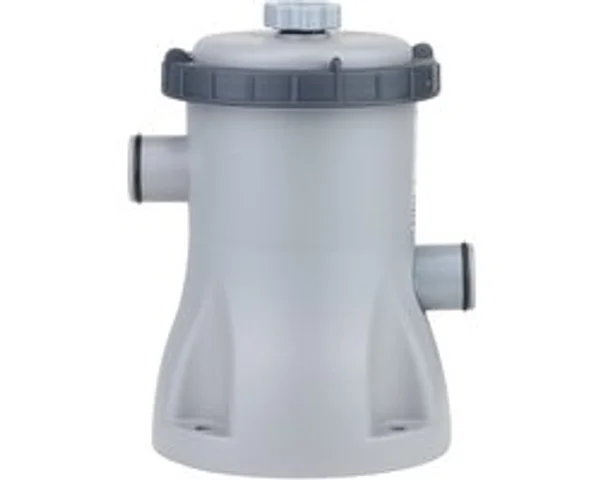
Bestway Flowclear Cartridge Filter Pump 2,006 l/h
BestwayCompact cartridge filter pump rated 2,006 l/h for small above-ground pools up to 8 m3. Affordable entry-level option for Easy Set and 244-305 cm Prism Frame models. Fits Bestway and Intex pools with 32 mm hose connections.
- Lowest purchase price
- Compact and quiet
- Works on both Intex and Bestway (32 mm hose)
- Quick install, no tools
- Cartridge consumable (€5-8 every 2 weeks)
- Too small for 366 cm+ pools
- Less economical than a sand filter over multiple seasons
Mid-sized above-ground pools (15 to 25 m3)
On 366 cm round or rectangular Intex and Bestway pools (Steel Pro Max, Prism Frame 457, Ultra XTR) a cartridge pump saturates too quickly. A sand filter pump rated 4 to 6 m3/hr filters finer, runs on silica sand you only replace after 4 years, and costs less over time than weekly cartridge replacements. This is also the segment the table above pairs with 0.5 to 1 HP: the SX2100 delivers exactly that 6 m3/hr.
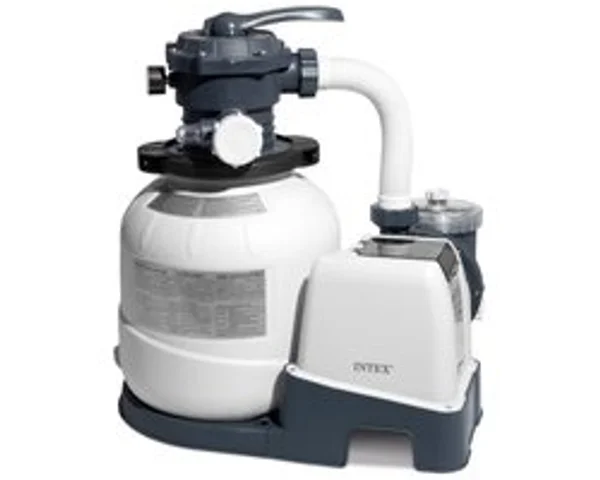
Intex Krystal Clear 26646GS SX2100 Sand Filter Pump 6 m3/h
IntexSand filter pump rated 6 m3/h (6,000 l/h) for Intex pools up to 19 m3. Uses standard filter sand (12 kg needed). 6-way backwash valve for normal, backwash, rinse, and winter modes. More powerful than the 4 m3/h variant and better suited for 457 cm and larger Intex models.
- 6,000 l/h throughput — sufficient for 457 cm and rectangular models
- 6-way valve for all operating modes
- Uses standard filter sand, not cartridges
- Intex Krystal Clear reliability
- Louder than a cartridge pump
- Backwash needed every 2 weeks
In-ground pools (20 to 40 m3)
Here you step up to a real standalone centrifugal pump with a strainer basket, decoupled from the sand filter. The DAB Euroswim is the Italian workhorse of this segment: self-priming up to 2.5 metres, robust glass-fibre-reinforced polypropylene body, a transparent strainer basket that empties in 30 seconds, and 50 mm union connections that fit standard PVC plumbing. At a 6-hour turnover for a 35 m3 pool you need 5.8 m3/hr, which the 50/M delivers comfortably at 10 m head (rated 10 m3/hr at that pressure point).
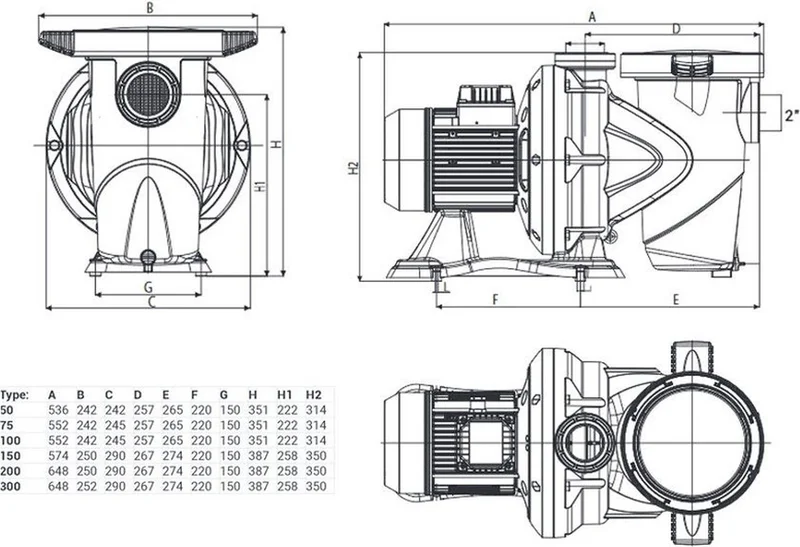
DAB Euroswim 50/M self-priming pool pump 0.5 HP
DABItalian self-priming centrifugal pump with transparent strainer basket, 0.5 HP (0.37 kW) and a peak flow of 18 m3/hr (around 10 m3/hr at 10 m head). Built for in-ground pools up to 40 m3 paired with an existing sand or cartridge filter. Glass-fibre-reinforced polypropylene body with 50 mm union connections.
- Self-priming up to 2.5 m above water level
- Transparent strainer basket for quick maintenance
- Up to 18 m3/hr, suitable for in-ground pools up to 40 m3
- 50 mm union connections fit standard PVC plumbing
- Single-speed, no energy savings on circulation mode
- Needs a pump enclosure for noise and weather protection
Large in-ground pools and energy-conscious owners (50 m3 and larger)
For larger installations, or once your power bill weighs heavy, pick a variable-speed pump. Thanks to the affinity law from the previous section, energy consumption drops exponentially the moment you cut RPM: a DAB E.swim 150 draws 150 to 250 watts on circulation speed instead of the 1,100 watts at full power. Over a year that is 400 to 600 euros less electricity for a 70 m3 pool running 12 hours per day.
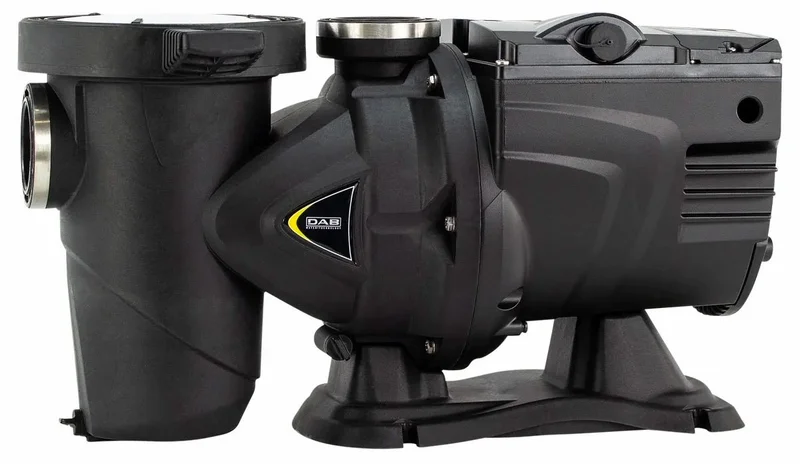
DAB E.swim 150/M variable-speed pool pump 1.5 HP
DABFull-inverter pump with a permanent-magnet motor, speed range of 600 to 2,850 RPM and a peak flow of 25 m3/hr. Touchscreen controller with four programmable speed presets and a built-in 24-hour timer. Built for in-ground pools of 50 to 100 m3 aiming for structural energy savings.
- Up to 80% energy savings on low speed
- Touchscreen with 4 presets and 24-hour schedule
- Very quiet on circulation speed (around 45 dB)
- IE5 efficiency, well above EU Ecodesign 2021 requirements
- Higher purchase price, payback in 1 to 2 seasons
- Installation needs a bit of technical confidence
The same segment includes the Pentair SuperFlo VS, an American alternative with comparable specs and a broader spare-parts network through Dutch pool specialists. Useful if you value local service or if your existing installation already runs Pentair plumbing.
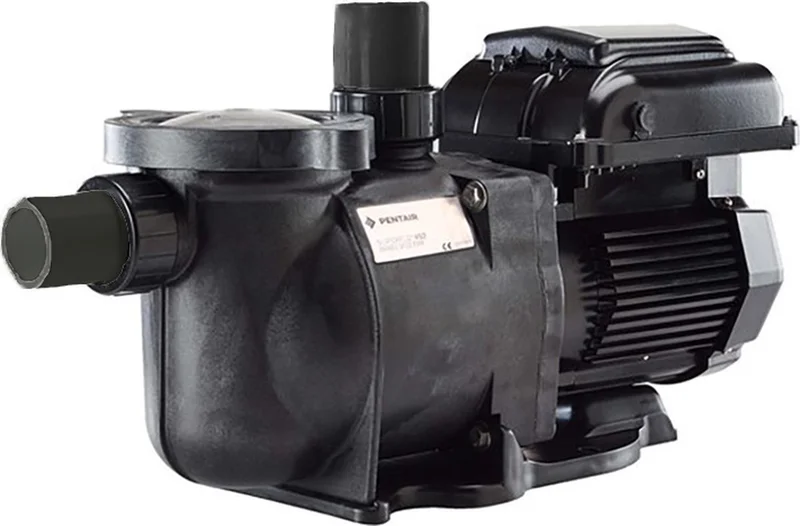
Pentair SuperFlo VS2 variable-speed pool pump
PentairAmerican premium variable-speed pump with a 1.5 HP TEFC motor, peak flow of 22 m3/hr and four programmable speeds. Sized for in-ground pools of 40 to 80 m3. The main alternative to the DAB E.swim in the same high-efficiency segment and a familiar name with Dutch pool installers.
- TEFC motor with 3-year manufacturer warranty
- 4 programmable speed schedules
- High efficiency on low speed (IE5)
- Strong parts network via Dutch pool specialists
- Expensive alternative
- Menu layout less intuitive than DAB touchscreen
For more help picking the right pump, see the buying guide (available at the Dutch site under filterpomp kiezen ).
Energy consumption and noise
The filter pump is the most energy-hungry component of your pool. For a pool that operates 6 months per year, the pump runs 1,500 to 3,600 hours per season.
Energy use by type
| Pump type | Power | Hours/day | kWh/day | Cost/day (0.30 euros/kWh) |
|---|---|---|---|---|
| Single-speed 0.75 HP | 550 W | 8 hours | 4.4 | 1.32 euros |
| Single-speed 1.5 HP | 1,100 W | 8 hours | 8.8 | 2.64 euros |
| Variable-speed 1.5 HP (low) | 200 W | 18 hours | 3.6 | 1.08 euros |
| Variable-speed 1.5 HP (high) | 1,100 W | 2 hours | 2.2 | 0.66 euros |
Noise levels
Noise is a common complaint with pool pumps. A single-speed pump produces 65 to 75 dB at 1 metre: comparable to a vacuum cleaner. A variable-speed pump on low speed sits at 45 to 55 dB, comparable to a refrigerator.
Place the pump on vibration dampers (rubber feet, 10 to 20 euros) and leave at least 50 cm of clearance around it for ventilation. A well-ventilated, insulated pump enclosure reduces noise by 10 to 15 dB.
The strainer basket: first line of defence
Every pool pump has a strainer basket on the suction side. It sits in a transparent housing and catches coarse debris before it reaches the impeller.
Without a strainer, pebbles, twigs and other debris would damage the impeller vanes. The basket mesh is roughly 3 to 5 mm and catches all larger material. Empty the strainer at least once a week and after every storm.
The transparent housing has another advantage: you can see if there is air in the system. Air bubbles in the strainer housing point to a suction-side leak, low water level or a worn seal.
More on daily and seasonal pump maintenance at filter pump maintenance .
How the filter pump connects to the full system
The pump sits at the centre of the water circuit. Everything upstream (skimmer, main drain, suction plumbing) is under negative pressure. Everything downstream (filter, heater, return jets) is under positive pressure. The pump converts suction into pressure.
With a clean filter, system pressure is 0.8 to 1.2 bar. When it rises to 1.5 to 1.8 bar, the filter needs a backwash or the media needs replacing. A pressure gauge on the filter shows this in real time.
Read more about the complete system at how does a swimming pool work: the system from A to Z .