A pool heat pump extracts warmth from outdoor air and transfers it to pool water through a refrigerant cycle involving an evaporator, compressor, condenser, and expansion valve. For every 1 kW of electricity it consumes, a good heat pump delivers 4 to 6 kW of heat (COP of 4 to 6), making it the most energy-efficient way to keep an outdoor pool at a comfortable temperature. Below you will find exactly how the technology works and how to choose the right size for your pool.
Last updated: 2026-03-22
How a pool heat pump works: the refrigerant cycle
A heat pump moves thermal energy from a cooler source (outdoor air) to a warmer destination (pool water). This seems to defy physics, but it works thanks to a refrigerant cycle with four stages and four components.
The four stages of the refrigerant cycle
Evaporator: the fan draws outdoor air across the evaporator (a heat exchanger with aluminium fins). The liquid refrigerant inside absorbs heat from the air and evaporates into gas. Even at 5 degrees Celsius (41 degrees Fahrenheit) there is enough thermal energy in the air for this process.
Compressor: the gaseous refrigerant is compressed, raising its temperature dramatically: from roughly 10 degrees Celsius to 60 to 80 degrees Celsius (140 to 176 degrees Fahrenheit). This is the component that consumes the most electricity.
Condenser: the hot, compressed gas flows through the condenser (a titanium heat exchanger). Pool water flows on the other side. The refrigerant releases its heat to the water and condenses back into liquid. The pool water typically warms by 1 to 3 degrees Celsius per pass.
Expansion valve: the liquid refrigerant passes through the expansion valve, where pressure drops suddenly. Temperature drops with it, and the refrigerant is ready to absorb heat again in the evaporator. The cycle restarts.
Tip
Always select a heat pump with a titanium condenser. Titanium resists chlorine and salt. A copper heat exchanger corrodes within 2 to 3 years at chlorine levels above 1.0 mg/l.
What is COP and why does it matter?
COP stands for Coefficient of Performance and expresses the ratio of heat delivered to electricity consumed. A COP of 5 means: for every 1 kW of electricity you get 5 kW of heat. Of those 5 kW, 4 kW come free from the outdoor air and 1 kW comes from the power socket.
COP is not a fixed number. It changes with outdoor temperature:
| Outdoor temperature | Expected COP | 1 kW electricity delivers |
|---|---|---|
| 30°C (86°F) | 6-7 | 6-7 kW of heat |
| 25°C (77°F) | 5-6 | 5-6 kW of heat |
| 20°C (68°F) | 4-5 | 4-5 kW of heat |
| 15°C (59°F) | 3-4 | 3-4 kW of heat |
| 10°C (50°F) | 2-3 | 2-3 kW of heat |
| 5°C (41°F) | 1.5-2 | 1.5-2 kW of heat |
Below 8 to 10 degrees Celsius (46 to 50 degrees Fahrenheit), a heat pump becomes significantly less efficient. Most manufacturers specify a minimum operating temperature of 5 degrees Celsius (standard models) or even -5 degrees Celsius (full inverter models). In northern European climates, a pool heat pump is typically used from April through October.
Important: manufacturers often measure COP at 26 degrees Celsius and 80% humidity. Those are ideal conditions. In a northern European spring (12 to 15 degrees Celsius, 70% humidity), real-world COP is 20 to 30% lower than the catalogue value.
Inverter vs on/off heat pump: what is the difference?
Two types of compressor technology exist: on/off and inverter. The difference lies in how they regulate output.
On/off heat pump
An on/off heat pump runs the compressor at 100% power at all times. Once the water reaches the set temperature, the compressor shuts off. When the temperature drops again, it starts back up at full power.
The downside: constant starting and stopping wears the compressor faster, causes power surges, and makes the unit louder. Typical compressor lifespan for on/off models is 8 to 12 years.
Inverter heat pump
An inverter heat pump adjusts compressor speed continuously. When heat demand is low (pool water is nearly at target temperature), the compressor runs at 20 to 30% of capacity. When demand is high (cold spring, first startup of the season), it runs at 100%.
The advantages are substantial:
- 20 to 40% lower electricity consumption compared to an equivalent on/off model
- Quieter: 38 to 45 dB(A) at 1 metre vs 48 to 58 dB(A) for on/off
- Longer lifespan: 12 to 18 years thanks to reduced compressor wear
- More stable water temperature: fluctuations of 0.5 degrees Celsius maximum vs 1 to 2 degrees for on/off
The downside: purchase price is 30 to 50% higher. A 12 kW inverter heat pump costs roughly €2,000 to €3,500 ($2,300 to $4,000), while a 12 kW on/off model runs €1,200 to €2,000 ($1,400 to $2,300).
| Feature | On/off | Inverter |
|---|---|---|
| Compressor control | Full power or off | 20-100% variable |
| Noise level (1 m) | 48-58 dB(A) | 38-48 dB(A) |
| Energy savings | Baseline | 20-40% more efficient |
| Compressor lifespan | 8-12 years | 12-18 years |
| Purchase price (12 kW) | €1,200-2,000 | €2,000-3,500 |
| Temperature fluctuation | 1-2°C | 0.5°C |
Tip
For a 40 m3 (10,500 gallon) pool running April through October, an inverter saves roughly €200 to €400 per year in electricity. The price premium of €800 to €1,500 pays for itself in 3 to 5 years.
Above-ground or in-ground pool: two very different markets
Before looking at output, there is a fundamental distinction that determines which type of heat pump suits you.
Above-ground and inflatable pools (Intex, Bestway, frame pools): these pools hold 5 to 20 m³ and run on thin 32 or 38 mm hoses that screw directly onto the filter pump. For this type of pool, a plug & play heat pump of 3 to 6 kW is the right choice. It connects to the existing hoses without a plumber or installer, costs €200 to €500, and is operational within 20 minutes.
Fixed in-ground or built-in pools: pools with a volume of 20 to 80 m³ with permanent PVC pipework in 50 to 63 mm. These require a serious heat pump of 8 to 18 kW with a fixed hydraulic connection. Purchase price: €900 to €3,500. Professional installation is recommended.
How to size a heat pump for your pool
The required capacity depends on pool volume, target temperature, climate, and whether you use a cover. For northern European conditions, use this rule of thumb:
Required output (kW) = pool volume (m3) / 3 to 5
Use the factor 3 (more power) without a cover or for target temperatures above 28 degrees Celsius (82 degrees Fahrenheit). Use the factor 5 (less power) with a good solar blanket or roller shutter and a target temperature of 26 degrees Celsius (79 degrees Fahrenheit).
| Pool volume | Pool type | Without cover | With solar blanket |
|---|---|---|---|
| 5–10 m3 (1,300–2,600 gal) | Inflatable / frame | 2–3 kW | 1.5–2 kW |
| 10–20 m3 (2,600–5,300 gal) | Above-ground / frame | 4–7 kW | 3–5 kW |
| 20–30 m3 (5,300–8,000 gal) | Fixed above-ground / in-ground | 7–10 kW | 5–7 kW |
| 30–45 m3 (8,000–12,000 gal) | In-ground | 10–15 kW | 7–10 kW |
| 45–65 m3 (12,000–17,000 gal) | In-ground | 15–20 kW | 11–14 kW |
An undersized heat pump either never reaches the target temperature or runs continuously at full power, shortening its lifespan. A slightly oversized heat pump is not a problem: an inverter model adjusts itself and runs at a lower percentage.
Plug & play for above-ground and frame pools (up to 20 m3)
Have an Intex or Bestway above-ground pool? A plug & play heat pump is the only practical option. The LIVIN’ 5 kW connects directly to standard 32/38 mm hoses with no installer or additional fittings required.
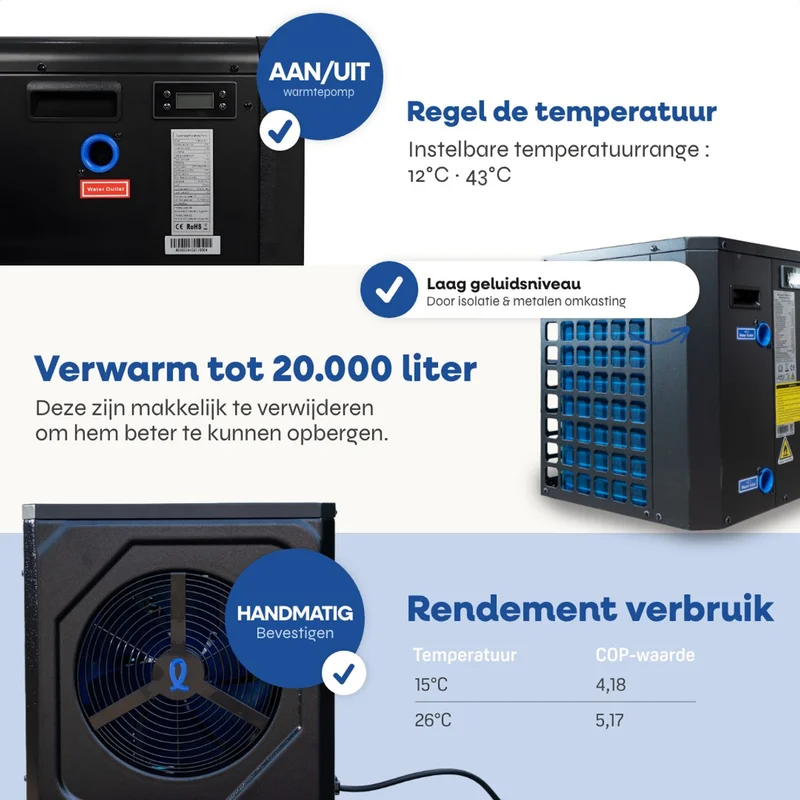
LIVIN' Pool Heat Pump 5 kW (Plug & Play)
LIVIN'Plug & play 5 kW heat pump for above-ground pools up to 20 m3. Fits standard Intex and Bestway hose connections (32/38 mm). No installer needed.
- Plug & play: fits Intex and Bestway 32/38 mm hoses directly
- No electrician or plumber required
- Compact and lightweight
- Affordable entry price for active heating
- On/off compressor, not inverter
- Suitable for pools up to ~20 m3
- Lower COP than larger inverter models
Fixed plumbing: on/off for in-ground pools up to 45 m3
For fixed pools up to 45 m3 without strict noise or energy requirements, a 9 kW on/off heat pump is a solid choice.
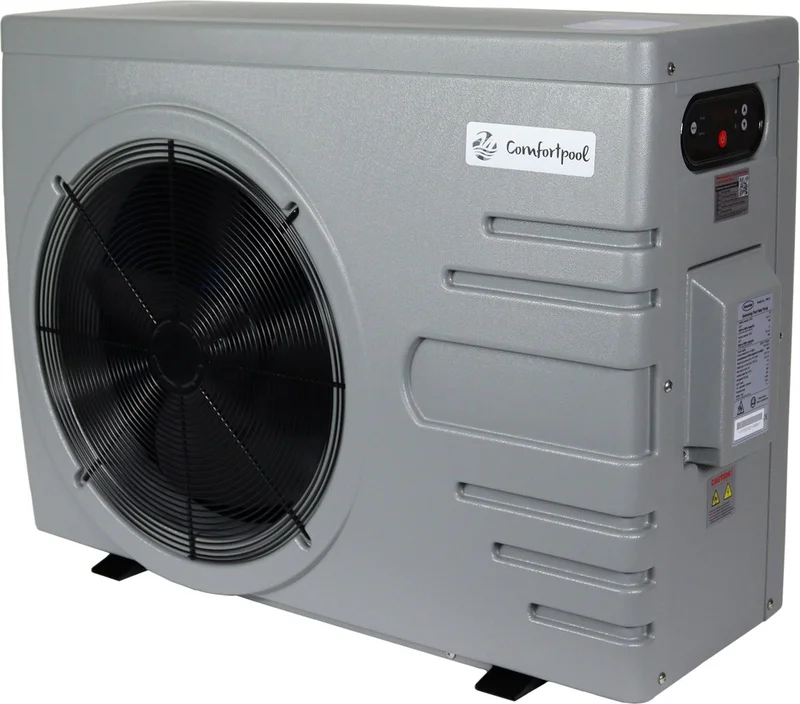
Comfortpool Inverter Pro 9 Warmtepomp (9,2 kW)
ComfortpoolFull-inverter warmtepomp van 9,2 kW voor zwembaden tot 40 m3. COP tot 6,5. Regelt vermogen stapsgewijs voor lager energieverbruik en stil gebruik.
- Affordable purchase price for a heat pump
- Straightforward connection to standard 50 mm PVC
- Quiet enough for use near a terrace
- On/off compressor, slightly less efficient than inverter
- COP drops sharply below 10 degrees ambient temperature
Fixed plumbing: full inverter for long-season, low-running-cost heating
For larger pools or those who want to maximise efficiency: a full-inverter model pays for itself in 3 to 5 years through 20 to 40% lower electricity consumption.
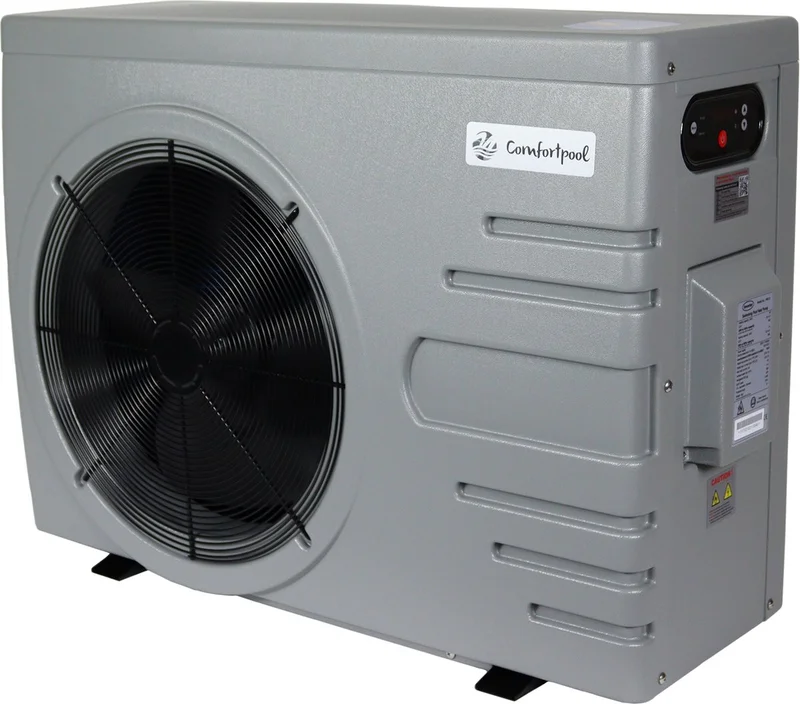
Comfortpool Inverter Pro 13 Warmtepomp (12,5 kW)
ComfortpoolFull-inverter warmtepomp van 12,5 kW voor zwembaden tot 65 m3. COP tot 7,5 bij 28 graden. Stil (40 dB) en effectief tot 5 graden buitentemperatuur.
- Full inverter: up to 40% more efficient than on/off
- Operates effectively down to 5 degrees ambient
- Very quiet at partial load (40 dB)
- Longer compressor life thanks to soft starts
- Higher purchase price
- Larger housing than on/off models
Placement and airflow: where to install the heat pump
The heat pump needs a constant supply of outdoor air to extract heat. Incorrect placement can reduce efficiency by 30 to 50%.
Minimum clearances:
- Front (air discharge): at least 2 metres (6.5 feet) of open space
- Rear (air intake): at least 30 cm (12 inches)
- Sides: at least 50 cm (20 inches)
- Top: no canopy, or at least 50 cm above the top of the unit
Placement rules:
- On a flat, solid surface (concrete pad or rubber vibration dampers on paving)
- Not in an enclosed space or alcove
- Not hard against a wall (recirculation of cold exhaust air reduces COP)
- Condensate drain to a sump or drainage point (a 12 kW heat pump produces up to 5 litres/1.3 gallons of condensate per hour)
Distance from neighbours:
- Maintain at least 3 metres (10 feet) from the property boundary
- Do not aim the air discharge toward a neighbour’s patio or garden
- Many local regulations require no more than 40 dB(A) at the property line
How loud is a pool heat pump?
Noise is a common concern with heat pumps. The two noise sources are the compressor (low-frequency hum) and the fan (air movement).
| Distance | Inverter (full power) | On/off |
|---|---|---|
| 1 metre (3.3 ft) | 38-48 dB(A) | 48-58 dB(A) |
| 5 metres (16 ft) | 26-36 dB(A) | 36-46 dB(A) |
| 10 metres (33 ft) | 20-30 dB(A) | 30-40 dB(A) |
For reference: 30 dB(A) is comparable to a whisper, 40 dB(A) to background noise in a library, and 50 dB(A) to a quiet conversation.
An inverter running at partial load (30 to 50%) is barely audible at 5 metres. This is a major advantage when the pool is close to a patio or the property line.
When is a heat pump worth it (and when is it not)?
A heat pump is the best choice if you want to heat the pool regularly throughout the season (April to October in northern Europe). But there are situations where a different solution makes more sense.
Heat pump makes sense when:
- You want to maintain 26 to 28 degrees Celsius (79 to 82 degrees Fahrenheit)
- Your pool is 20 m3 (5,300 gallons) or larger
- You have a reliable electrical supply (16A circuit or higher)
- You want low running costs (€0.03 to €0.06 per kWh of heat at COP 5 and €0.25/kWh electricity)
Heat pump is less practical when:
- Your pool is smaller than 10 m3 (2,600 gallons): a solar blanket may be enough
- You use the pool fewer than 3 months per year
- There is no suitable location with adequate airflow
- You have a natural gas connection and are considering a gas heater (faster warm-up, but higher cost per kWh)
Annual electricity costs for a heat pump on a 40 m3 pool, target temperature 27 degrees Celsius, with a solar blanket, in a northern European climate are roughly €400 to €700 (inverter) or €600 to €1,000 (on/off). By comparison, an electric resistance heater costs €2,000 to €3,500 per season for the same result.
Want to compare all heating options side by side? Read the overview at pool heating . For information on how a cover reduces heat loss, see pool cover . And for the complete picture of all pool components, check how a pool works .