The most efficient way to heat a pool is a heat pump: for every 1 kW of electricity consumed it delivers 4 to 5 kW of heat (COP 4-5). Solar mats are even cheaper to run but depend on sunshine. A wood-fired heater works well for small pools and off-grid situations. Electric resistance heating is the most expensive method to operate.
Heat pump: the most efficient pool heating option
A pool heat pump works like a refrigerator in reverse: it extracts heat from the ambient air and transfers it to the pool water. The efficiency metric is the COP (Coefficient of Performance). A heat pump with COP 5 delivers 5 kW of heat from 1 kW of consumed electricity.
Sizing a pool heat pump
For a pool of 20,000 to 40,000 liters you need a heat pump with 6 to 9 kW of thermal output. Models up to 18 kW are available for pools up to 80,000 liters. The rule of thumb is 1 kW of thermal output per 4,000 to 5,000 liters of water.
| Pool volume | Recommended heat pump | Heat-up time (10°C to 28°C) | Daily energy (standby) |
|---|---|---|---|
| 10,000 L | 3-5 kW | 30-50 hours | 1-2 kWh |
| 20,000 L | 5-8 kW | 40-60 hours | 2-4 kWh |
| 40,000 L | 9-12 kW | 50-80 hours | 3-6 kWh |
| 80,000 L | 15-18 kW | 80-100 hours | 5-10 kWh |
Heat-up times assume COP 5 and a 15°C ambient temperature. Always pair a heat pump with a properly sized pool filter pump to ensure even heat distribution throughout the pool.
Heat pump purchase and running costs
Pool heat pump purchase prices run from €1,000 to €3,500 for a 6 to 12 kW model. Premium air-source heat pumps from Zodiac, Hayward, or Pentair cost €2,000 to €4,500. Seasonal running cost from April to September: at 150 heating hours and COP 5, the effective heat cost is around €0.06 per kWh (at €0.30 electricity). A full swimming season costs approximately €150 to €400 in electricity.
Solar pool heating: free energy from the sun
Solar heating uses free energy from the sun. There are two types: solar mats (rubber blankets) and solar panels or collectors (glazed panels).
Solar mats for pools
EPDM rubber or polypropylene solar mats are laid on a sloped roof or another sunny surface.
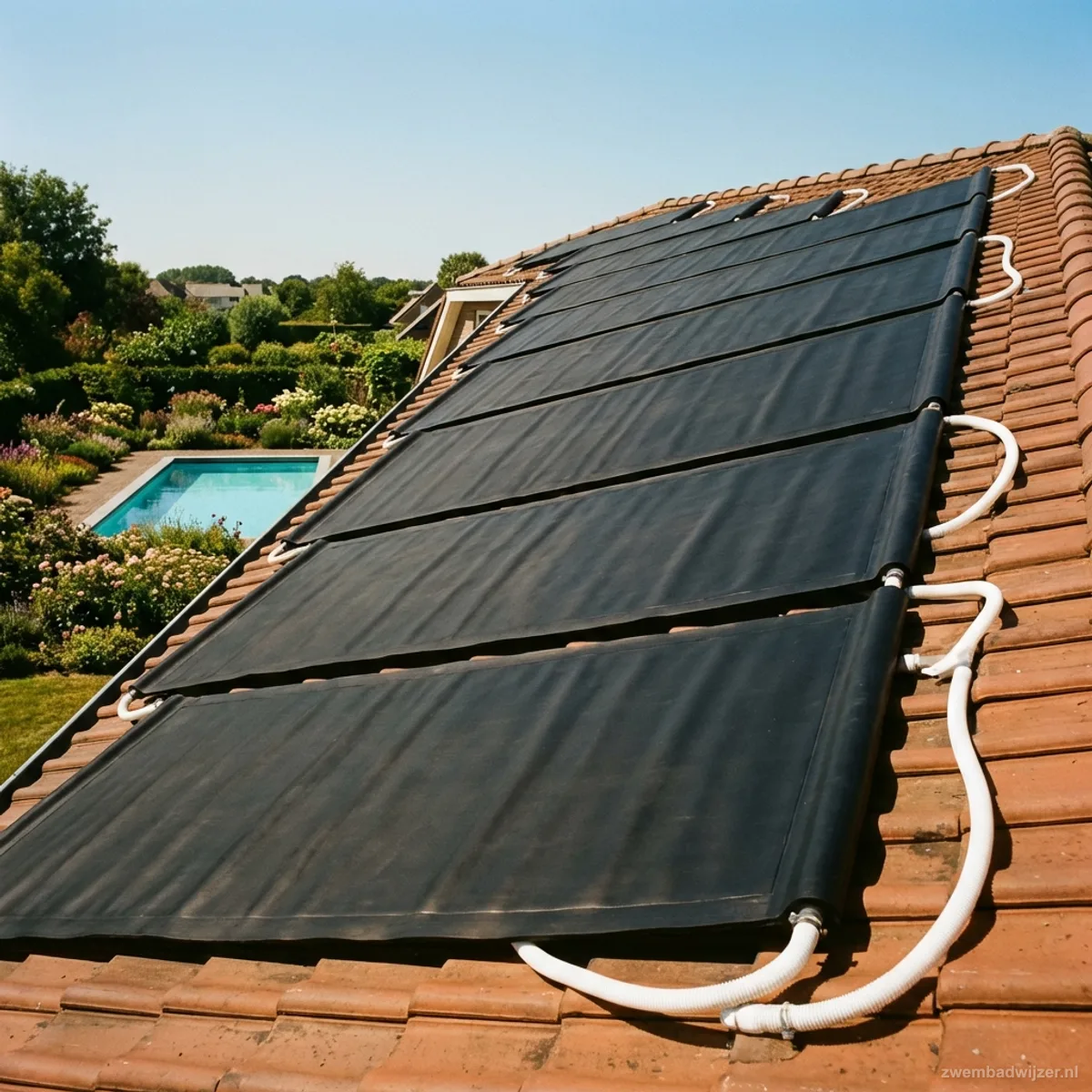
Heating capacity depends on mat area and sun intensity. As a rule of thumb, solar mats covering 50 to 75 percent of the pool surface area are sufficient for Northern European conditions. For a 32 m² pool (8 x 4 m) you need 16 to 24 m² of solar mats.
Solar pool heating panels and collectors
Solar panels (glazed collectors) are more efficient per m² than rubber mats but more expensive. Glazed collectors cost €300 to €600 per m² installed. They work in overcast conditions and during the early and late season when rubber mats perform poorly.
For a 40,000-liter pool in Northern Europe, 8 to 12 m² of glazed collector provides a mean temperature increase of 4 to 6°C compared to an unheated pool.
Wood-fired pool heater: off-grid heating
A wood-fired pool heater (external wood-fired boiler) heats water through a heat exchanger. Hot water from the firebox circulates through the exchanger and warms the pool water without direct contact between the fire and pool water.
Cost: €300 to €1,500 depending on model and output. Heating capacity: 15 to 40 kW, substantially more than a heat pump. A 25 kW wood-fired heater warms 10,000 liters from 20°C to 30°C in 2 to 4 hours.
Downsides: requires someone present while firing, wood costs (€50 to €200 per ton of beech), smoke, and it is not suited to large in-ground pools. A wood-fired heater is ideal for above-ground pools in rural settings.
Electric resistance heating: the most expensive method
Electric resistance heating converts electricity directly to heat at 100 percent efficiency, but costs 4 to 5 times more to run than a heat pump.
Cost: €200 to €800 to purchase. Power draw: 3 to 6 kW for a small heater, 9 to 18 kW for larger models. At €0.30 per kWh, a 6 kW resistance heater costs €1.80 per hour versus €0.36 per hour for an equivalent heat pump at COP 5.
Use electric resistance heating only as a supplement during very cold weather or for small above-ground pools where a quick warm-up is needed.
Heating methods compared
| Method | Purchase cost | Seasonal cost | Heating speed | Eco rating | Best for |
|---|---|---|---|---|---|
| Solar mats | €80-€500 | €0 | Slow (sun-dependent) | +++++ | All types in sunny conditions |
| Heat pump | €1,000-€4,500 | €150-€400 | Medium (0.5-1°C/h) | ++++ | In-ground and large above-ground |
| Wood-fired heater | €300-€1,500 | €50-€200 (wood) | Fast (2-4°C/h) | ++ | Small above-ground, rural |
| Gas (natural gas/propane) | €1,500-€3,000 | €300-€800 | Fast (2-5°C/h) | + | In-ground, limited sun |
| Electric resistance | €200-€800 | €500-€1,500 | Medium | + | Small above-ground, backup |
Combining methods for best results
The most efficient approach is to combine methods: solar mats as the primary heat source in summer, supplemented by a heat pump during cold spring and autumn periods. Add a solar bubble cover at night to retain the heat you gained during the day.
For year-round swimming in combination with a pool enclosure, a heat pump of at least 9 kW is the right primary choice. Review our pool winterizing guide to understand how heating interacts with the seasonal shutdown and startup process.
Frequently asked questions
What is the cheapest way to heat a pool?
Solar mats or collectors are the cheapest long-term option because the energy is free. Setup costs are €100 to €500. A heat pump costs more upfront (€1,000-€3,000) but is cheaper to run than electric resistance or gas. A solar bubble cover is the cheapest supplement regardless of which primary heating method you use.
How much does a pool heat pump raise the temperature per day?
A 9 kW heat pump raises a 40,000-liter pool by approximately 0.5 to 1°C per hour, depending on the outside temperature. Over a 10-hour heating day that is a 5 to 10°C gain. A 40,000-liter pool can be heated from 18°C to 28°C in 2 to 3 days of continuous operation.
How much does pool heating cost per month?
A 9 kW heat pump at COP 5 and €0.30/kWh costs roughly €1.80 per effective heating hour (6 kW x €0.30). At 6 hours daily operation that is €10.80 per day or about €324 per month. Solar mats cost nothing to run. Electric resistance heating costs 5 times more than a heat pump.
What is the ideal swimming pool temperature?
The ideal pool temperature for recreational swimming is 26 to 28°C. Children swim comfortably at 28 to 30°C. Competitive or serious swimmers prefer 24 to 26°C. Above 30°C bacteria multiply more quickly and chlorine loses effectiveness faster.
Does a heat pump work in cold weather?
Most pool heat pumps work down to -5°C ambient temperature, but efficiency drops significantly below 10°C. At 15°C outside the COP is around 5; at 7°C it falls to around 3. Below 5°C, supplemental electric heating or another method is often more cost-effective.