The skimmer is your pool’s first line of defence: it continuously draws in the top layer of water and captures leaves, insects, pollen and sunscreen residue before they sink to the floor. Roughly 70 to 80 percent of all water processed by the filter pump enters the system through the skimmer. Without a properly working skimmer, your pool surface stays dirty and the filter clogs faster.
What is the difference between a skimmer pool and an infinity pool?
In a skimmer pool (the most common type) the water level sits 15 to 20 cm below the top of the pool wall. A skimmer built into the wall at waterline level draws in surface water actively via the pump.
In an overflow pool (infinity pool) the water sits level with or just above the pool coping. Water spills over the edge into a collection trough (buffer tank), is pumped through the filter and returned via the jets. There is no visible skimmer: the overflow channel performs the same function.
| Feature | Skimmer pool | Overflow/infinity pool |
|---|---|---|
| Water level | 15-20 cm below coping | Level with coping |
| Surface cleaning | Via wall-mounted skimmer(s) | Via overflow channel |
| Construction cost | Standard | 30-50% more expensive |
| Skimmer maintenance | Yes (empty basket, check weir) | No (check buffer tank instead) |
| Visual effect | Classic | Vanishing edge effect |
For most residential pools, the skimmer pool is the standard. An overflow pool requires a larger technical installation and a buffer tank of at least 5 to 10 percent of the pool volume.
What does a pool skimmer do?
A pool skimmer continuously draws off the top layer of your pool water and captures the floating debris in it: leaves, insects, pollen and sunscreen residue. This removes debris before it sinks to the bottom, where it is far harder to remove. The skimmer feeds roughly 70 to 80 percent of all circulated water to the filter, making it the main intake of your entire circulation system.
How does a pool skimmer work?
A skimmer works on suction: when the filter pump runs, it draws the top layer of pool water in through the skimmer mouth, carrying floating debris into the catch basket. The filtered water then travels through the suction line to the pump and filter.
A skimmer sits in the pool wall at water-line level. When the filter pump runs, it creates negative pressure in the plumbing. Water flows through the skimmer mouth into the system, carrying floating debris with it.
The water first passes through a catch basket (the skimmer basket) that traps coarse debris. From there it travels through the suction line to the pump and on to the filter. The entire process runs automatically whenever the pump is on.
A standard residential skimmer pulls roughly 5 to 8 m3 per hour, depending on pump size. In a 30,000-litre pool with an 8 m3/hr pump, the skimmer handles about 6 m3/hr while the remaining 2 m3/hr enters via the main drain.
Skimmer parts: from mouth to plumbing connection
Every skimmer shares the same core components regardless of brand or model. Below is a breakdown of each part and its function.
| Part | Function | Material |
|---|---|---|
| Skimmer mouth (opening) | Water inlet at water-line level | ABS plastic |
| Weir flap | Keeps debris inside when the pump stops | ABS plastic, sometimes stainless steel |
| Skimmer basket | Catches leaves and coarse debris | Polypropylene |
| Skimmer body | Houses all components, embedded in the wall | ABS or PVC |
| Lid | Provides access to the basket for cleaning | ABS plastic |
| Suction port (bottom) | Connection to plumbing running to the pump | PVC 50 mm or 63 mm |
| Equaliser port | Optional link to main drain to prevent air intake | PVC |
How does the weir flap work?
The weir is the hinged flap at the front of the skimmer mouth. When the pump runs, suction pulls the weir inward. This draws a thin layer of surface water into the skimmer.
When the pump stops, the weir falls back to its closed position. Debris already inside the skimmer cannot float back into the pool. It is a simple but essential mechanism.
Check the weir at least once a month. A stuck or broken weir reduces skimming efficiency by 30 to 50 percent. Replacement weirs cost 5 to 15 euros and take about two minutes to install.
Built-in skimmer versus hang-on skimmer: which type fits your pool?
There are two main skimmer types. Your choice depends on what kind of pool you have.
Built-in skimmer for in-ground pools
A built-in skimmer is set into the pool wall during construction. The skimmer body is completely hidden behind the wall. Only the mouth and lid are visible from the pool side.
Built-in skimmers have a larger opening (standard 21 x 15 cm) and a sturdier basket (1 to 2 litres capacity). They typically handle 5 to 10 m3 per hour and last 15 to 25 years. Most in-ground pools have 1 skimmer per 25 m2 of water surface.
Hang-on skimmer for above-ground pools
A hang-on skimmer clips over the top rail of an above-ground pool (Intex, Bestway and similar brands). It either has its own small pump or connects to the existing filter set.
Hang-on skimmers are compact and affordable (15 to 40 euros). They handle 2 to 4 m3 per hour. The basket is smaller (0.5 litres) and needs emptying more often. For pools up to 15,000 litres, one hang-on skimmer is sufficient.
| Feature | Built-in skimmer | Hang-on skimmer |
|---|---|---|
| Suited for | In-ground pools | Above-ground pools |
| Opening size | 21 x 15 cm (standard) | 12 x 10 cm |
| Flow rate | 5 to 10 m3/hr | 2 to 4 m3/hr |
| Basket capacity | 1 to 2 litres | 0.3 to 0.5 litres |
| Lifespan | 15 to 25 years | 3 to 5 years |
| Price | 30 to 80 euros (part of construction) | 15 to 40 euros |
| Installation | Built in during construction | Clips over the rim |
Tip
For pools larger than 50 m2 of surface area, use a wide-mouth skimmer with an opening of 40 x 20 cm. It covers a broader surface strip and reduces the number of skimmers needed. Budget one wide-mouth skimmer per 40 m2.
Time to replace your skimmer basket or keep a spare handy?
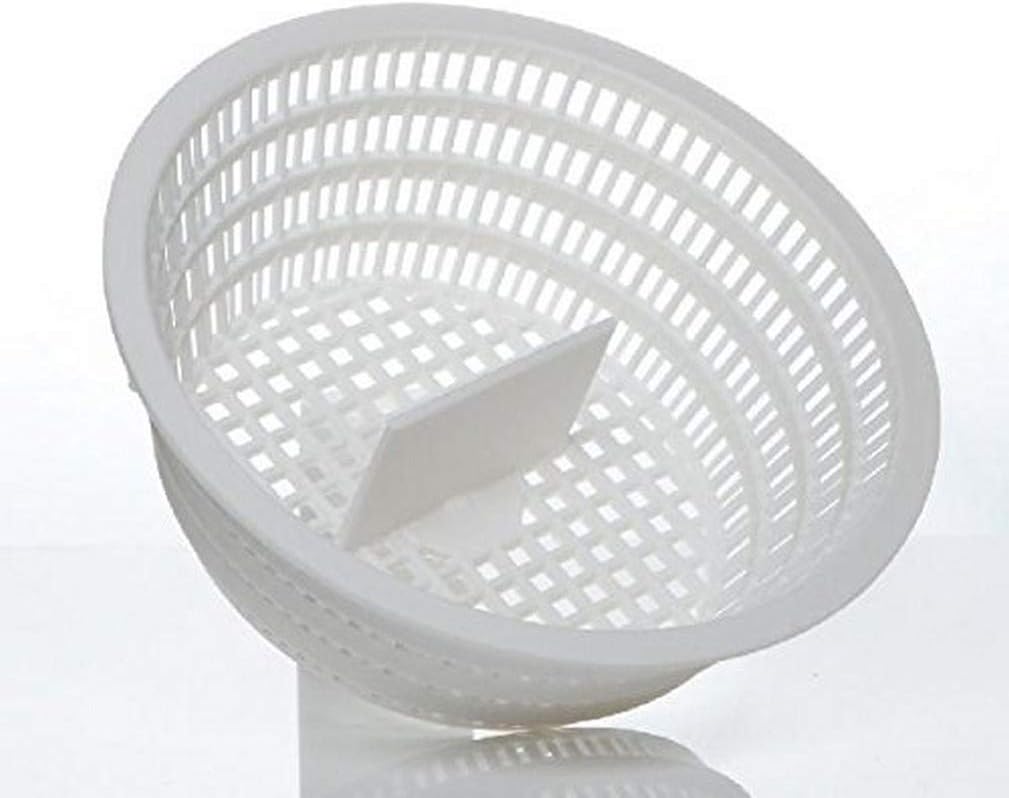
Universal Replacement Skimmer Basket
SwimlineReplacement skimmer basket that fits most standard skimmer housings. Fine mesh catches smaller debris than most stock baskets and rinses clean in seconds.
- Fits most standard skimmer housings
- Finer mesh than original basket
- Easy to clean under the tap
- Check dimensions before ordering, not universal for all brands
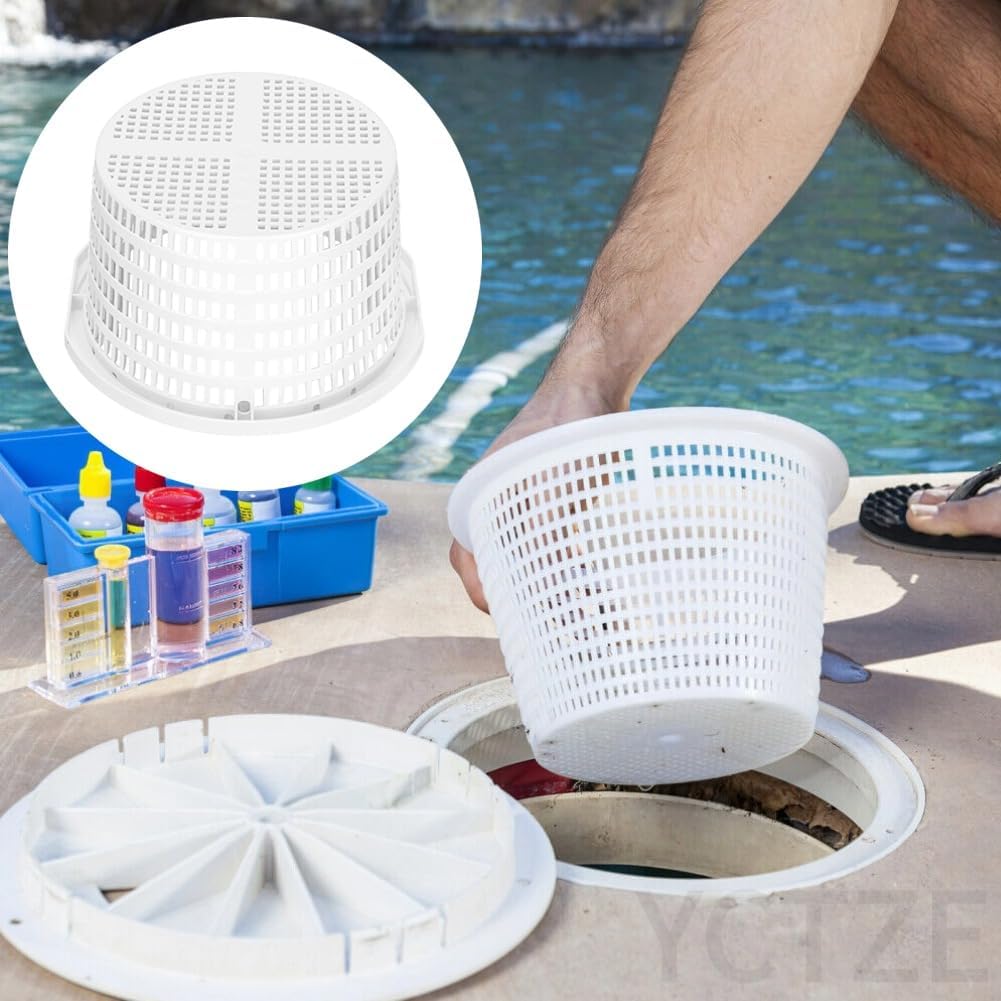
Fine Mesh Skimmer Basket
SwimlineFine mesh skimmer basket that catches small debris, insects and pollen. Fits most standard in-ground and above-ground skimmer housings.
- Extra fine mesh
- Fits standard skimmer housings
- Easy to rinse clean under the tap
- Needs emptying more often with heavy fine debris
Where should you place the skimmer?
Skimmer placement determines how effectively it collects debris. A poorly positioned skimmer lets floating dirt accumulate in corners untouched.
Always on the downwind side
Place the skimmer on the side of the pool where the wind blows toward. Wind pushes floating debris across the surface. If the skimmer sits on that downwind side, debris drifts straight into it. In many northern-European climates the prevailing wind comes from the south-west, so the skimmer goes on the north-east or east wall.
If you have multiple skimmers, space them evenly along the long wall. In a 10 x 5 metre pool with two skimmers, place them at the one-third and two-third points. Aim the return jets from the opposite wall toward the skimmers.
Working together with the return jets
The return jets and the skimmer function as a team. Angle the return jets so they create a circular flow pushing debris toward the skimmer. A common setup is return jets on the wall opposite the skimmer, angled slightly downward (15 degrees) and sideways.
For a full overview of how all components interact, read how does a swimming pool work: the complete system .
Water level and the skimmer: why it matters so much
The water level is directly tied to skimmer performance. Too high or too low and the entire system struggles.
Ideal level: water sits halfway up the skimmer mouth. On a standard skimmer opening of 15 cm tall, that means roughly 7 to 8 cm from the bottom of the opening.
Too low (below one-third of the opening): the weir clears the water and the skimmer draws air. The pump begins to sputter, loses suction and can overheat. You will hear a gurgling or hissing sound from the pump room.
Too high (above the top of the opening): surface debris cannot be pulled over the weir. The skimmer draws water from a few centimetres below the surface but leaves the very top layer, where debris floats, untouched.
Tip
An automatic fill valve keeps the water level at the correct point around the clock. These cost 40 to 80 euros and save you the hassle of manually topping up after evaporation or rainfall. Connect it to a garden tap.
Common skimmer problems and how to fix them
Below are the most frequent skimmer issues, their causes and solutions.
| Problem | Cause | Solution |
|---|---|---|
| Skimmer draws air | Water level too low | Top up the pool to halfway up the skimmer mouth |
| Debris floats back into the pool | Weir is stuck or broken | Clean or replace the weir (5 to 15 euros) |
| Reduced suction | Full skimmer basket | Empty the basket; also check the pump strainer |
| Crack in the skimmer body | Frost damage or ground shift | Repair with PVC cement or replace the skimmer |
| Leak around the skimmer mouth | Aged gasket | Replace the gasket between skimmer and pool wall |
For a detailed cleaning guide, read skimmer cleaning: step-by-step instructions .
How many skimmers does your pool need?
The number of skimmers depends on the water surface area. The rule of thumb is 1 skimmer per 25 m2. Larger pools or pools surrounded by trees need additional units.
| Surface area | Number of skimmers |
|---|---|
| Up to 25 m2 | 1 |
| 25 to 50 m2 | 2 |
| 50 to 75 m2 | 3 (or 2 wide-mouth) |
| 75 to 100 m2 | 4 (or 3 wide-mouth) |
For above-ground pools with one hang-on skimmer, the surface is rarely larger than 15 m2, so a single unit is enough. If you have a round above-ground pool of 4.5 metres diameter (roughly 16 m2), one hang-on skimmer will do, but empty the basket daily.
How the skimmer works with the main drain
The skimmer and the main drain complement each other. The skimmer cleans the surface while the main drain pulls deeper water where settled debris collects.
In most setups you can use a three-way diverter valve to adjust the ratio between skimmer and main drain. The standard split is 70 percent skimmer and 30 percent main drain. In autumn, when leaves are heavy, increase skimmer flow to 80 to 90 percent.
Pools without a main drain (most above-ground pools) depend entirely on the skimmer. In that case, compensate for the missing bottom circulation with a robotic pool cleaner or a manual vacuum head.