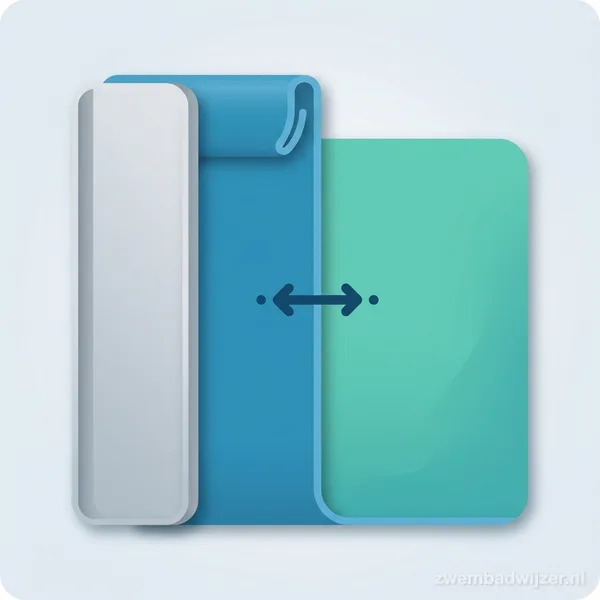
The best tiles for around a pool are frost-resistant porcelain or ceramic with an anti-slip rating of at least R10. For the pool coping, use specially shaped coping tiles with a rounded or bull-nosed edge. Good pool tiles resist chlorine, UV exposure and frost and last for decades with proper care.
Which tiles should you choose for the pool coping?
The pool coping (the edge between the water and the terrace) is the most critical part of your tiling. It must meet specific requirements.
Dedicated coping tile or standard tile? A dedicated coping tile has a rounded or downward-curved nose that directs water into the overflow channel or away from the pool structure. Standard floor tiles lay flat and give a square edge. Infinity pools require special overflow coping tiles.
Requirements for pool coping:
- Water absorption maximum 0.5% (class BI): prevents frost damage
- Anti-slip at least R10 for the transition zone
- Chlorine-resistant glaze: not all ceramics withstand prolonged contact with chlorinated water
Popular coping tile sizes are 20 x 20 cm and 30 x 30 cm. Larger formats (60 x 60 cm) are possible but demand a more precisely levelled substrate.
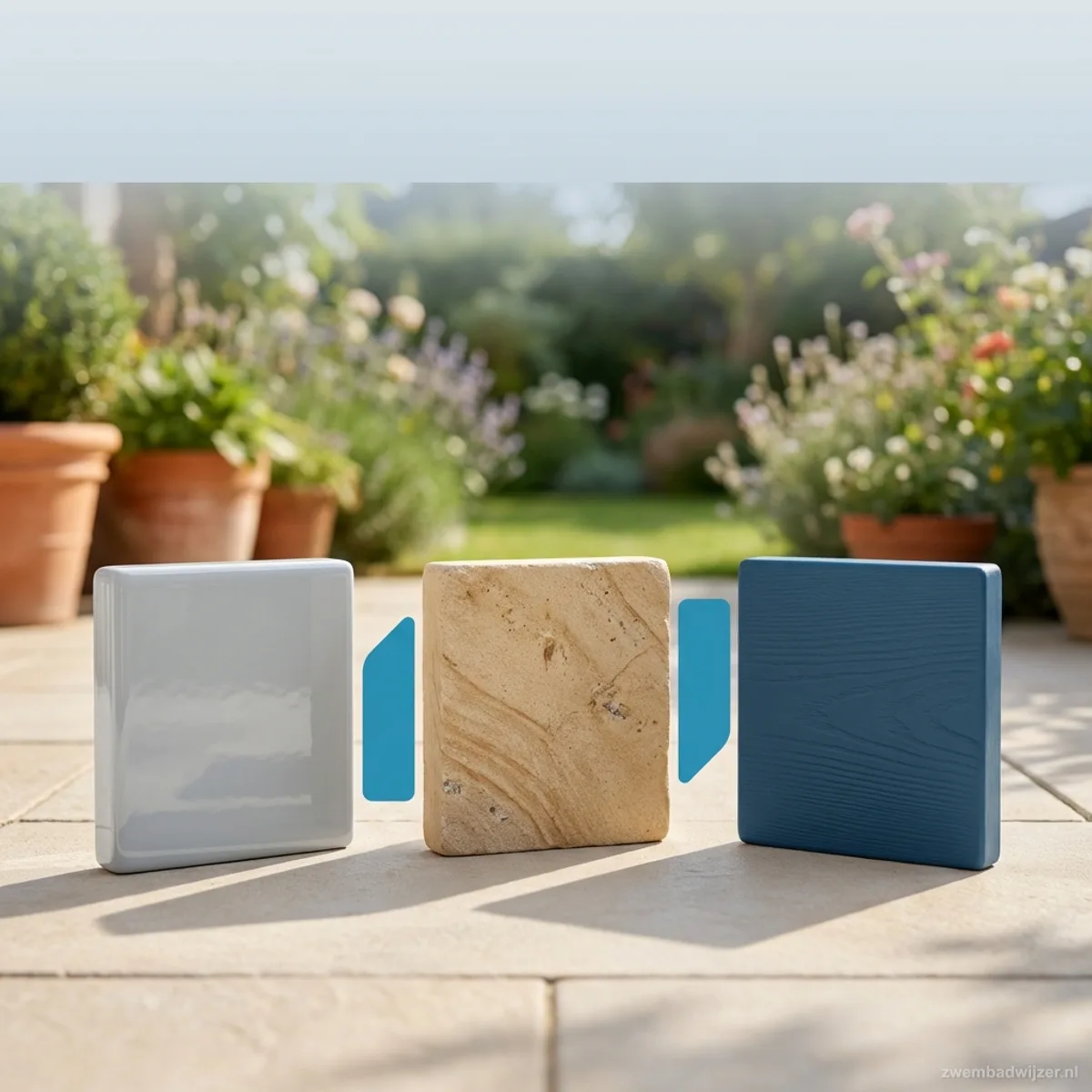
Which materials work as pool tiles?
Porcelain (high-fired ceramic)
Porcelain is the most popular material for pool applications. It is fired at over 1,200°C, giving water absorption of less than 0.5%. This makes it fully frost-resistant. Porcelain is available in matt (anti-slip) and polished (smooth) finishes.
Always choose matt or textured porcelain for areas around the pool. Polished porcelain looks beautiful but is dangerously slippery when wet.
Ceramic tile
Standard ceramic has higher water absorption (0.5 to 3%) than porcelain and is less reliably frost-resistant. Suitable in milder climates but a risk in Northern European winters. Always check the frost-resistance certificate.
Natural stone
Granite and bluestone (hard limestone) are durable choices. Granite has water absorption below 0.5% and is fully frost-resistant. Note: marble and limestone are porous and attacked by chlorine. Avoid these materials in direct contact with pool water.
Composite and wood-composite
Composite tiles (plastic or cement-bonded fibre) are lightweight, anti-slip and low-maintenance. Well suited for terraces around the pool. Less suited for surfaces in direct water contact. Wood-composite gives a warm look but needs specific cleaning care.
| Material | Water absorption | Frost resistant | Anti-slip | Chlorine resistant | Price/m2 |
|---|---|---|---|---|---|
| Porcelain matt | < 0.5% | Yes | R10 to R12 | Yes | €35 to €90 |
| Ceramic | 0.5 to 3% | Limited | Variable | Mostly | €25 to €70 |
| Granite | < 0.5% | Yes | R10 (sawn) | Yes | €60 to €120 |
| Bluestone | < 0.5% | Yes | R11 to R12 | Yes | €50 to €100 |
| Composite | Low | Yes | R11 | Yes | €40 to €80 |
Anti-slip ratings explained: which class do you need?
Slip resistance for outdoor tiles is rated under DIN 51130 (R-classes, footwear) and DIN 51097 (A-classes, barefoot use such as pools).
R-classes (footwear, DIN 51130):
- R9: Light grip. Indoor dry floors only.
- R10: Standard for terraces and walkways. Minimum for a pool surround.
- R11: Increased grip. Suitable for wet zones around the pool.
- R12: High anti-slip. For steps, splash zones and pool entry.
- R13: Extreme grip. Industrial use.
A-classes (barefoot, DIN 51097):
- A: Minimum for barefoot use
- B: Wet zones and pool entry areas
- C: Maximum grip for pool steps and ladder surrounds
For pool coping and entry steps, specify at least R10/A. For pool steps and the splash zone, use R11 to R12/B to C.
Do you need tiles under an above-ground pool?
For in-ground and semi-inground pools, the floor is a structural element (concrete or fibreglass). Tiles on the pool floor are an aesthetic choice, not a structural necessity.
Tiles inside the pool (wall cladding and floor): Small mosaic tiles (2.5 x 2.5 cm or 5 x 5 cm) are classic for the walls and floor of concrete pools. They are fully waterproof, decorative and easy to repair section by section. Cost: €40 to €150 per m2 material plus €60 to €90 per m2 for installation.
Tiles under an above-ground pool: An above-ground pool has no fixed floor — the liner rests directly on the ground. A concrete or paving slab base:
- Protects the liner from stones and roots
- Distributes the weight (water weighs 1 tonne per m3) evenly
- Prevents ground subsidence from moisture
If you prefer not to tile, use purpose-made pool underlay mat or 4 to 6 mm EVA foam as a protective base.
Tiles around your pool: materials and practical tips
The surround forms the terrace, the walking zone and the entry path. Make it at least 1.5 metres wide to walk comfortably and place sun loungers.
Recommended tile sizes for terraces:
- Small tiles (30 x 30 cm): easier to fit around curved edges
- Medium (60 x 60 cm): modern look, fewer grout lines, easier to clean
- Large format (80 x 80 cm or 120 x 60 cm): premium look, requires a precise substrate
Laying patterns: Straight (parallel to the pool edge) gives a clean, contemporary look. Diagonal (45° rotation) disguises irregularities but creates 10 to 15% extra cut waste.
Slope and drainage: Lay the terrace with a 1 to 2% fall away from the pool. This prevents rain and splash water from draining back into the pool.
For the full pool finishing picture including enclosures and terracing, read the article on pool enclosures .
If you are still in the installation phase, see the step-by-step guide for installing a pool for the correct sequence of work.
What do pool tiles cost?
Total tiling costs include material, grout, adhesive mortar and labour. A realistic cost overview:
| Situation | Area | Material (€/m2) | Installation (€/m2) | Total |
|---|---|---|---|---|
| Pool surround terrace (porcelain R10) | 40 m2 | €40 to €80 | €45 to €55 | €3,400 to €5,400 |
| Pool coping tiles | 12 lin m | €50 to €120 | €50 to €70 | €1,440 to €2,280 |
| Mosaic pool interior walls | 30 m2 | €60 to €150 | €60 to €90 | €3,600 to €7,200 |
| Base slab under above-ground pool | 12 m2 | €20 to €40 | €30 to €45 | €600 to €1,020 |
How to maintain pool tiles
Green algae staining, waterline scale deposits and grout failure are the three most common problems with pool tiles.
Waterline scale: A combination of calcium carbonate and sunscreen builds up on tiles at the waterline. Use a dedicated waterline cleaner or 5% white vinegar and a soft scrubbing brush. Clean every 2 to 4 weeks.
Green algae on terrace tiles: Use an algae remover or diluted bleach (1:10 ratio). Leave for 10 minutes, then scrub. Preventively treat tiles each spring with a penetrating sealer that also inhibits algae growth.
Grout maintenance: Cement grout degrades under chlorine water and UV exposure. Inspect grout lines annually and repair cracks immediately with a waterproof grout repair kit. Always use epoxy grout or chlorine-resistant cement grout from the start.
Frequently asked questions
Which tiles are suitable around a pool?
Choose frost-resistant anti-slip tiles with at least R10 for the pool surround and coping. Porcelain and ceramic are the most popular choices. Never use polished or smooth stone — it is dangerously slippery when wet.
Do you need to put tiles under an above-ground pool?
Not essential, but tiles protect the pool floor from stones and distribute the weight more evenly. A pool underlay mat is a practical alternative.
What do pool surround tiles cost?
Material costs €30 to €120 per m2. Installation runs €40 to €60 per m2. A 40 m2 terrace costs €2,800 to €7,200 combined.
How do you remove green algae from pool tiles?
Use an algae or anti-mould cleaner, leave for 10 minutes, scrub with a stiff brush and rinse well. Treat preventively each spring before algae appear.
What grout should you use around a pool?
Use epoxy grout or a specialist waterproof cement grout. Standard cement grout crumbles within 2 to 3 years under chlorine and UV exposure. Inspect annually and repair small cracks immediately.