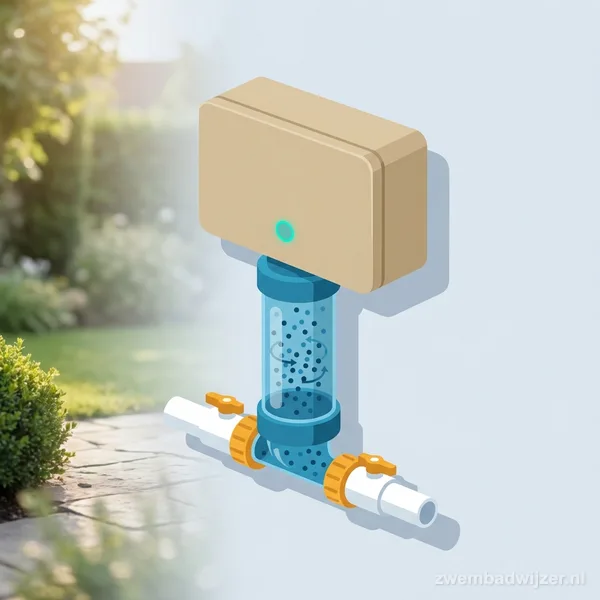
Salt electrolysis converts kitchen salt (NaCl) dissolved in your pool water into chlorine through an electrolysis cell. You need 1.5 to 5 g/L of salt depending on the system, the cell produces fresh chlorine continuously while the pump runs, and the water feels noticeably softer than with manually dosed chlorine tablets or liquid chlorine.
How salt electrolysis actually works
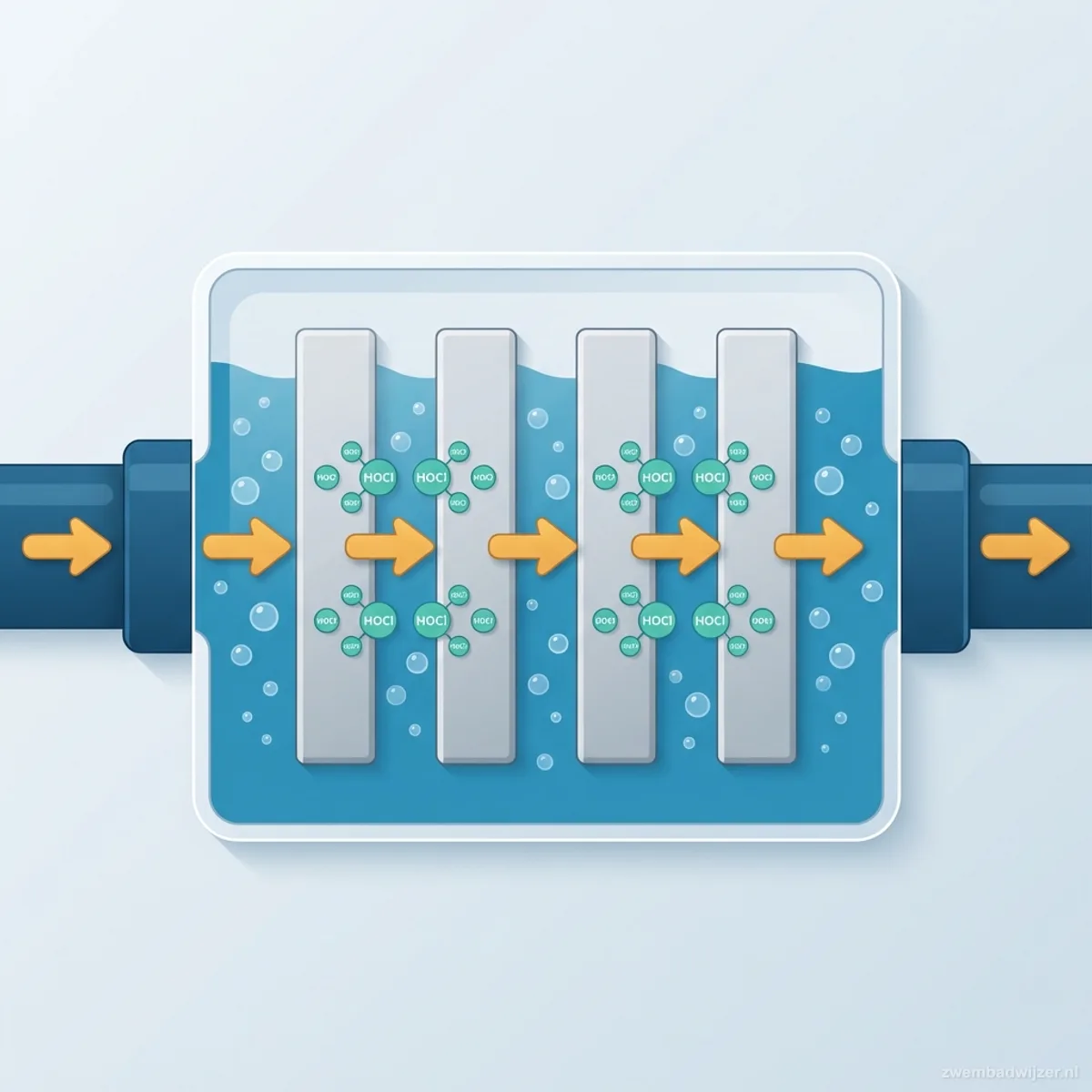
The heart of the system is the electrolysis cell: a housing containing titanium plates coated with ruthenium or iridium oxide. Saltwater flows continuously through this cell. A DC voltage of 3 to 9 volts across the plates splits the sodium chloride (NaCl) chemically.
At the anode, chloride ions (Cl-) are converted to chlorine gas (Cl2), which instantly dissolves in water to form hypochlorous acid (HOCl). At the cathode, sodium hydroxide (NaOH) and hydrogen gas (H2) form. HOCl is the active disinfectant, exactly the same substance as in liquid chlorine or chlorine tablets.
Modern electrolysis cells automatically reverse the polarity of the plates every 2 to 4 hours. This polarity reversal prevents calcium build-up on the titanium plates, which significantly extends the life of the cell.
After disinfecting bacteria and algae, HOCl breaks down and regenerates sodium chloride. The salt is not consumed in the chlorine production process; it is recycled continuously.
Traditional salt versus low-salt systems
Most electrolysis cells on the market work with a salt concentration of 3 to 5 g/L (3,000 to 5,000 ppm). These are called traditional salt systems. Low-salt systems are newer generations that operate efficiently at 1.5 to 2.0 g/L.
| Feature | Traditional (3-5 g/L) | Low-salt (1.5-2 g/L) |
|---|---|---|
| Salt concentration | 3,000 to 5,000 ppm | 1,500 to 2,000 ppm |
| Taste threshold | Slightly salty noticeable | Barely perceptible |
| Corrosion risk grade 304 SS | Present | Negligible |
| Cell lifespan | 5,000 to 10,000 hours | Comparable |
| System purchase price | 600 to 1,500 euros | 1,200 to 2,500 euros |
| Salt cost per season | 20 to 50 euros | 10 to 25 euros |
Traditional systems are cheaper to buy and represent decades of proven technology. Low-salt systems make the pool virtually indistinguishable from fresh water, which is beneficial for swimmers sensitive to the salt feel on their skin.
What equipment do you need?
A complete salt electrolysis installation is more than just the cell. Here is the full equipment list:
Required:
- Electrolysis cell: the core of the system, installed in the return line after the filter
- Control unit: manages chlorine output (0 to 100%), displays readings, and triggers alarms
- Flow switch: automatically stops chlorine production when there is no water flow, protecting the cell
- Salt meter: digital sensor or separate tester for monthly salt level checks
Strongly recommended:
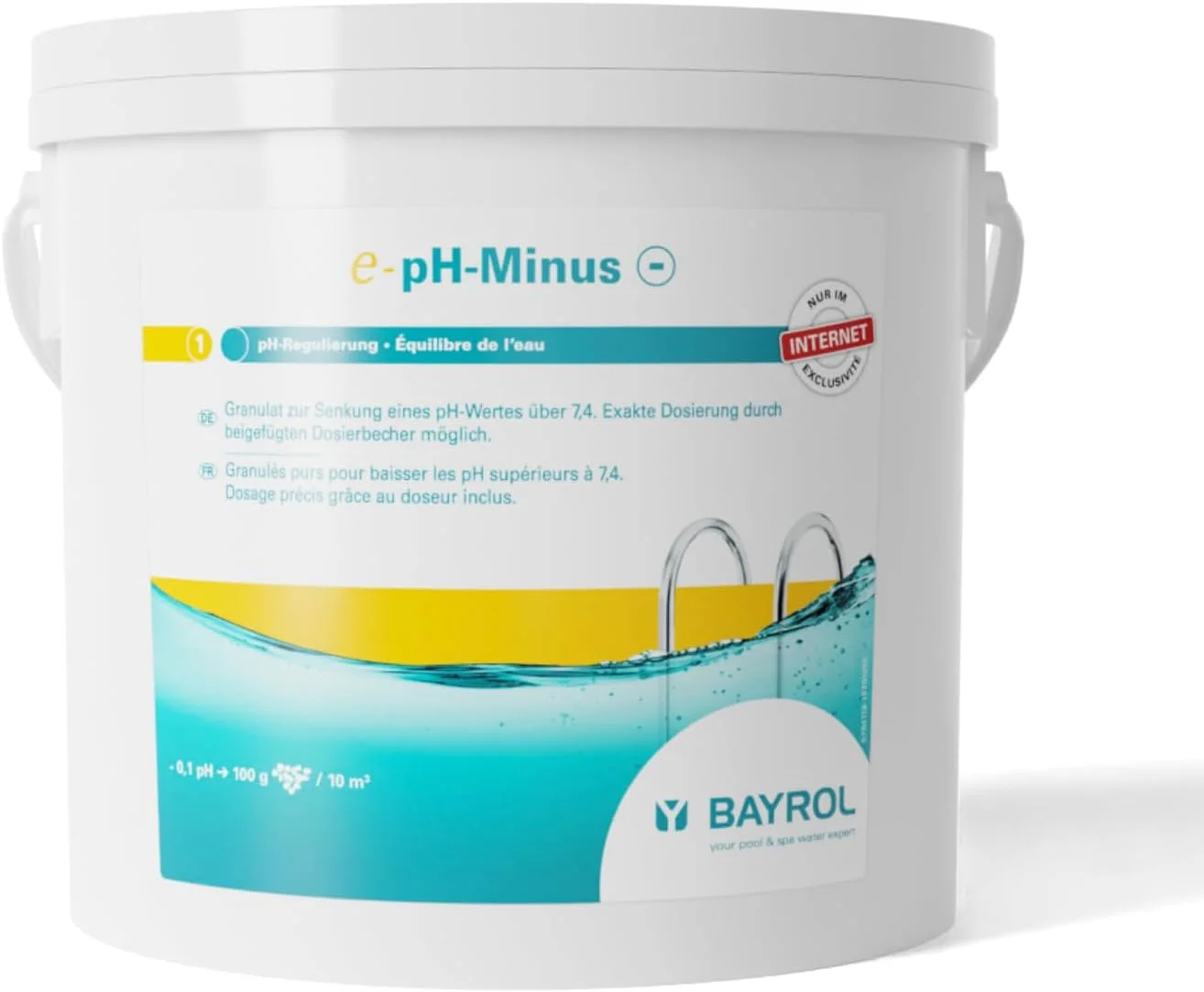
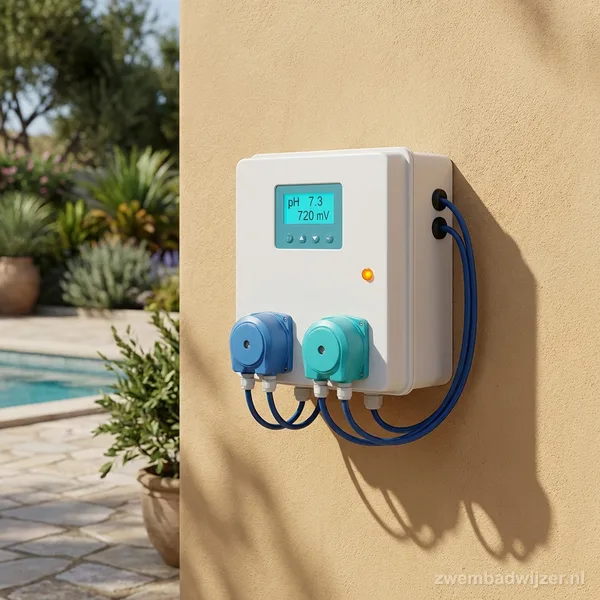
- pH-minus dosing pump: electrolysis raises pH structurally, and an automatic dosing pump is practically essential in real-world use
- Temperature sensor: switches off the cell at water temperatures below 12°C when production collapses
Optional:
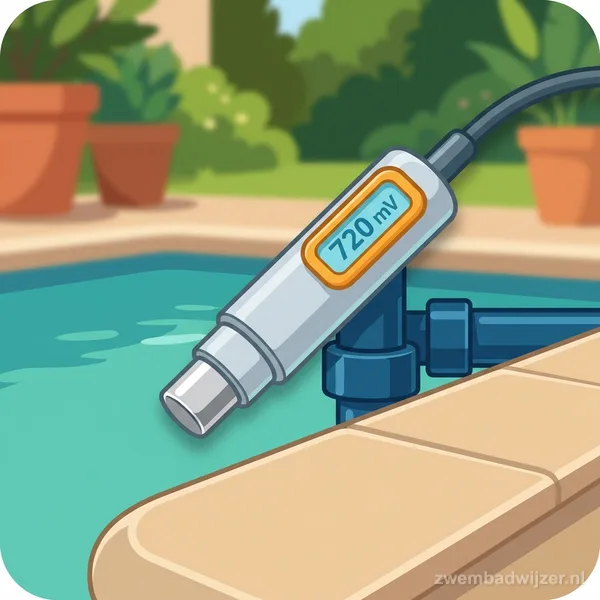
- ORP/Redox sensor: measures the disinfecting power of the water directly for more precise control. Learn more about pool ORP and redox values
The control unit and cell are installed in the equipment room, no more than 3 to 5 metres apart. The cell goes in the return line as the last component, after the filter, heat pump, and UV system.
The pH effect of salt electrolysis
Electrolysis raises the pH of your pool water. During electrolysis, sodium hydroxide (NaOH) forms at the cathode. This strong base raises pH by 0.1 to 0.3 per day during active chlorine production.
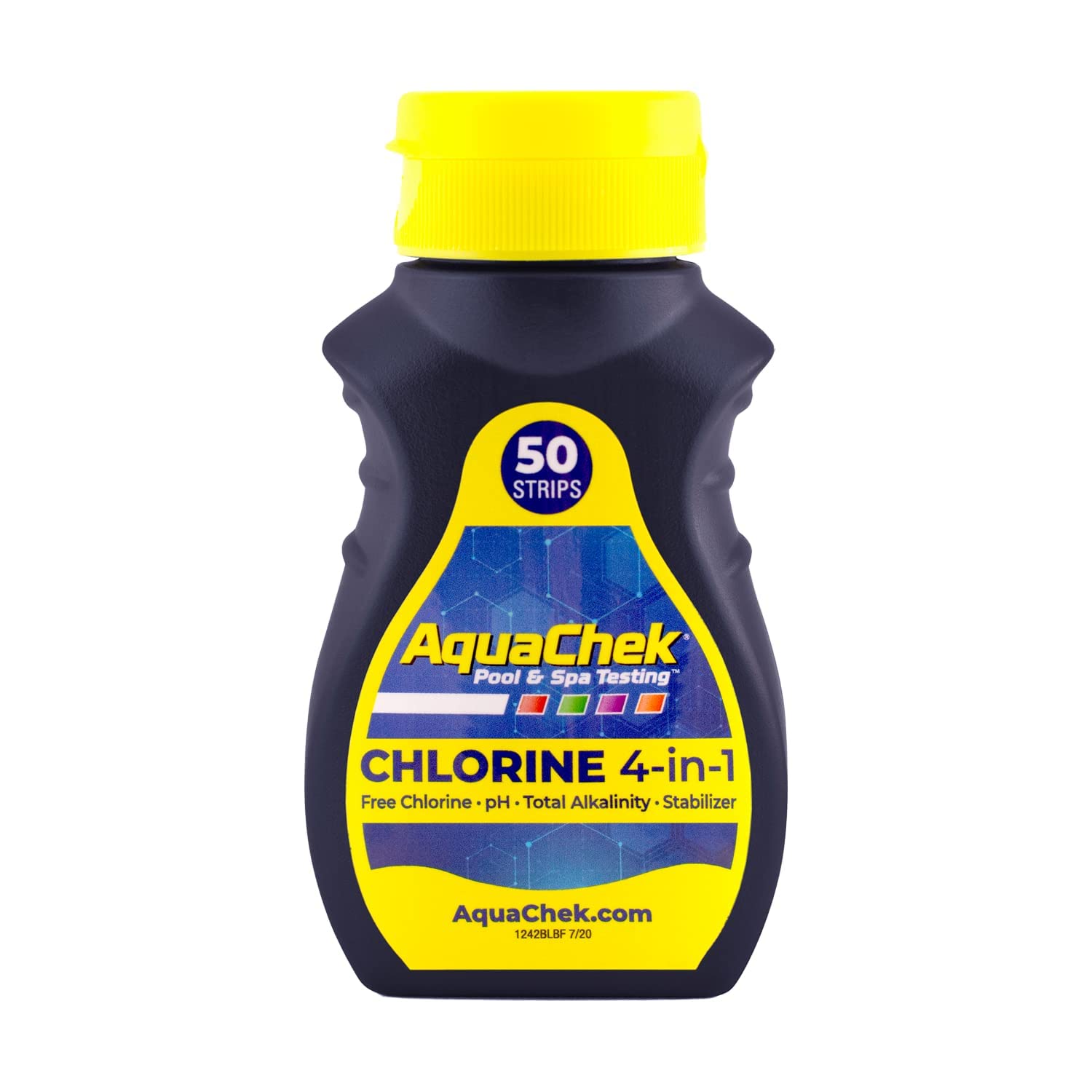
A salt electrolysis pool without pH correction quickly reaches pH 8.0 or higher. At that level, HOCl’s disinfecting power drops sharply: at pH 8.0 only 22% of the available chlorine is active as HOCl, compared with 73% at pH 7.2.
The target pH range for salt electrolysis pools is 7.2 to 7.4, slightly lower than the standard guideline of 7.2 to 7.6. That lower target compensates for the continual pH rise from electrolysis. Read everything about measuring and correcting pH on the pool pH levels page.
For automatic pH correction combined with chlorine control, see the page on automatic pH and chlorine control .
Electrolysis cell maintenance
A well-maintained cell lasts 5,000 to 10,000 operating hours. For a seasonal pool running 8 hours a day from April to October, that translates to 7 to 14 years. Calcium build-up is the primary cause of premature wear.
Automatic maintenance by the cell: Polarity reversal switches the current direction every 2 to 4 hours, which dislodges calcium deposits automatically. This is a baseline mechanism, not a substitute for manual maintenance.
Manual cleaning 1 to 2 times per season: Remove the cell and inspect the titanium plates. White deposits indicate calcium; brown deposits can indicate iron. Mix 1 part hydrochloric acid (31%) with 10 parts water. Submerge the cell for 5 to 10 minutes until you see the bubbling slow down. Rinse thoroughly with clean water afterwards. Never use a metal brush on the plates.
Annual check: Inspect the O-rings on the cell connections, verify the flow switch is operating correctly, and check the cable connections for corrosion. Have the control unit inspected visually each year by your installer.
Cost comparison: salt electrolysis versus chlorine tablets
| Feature | Salt electrolysis | Dosing pump + liquid chlorine | Chlorine tablets |
|---|---|---|---|
| System purchase | 600 to 2,500 euros | 300 to 800 euros | 0 euros |
| Annual chemical costs | 20 to 80 euros | 100 to 200 euros | 150 to 300 euros |
| pH correction costs/year | 30 to 60 euros | 30 to 60 euros | 15 to 40 euros |
| Labour intensity | Low (monthly checks) | Low to medium | High (weekly refills) |
| Water feel | Soft and comfortable | Neutral | Sometimes irritating at peak |
| Payback period | 3 to 6 years | N/A | N/A |
The economics of salt electrolysis are straightforward: for a 50,000-litre pool, the system costs around 1,200 euros. Annual savings on chemicals versus tablets: 100 to 200 euros. Payback period: 6 to 12 years before cell replacement, 3 to 6 years when factoring in the savings over time.
Water chemistry with salt electrolysis
Salt levels need to be checked monthly. A salt level that is too low (below 2,500 ppm on a traditional system) triggers an alarm on the control unit and reduces chlorine output. A level that is too high (above 6,000 ppm) is not dangerous, but it can accelerate corrosion of sensitive materials.
One important difference from chlorine tablets: tablets always contain cyanuric acid (CYA) as a stabiliser. With regular use, CYA builds up to 80 to 150 mg/L, which significantly reduces chlorine effectiveness. Salt electrolysis produces no CYA. You can keep CYA low (10 to 30 mg/L), which means lower chlorine levels (0.5 to 1.0 ppm) are sufficient for effective disinfection.
Maintain calcium hardness at 200 to 400 mg/L in a salt electrolysis pool. Harder water (above 400 mg/L) accelerates calcium scaling on the titanium plates, while softer water (below 150 mg/L) is more aggressive toward the concrete pool shell.
Common problems and solutions
Low chlorine output: First check the salt level. Below the minimum threshold (specified in your system’s manual), the cell does not produce. Second cause: calcium scaling on the plates. Clean the cell as described above. Third cause: the cell has reached the end of its service life.
Conductivity error (E1 or similar): This alarm indicates a salt level that is too low or contaminated water with poor conductivity. Measure the salt level and add salt if needed. Wait 12 hours before resetting the alarm.
Persistently high pH: Normal with salt electrolysis. The solution is automatic pH-minus dosing. Set the dosing pump to a setpoint of 7.2 with a hysteresis of 0.1. A rule of thumb for the first setting: 200 ml pH-minus per 50,000 litres per day.
Flow switch alarm: The cell detects no water flow. Check that the filter pump is running, that the flow switch trigger is positioned correctly, and that the flow switch is not blocked with calcium deposits.
When salt electrolysis is not the best choice
Salt electrolysis is excellent for most in-ground pools, but there are situations where you should avoid it:
Small above-ground pools under 15,000 litres: the cell purchase cost is relatively high, and the payback period becomes unattractive. Chlorine tablets are more practical here.
Pools with hard water above 600 mg/L calcium: calcium scaling on the cell is so intensive that lifespan drops dramatically unless you add water softening. This makes the total installation considerably more expensive.
Pools with grade 304 stainless steel fittings and accessories: saltwater at 3 to 5 g/L can attack grade 304 stainless steel over time. Replace those components with grade 316 or choose a low-salt system.
Pools with heavy shading or low average water temperature: when the average water temperature stays below 16°C, cell output drops sharply. You still need manual chlorine addition during cooler periods.
More information about the basic operation of saltwater disinfection is in the saltwater chlorinator article, which also covers plumbing and installation position. The pool filter pump always sits before the electrolysis cell in the pipework.
Frequently asked questions
How much salt do you need for a pool with salt electrolysis?
Traditional systems work at 3 to 5 g/L (3,000 to 5,000 ppm). Low-salt systems are designed for 1.5 to 2.0 g/L. For a 50,000-litre pool with a traditional system at 4 g/L, you need 200 kg of pool salt for the initial fill.
What type of salt should you use for electrolysis?
Use only pool salt: pure NaCl with a purity of at least 99.5%. Never use iodised table salt, road salt, or sea salt with impurities. These can damage the titanium plates and disturb the cell’s electronics.
Does salt damage the pool shell and coping stones?
At the concentrations required for salt electrolysis (1.5 to 5 g/L), saltwater is not aggressive toward concrete, tiles, liner, or PVC. However, grade 304 stainless steel accessories can corrode over time. Replace them with grade 316 or plastic. Seawater at 35 g/L is corrosive; pool saltwater is not.
How often do you need to top up the salt?
Salt only leaves the pool through splash-out, backwash water, and evaporation. During a normal season (April to October) you typically add salt 1 to 3 times, usually 20 to 50 kg per time. Test salt levels monthly with a digital salt meter.
Is salt electrolysis better than chlorine tablets?
Salt electrolysis delivers more stable chlorine levels, softer water, and less manual work. Chlorine tablets are cheaper to set up and simpler to install. Salt electrolysis pays for itself in 3 to 5 years through lower chemical costs. The choice depends on your pool size and appetite for automation.
What is the minimum pool size for salt electrolysis?
Most electrolysis cells are designed for pools of 15,000 litres and above. Smaller cells exist, but the relatively high purchase cost (600 to 2,500 euros) makes the system economically attractive only for larger pools. For above-ground pools under 10,000 litres, chlorine tablets are more practical.
Conclusion
Salt electrolysis is the most comfortable water treatment option for most in-ground residential pools. The automatic chlorine production, soft water feel, and low long-term chemical costs outweigh the higher upfront investment. The system does require discipline: monthly salt checks, regular cell maintenance, and almost always an automatic pH dosing system.
Want to automate your water chemistry further? Read everything about automatic pH and chlorine control and how a complete system monitors water values 24/7. For a deeper understanding of how disinfection effectiveness is measured, see the pool ORP and redox value guide.