For most private above-ground pools (15,000 to 50,000 litres), a sand filter is the more practical choice: lower purchase price, simple maintenance via backwash and a long service life. A cartridge filter filters more finely but requires more hands-on maintenance.
How does a sand filter work?
Water flows downward through a bed of quartz sand. Dirt, algae and bacteria cling to the sand grains. Clean water passes through the laterals at the bottom and returns to the pool.
As the filter collects more debris, the filter pressure rises. When pressure rises 0.5 bar above the starting pressure, backwash is needed. During backwash, water flows in reverse through the sand, loosening the trapped dirt which then exits through the waste port.
Filtration accuracy: 20 to 40 microns with standard quartz sand. With glass media (recycled glass beads as filter medium) this improves to 5 to 10 microns. For more on how the sand filter works in detail, read our pool sand filter guide .
How does a cartridge filter work?
Water flows through a cylindrical filter element made of polyester or paper. Particles smaller than 10 to 15 microns are captured by the pleated surface. No backwash is needed: the cartridge is manually rinsed clean.
Filtration accuracy: 10 to 15 microns standard.
Sand filter vs. cartridge filter: side by side
| Feature | Sand filter | Cartridge filter |
|---|---|---|
| Filtration accuracy | 20 to 40 microns | 10 to 15 microns |
| Maintenance | Backwash (automatable) | Manual rinse |
| Water use | 300 to 500 litres per backwash | No water use |
| Purchase price | EUR 100 to EUR 400 | EUR 80 to EUR 250 |
| Replacement cost | Sand EUR 20 to EUR 50 / 4 years | Cartridge EUR 20 to EUR 60 / year |
| Compatible with flocculant | Yes | No (clogs the element permanently) |
| System lifespan | 10 to 20 years (sand 3 to 5 years) | 5 to 10 years (cartridge annually) |
When to choose a sand filter
- Pool larger than 20,000 litres
- You want minimal hands-on maintenance
- You want to use flocculant for extra clarity
- Heavy leaf fall or tree-lined environment
- Budget pool (combined pump and filter kits are cheaper)
When to choose a cartridge filter
- Small pool under 15,000 litres
- Water consumption is a consideration (no backwash water loss)
- You want finer filtration than standard sand can deliver
- Small above-ground pools with limited space for equipment
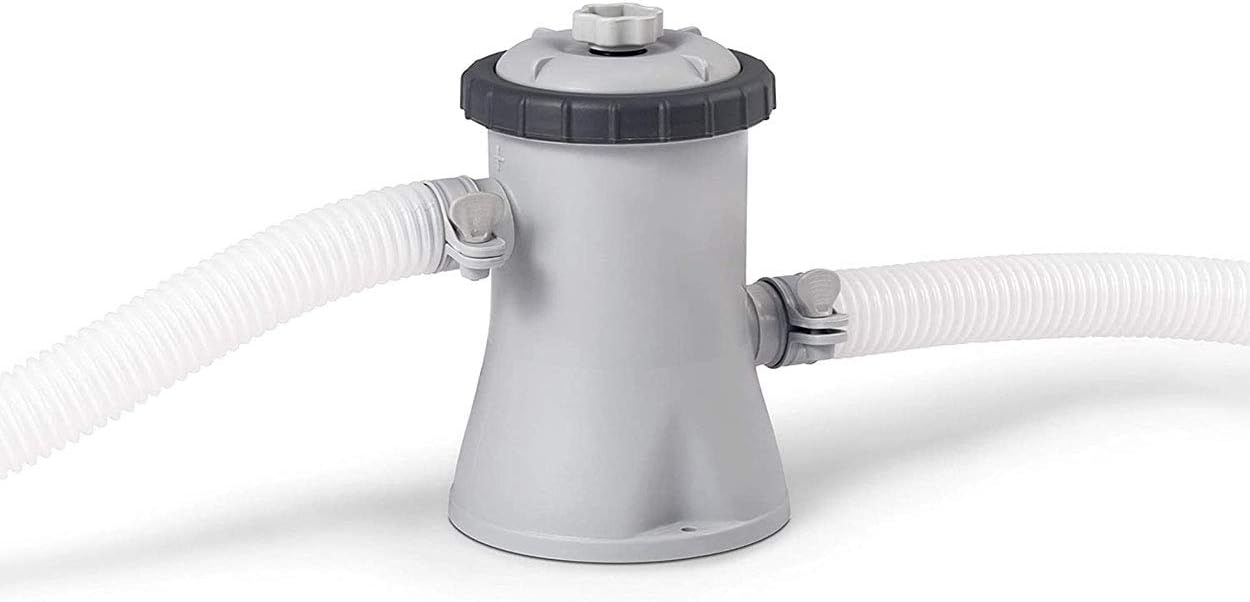
Intex Pool Filter Pump 28602GS C330 1,250 l/h
IntexCompact cartridge filter pump with 1,250 l/h capacity. Energy-efficient entry-level option for small pools up to 10,000 litres. Model 28602GS C330.
- Lowest purchase price
- Energy efficient
- Compact size
- Easy installation
- Cartridges need replacing every 4-6 weeks
- Not suited for pools over 10,000 litres
- Higher seasonal cost than sand filter
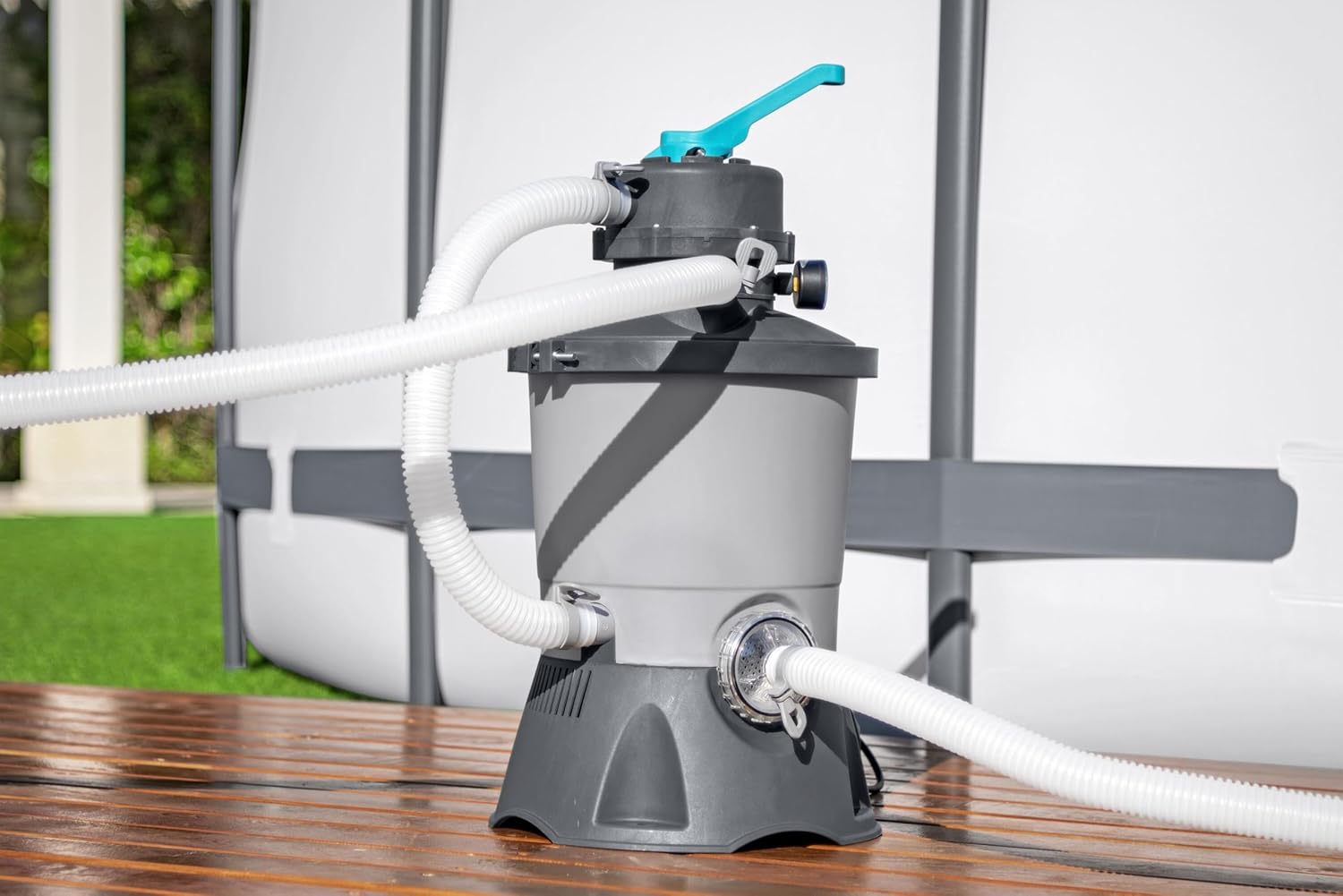
Bestway 58515 Flowclear Cartridge Filter Pump (3,028 l/h)
BestwayCartridge filter pump, 3,028 l/h, with integrated ChemConnect chlorinator. Quiet Flowclear motor. Suitable for Bestway pools; not compatible with Intex fittings.
- Quiet Flowclear motor
- Integrated chlorine dispenser
- 6-way valve
- Solid build quality
- Bestway fittings not compatible with Intex
- Higher purchase price
Glass media as an alternative to sand
Glass media beads as the filter medium in a sand filter significantly improve filtration performance:
- Filters down to 5 to 10 microns (comparable to a cartridge filter)
- Algae and bacteria adhere less readily to glass than to sand
- 20 to 30% less water needed per backwash
- Lifespan 10 or more years (sand wears, glass barely does)
Glass media costs more (EUR 80 to EUR 150 for a full charge) but for serious pool owners it is the recommended upgrade.
For most private pools these are the top picks in their category.
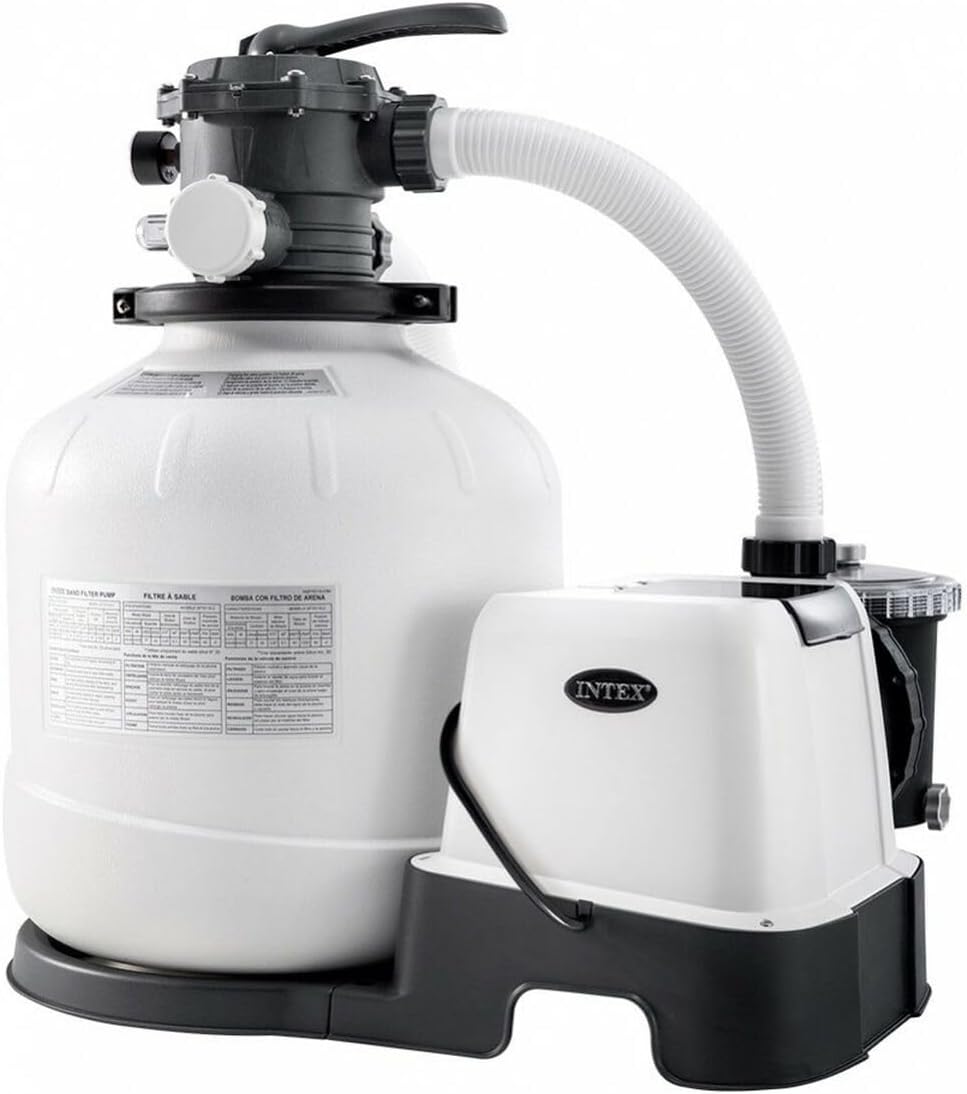
Intex Krystal Clear 26646GS SX2100 Sand Filter Pump 6 m3/h
IntexSand filter pump 6 m3/h (6,000 l/h) with 6-way valve for pools up to 19 m3. Requires 12 kg filter sand. Model 26646GS SX2100.
- Complete kit with 6-way valve
- Sand lasts 3 to 5 years
- Good filtration down to 20 microns
- Widely available Intex spare parts
- Pump is audible during operation
- Larger pools need the 6 m3/h model
Want to upgrade to glass media for better filtration and fewer backwashes?
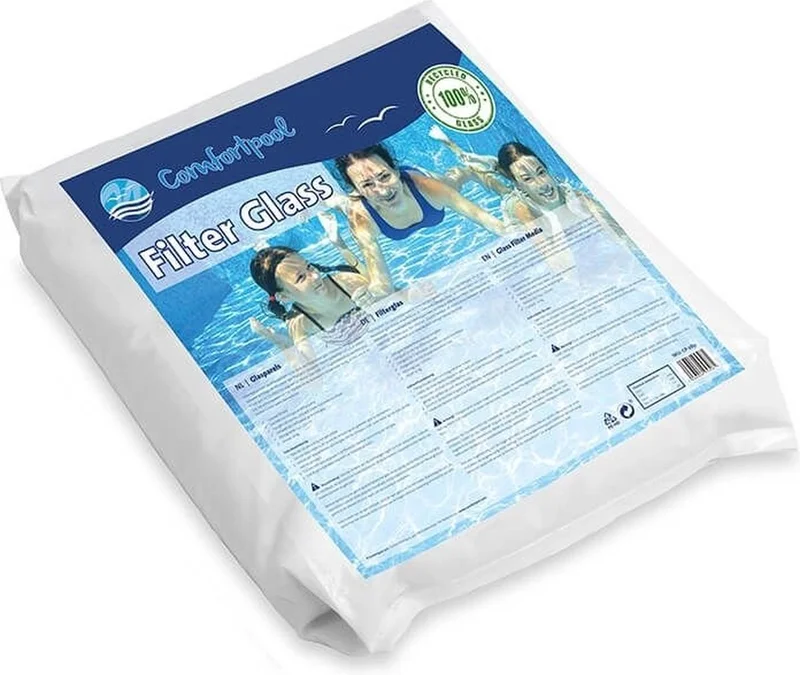
Waterco Micron Filter Glass Media 25 kg
WatercoRecycled glass filter media for sand filters: filters down to 5 microns, 20% lighter than quartz sand and lasts 8 to 10 years.
- Filters 4x finer than quartz sand (5 vs 20 microns)
- 20% lighter weight reduces filter stress
- Longer lifespan: 8 to 10 years
- Higher upfront cost than sand
- No benefit over sand for basic above-ground pools
Full filtration comparison
| Filter type | Filtration (microns) | Maintenance cycle | Water loss | Flocculant compatible |
|---|---|---|---|---|
| Sand filter (quartz) | 20 to 40 | Weekly backwash | 400 to 500 L per backwash | Yes |
| Sand filter (glass media) | 5 to 10 | Weekly backwash | 300 to 400 L per backwash | Yes |
| Cartridge filter | 10 to 20 | Every 2 weeks, manual rinse | None (chemical cleaning) | No |
| DE filter (diatomaceous earth) | 3 to 5 | Monthly backwash + recharging | 200 to 400 L per backwash | No |
A DE filter produces the clearest water of all types. However, diatomaceous earth is classified as a respiratory hazard and must be handled with a dust mask. It remains an uncommon choice for private residential pools.
5-year total cost comparison
Sand filter (quartz sand):
- Sand replacement: EUR 30 to EUR 50 over 5 years
- Backwash water: 400 L x 40 backwashes x 5 seasons = 80,000 litres. At EUR 1.50 per 1,000 litres: EUR 120
- Filter cleaner: 1 bottle per season at EUR 12 = EUR 60
- Total: approximately EUR 210 to EUR 230 over 5 years
Cartridge filter:
- Cartridge replacement: EUR 20 to EUR 60 per cartridge. At 2 to 4 cartridges per season = EUR 40 to EUR 240 per season
- Small pool (10,000 L): 2 cartridges per season = EUR 40 x 5 years = EUR 200
- Medium pool (25,000 L): 4 cartridges per season = EUR 160 x 5 years = EUR 800
- Filter cleaner (degreaser): EUR 10 per season = EUR 50 over 5 years
- Total small pool: approximately EUR 250. Total medium pool: approximately EUR 850
Conclusion: for pools above 15,000 litres a sand filter is structurally cheaper after 2 to 3 seasons.
Pool size and usage as the deciding factor
For above-ground pools up to 15,000 litres, a cartridge filter is practical. Installation is simpler (no multiport valve, no backwash drain needed), the purchase price is lower (EUR 80 to EUR 150), and water consumption is zero.
Above 20,000 litres the cartridge filter quickly becomes labour-intensive. Cartridges fill faster and must be rinsed more often. Each rinse takes 30 to 45 minutes (remove, rinse, soak, rinse again, refit). A backwash takes 5 minutes.
With heavy use (daily swimming, more than 4 bathers) a sand filter handles high load better. Cartridges saturate faster when there is a lot of organic matter in the water.
Environmental considerations
Sand filters use 8,000 litres or more of water per season for backwashing. That water contains the collected debris but is not hazardous for the sewer. In most municipalities, pool backwash water can go to the household drain but not to surface water (ponds, streams).
Cartridge filters use no extra water but require chemical degreaser for deep cleaning. That flows into the drain. Use a biodegradable filter cleaner to reduce environmental impact.
Which filter is best in autumn?
In autumn there is heavy leaf fall and organic debris. A sand filter with backwash is more practical: you clean the filter in 5 minutes, several times a week if needed. A cartridge filter must be manually rinsed and with heavy leaf fall this becomes time-consuming.
If you have a cartridge filter and expect significant leaf fall, add a fine-mesh skimmer basket upstream. This captures more coarse debris before it reaches the cartridge.
The next step after choosing a filter type is matching it to the right pump. Read our guide on choosing a pool filter pump to ensure the pump and filter are properly sized to each other.