Backwash the sand filter when pressure rises 0.5 bar above baseline, or weekly as a preventive measure. Backwashing takes 3 to 5 minutes and uses 200 to 600 litres of water. Always turn the pump OFF before rotating the multiport valve.
Tip
- Pump OFF
- Multiport valve to BACKWASH
- Pump ON, run 3-5 minutes until sight glass is clear
- Pump OFF
- Multiport valve to RINSE
- Pump ON, rinse for 30 seconds
- Pump OFF, multiport valve to FILTER, pump ON
Important: never turn the multiport valve while the pump is running.
Why backwashing is necessary
The sand filter captures dirt, algae and bacteria in the sand bed. As the filter collects more debris, resistance increases and flow rate drops. A severely clogged filter can cause the pump to overheat or be damaged.
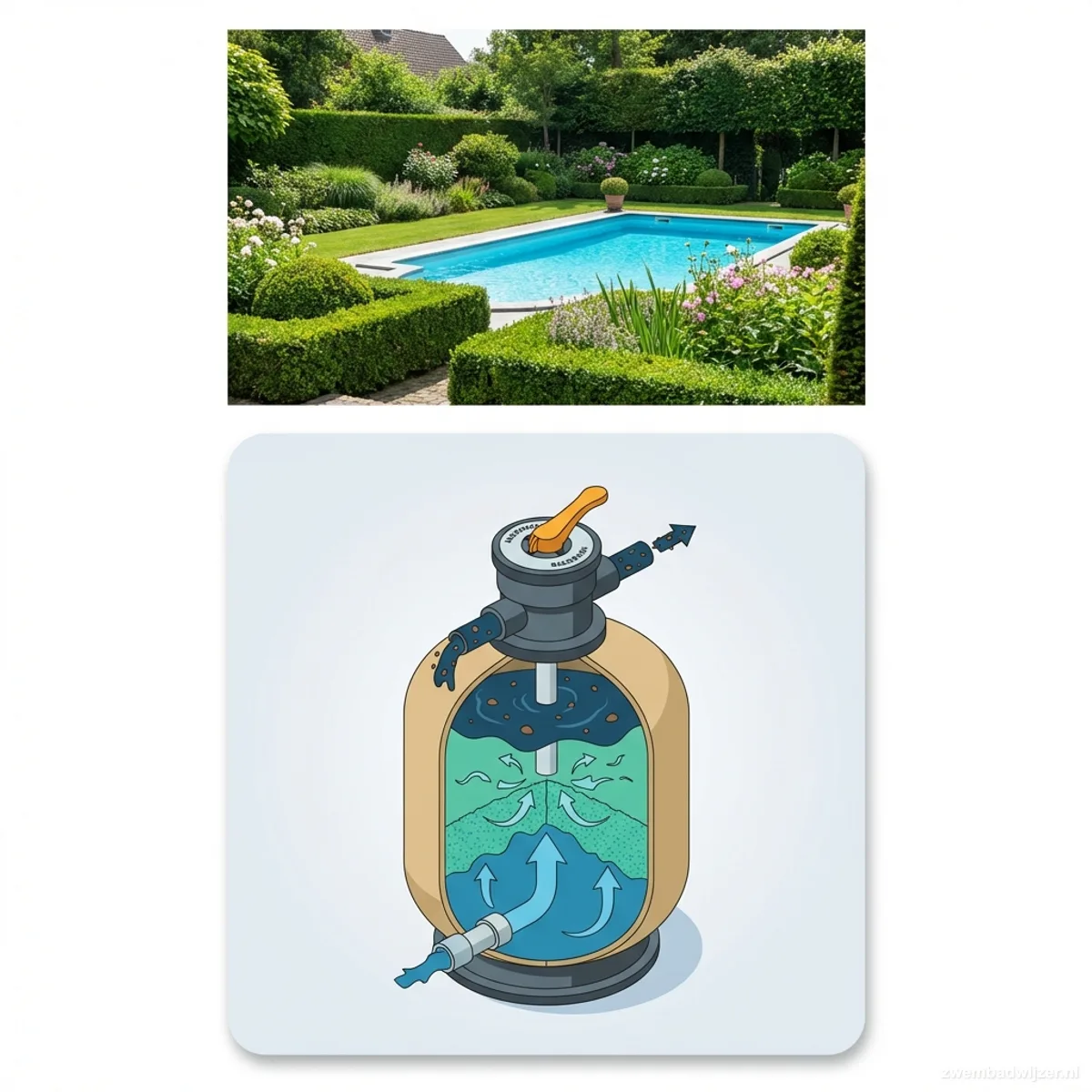
Backwashing cleans the filter by sending water in reverse through the sand: from bottom to top. The debris is carried out through the drain line.
How often should you backwash a sand filter?
Backwash your sand filter every 1 to 2 weeks, or immediately once filter pressure rises 0.5 bar above the reference pressure. In warm weather with heavy use, do it weekly, and during an algae treatment daily until the water clears.
Based on pressure (most accurate): Note the pressure gauge reading immediately after a fresh backwash. This is your reference pressure. Backwash when pressure is 0.5 bar above this baseline.
Based on schedule (simpler): Backwash every 1 to 2 weeks as a preventive measure. During algae treatment, backwash daily.
| Situation | Frequency |
|---|---|
| Normal use | Every 1 to 2 weeks |
| Hot weather, heavy use | Weekly |
| After algae treatment | Daily until water is clear |
| Pressure 0.5 bar above baseline | Backwash immediately |
Step by step backwash
Step 1: Turn pump off
Always turn the pump OFF before touching the multiport valve. Switching under pressure tears the internal O-ring and valve seal.
Step 2: Multiport valve to BACKWASH
Turn the valve handle smoothly to BACKWASH. Never force or yank the handle.
Step 3: Turn pump on
Turn the pump ON. Look at the sight glass (inspection window) on the backwash outlet. The water will initially be cloudy and brownish. Flush until the water in the sight glass runs clear.
Minimum flush time: 3 minutes. Maximum 5 minutes (longer is rarely needed and wastes water).
How long should you backwash?
A backwash takes 3 to 5 minutes: flush until the sight glass runs clear, with 3 minutes as the minimum. More than 5 minutes is almost never needed and just wastes water. If the sight glass never clears, the sand needs replacing.
| Filter size (tank diameter) | Minimum flush | Water use (approx.) |
|---|---|---|
| 350 mm (small) | 3 minutes | 200 litres |
| 500 mm (standard) | 3 to 4 minutes | 300 to 400 litres |
| 650 mm (large) | 4 to 5 minutes | 400 to 600 litres |
Stop criterion: sight glass clear. Cloudy sight glass after 5 minutes = sand replacement needed.
Step 4: Pump OFF
Turn the pump OFF.
Step 5: Multiport valve to RINSE
Turn to RINSE. This is essential: without rinsing, sand can enter the pool through the return jets.
Step 6: Rinse for 30 seconds
Pump ON, rinse for 30 seconds. Pump OFF.
Step 7: Return to FILTER
Multiport valve to FILTER. Pump ON. Done.
Warning
NEVER rotate the multiport valve while the pump is running. This applies to all positions: FILTER, BACKWASH, RINSE, WASTE. The internal rubber seal tears under pressure changes.
Backwash no longer effective: time to replace the sand?
If pressure rises again quickly after backwashing, or the water remains cloudy, the sand may have lost its filtration capacity:
- Clumped sand (calcium deposits): use filter cleaner to break up the sand bed
- Dirty sand: perform a longer backwash (10 minutes) with filter cleaner
- Silted sand (too fine): replace it
Filter sand should be replaced every 3 to 5 years. Quartz sand costs approximately EUR 20 to EUR 50 for a standard fill.
Bayrol Filterclear Sand Filter Cleaner (1 litre)
BayrolLiquid cleaner for sand filters. Dissolves clumped dirt, grease deposits and limescale from the filter bed. Use at the annual filter service.
- Extends sand media lifespan
- Improves filtration capacity after a single treatment
- Easy to add via the skimmer
- Not a substitute for regular backwashing
- Annual application recommended
When replacing filter sand, glass filter media is a better choice than quartz sand: it filters 4 times finer and lasts 8 to 10 years.
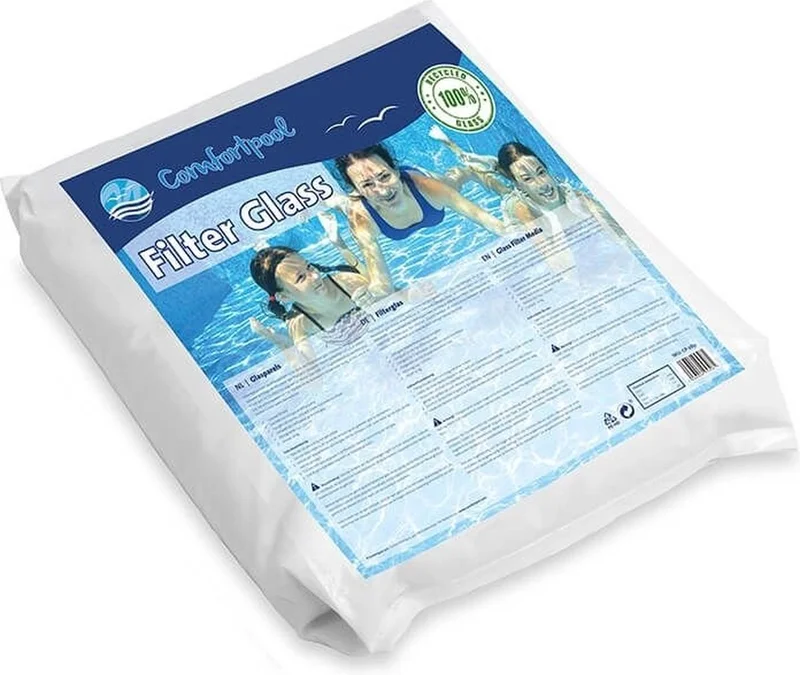
Waterco Micron Filter Glass Media 25 kg
WatercoRecycled glass filter media for sand filters: filters down to 5 microns, 20% lighter than quartz sand and lasts 8 to 10 years.
- Filters 4x finer than quartz sand (5 vs 20 microns)
- 20% lighter weight reduces filter stress
- Longer lifespan: 8 to 10 years
- Higher upfront cost than sand
- No benefit over sand for basic above-ground pools
Multiport valve positions explained
The multiport valve is the central switching hub of your sand filter system. Most residential valves have 6 positions:
FILTER: normal operation. Water enters from the top of the sand bed, flows down through the sand, and returns filtered to the pool via the laterals at the bottom.
BACKWASH: reverses the flow. Water pushes up through the sand from below, lifting and agitating the sand bed, carrying trapped dirt out through the waste pipe to the drain.
RINSE: short forward flush to waste after backwashing. Settles the sand back in place and clears the last of the dirty water before returning to FILTER mode. Always do a 30-second rinse after every backwash.
WASTE: bypasses the sand entirely. Water goes directly from the pump to the drain. Use this when vacuuming heavy algae debris so the contaminated water does not pass through the filter and clog the sand bed in minutes.
RECIRCULATE: bypasses the sand but keeps water circulating. Use for mixing liquid chemicals or for system diagnostics. No filtration occurs in this mode.
CLOSED: shuts all flow. Use only when working on the pump or plumbing with the pump switched off. Never start the pump with the valve in CLOSED position.
Reading the pressure gauge
Record the pressure reading immediately after every fresh backwash. This is your baseline pressure for that filter cycle, typically 0.5 to 1.5 bar for residential systems depending on pump size and pipe runs.
Backwash when pressure is 0.5 bar (about 7 psi) above that baseline. Example: clean baseline is 0.8 bar, so backwash at 1.3 bar.
No pressure gauge? Watch the return jets. Noticeably weaker flow means the filter is probably clogged. Adding a gauge costs EUR 8 to EUR 15 and eliminates guesswork. Fit one between the filter and the return pipe.
Water consumption per backwash cycle
A 3-minute backwash with an 8 m3/h pump: 8 m3/h divided by 60 x 3 minutes = approximately 400 litres per cycle.
Over a 20-week season with weekly backwashing: 20 x 400 litres = 8,000 litres per season. That is roughly equivalent to the evaporation loss of a 30 m3 pool over the same period. Backwash water can be discharged into the household sewer in most Dutch municipalities.
Troubleshooting backwash problems
Sand returning to the pool through the return jets: the lateral arms at the bottom of the filter tank are cracked, or the sand level is too high (it should fill no more than two-thirds of the tank). Inspect the laterals during the next sand replacement.
Pressure rises again within 1 to 2 days of backwashing: the sand bed has channelled. Water is finding paths of least resistance and bypassing most of the sand. Add filter cleaner (degreaser/decalcifier) via the skimmer, leave for 8 hours, then perform an extended backwash of 10 minutes. If this recurs, replace the sand.
Multiport valve leaks between positions: the spider gasket inside the valve body is worn. Replacement kits are available for most brands (Intex, Bestway, Hayward, Astralpool) for EUR 10 to EUR 25. Remove the valve bonnet, swap the gasket, apply O-ring grease, reassemble.
How often to backwash and when to replace sand
Backwash weekly in peak season (June to August), every two weeks in shoulder season. After an algae treatment, backwash daily until the water is clear.
Replace filter sand every 3 to 5 years. Replacement signs: water stays cloudy even with correct chemistry, pressure returns to clogged level within 1 to 2 days of a fresh backwash. Use quartz sand graded 0.4 to 0.8 mm. Typical quantities: 25 kg for a 400 mm tank, 50 kg for a 500 mm tank.
Related maintenance
A well-maintained sand filter is just one part of clear pool water. You also need the correct chlorine levels and pH balance . Include your sand filter in your weekly maintenance schedule and keep your filter pump in good shape. Not sure if a sand filter is the best filter type for your setup? Read our sand filter vs. cartridge filter comparison .