Shocking a pool means raising the free chlorine level to 10 mg/l or higher for a sustained period. At that concentration, chlorine destroys chloramines (combined chlorine compounds that cause the familiar strong chemical smell), kills algae and eliminates bacteria that routine maintenance levels cannot handle. Every pool needs shocking regularly - not just when something goes wrong, but as a preventive measure throughout the swimming season.
This guide explains when to shock, which type of shock product to use, how to calculate the correct dose and how to carry out the treatment correctly from start to finish.
When to shock your pool
Shock treatment is needed in more situations than most pool owners realise. Use this checklist to identify when your pool requires it.
- After heavy use. A pool party or a long swim session introduces a high load of body oils, sunscreen, urine and organic material. These compounds consume chlorine rapidly and generate chloramines. Shock the pool that evening or the following morning.
- After heavy rain. Rain dilutes and destabilises pool chemistry, often dropping pH and chlorine simultaneously. Rain also introduces organic material, algae spores and bacteria. Test and shock after any significant rainfall.
- When water turns cloudy or green. Cloudiness combined with a greenish tint indicates algae are establishing. This requires an immediate shock treatment, not a routine top-up.
- At the start of the season. Opening a pool after winter always calls for a full shock, even if the cover kept the water relatively clean. Stagnant water develops biofilm and bacteria during the closed period.
- When combined chlorine exceeds 0.5 mg/l. If the difference between total chlorine and free chlorine is more than 0.5 mg/l, you have a significant chloramine load that needs to be broken with shock treatment.
- As a weekly preventive measure in midsummer. In warm weather with heavy use, a weekly preventive shock keeps chloramine build-up under control and reduces the risk of algae outbreaks.
Types of pool shock
Different shock products have different strengths, stabiliser content and dissolve speeds. Choosing the right one for the situation matters.
Calcium hypochlorite (cal-hypo)
Cal-hypo is the most widely used shock product for residential pools. It contains 65 to 78% available chlorine, is unstabilised (no CYA) and dissolves in 30 to 60 minutes. Because it does not add CYA, it will not contribute to CYA build-up over the season. This makes it the best choice for regular shock treatment in pools that are already correctly stabilised.
Cal-hypo raises pH slightly, so check and correct pH before and after treating.
Dichlor granules
Dichlor (sodium dichloroisocyanurate) contains approximately 56 to 62% available chlorine and includes CYA as a stabiliser. It dissolves very quickly and can be added directly to the pool without pre-dissolving. Because it contains CYA, it raises the stabiliser level with each dose. This makes dichlor useful as a maintenance dose and for occasional shocks early in the season, but it is not ideal for heavy repeated shocking if CYA is already near the upper limit.
Non-chlorine shock (potassium monopersulphate)
Non-chlorine shock (MPS) oxidises organic compounds and breaks down chloramines without adding chlorine. It is the right choice for clearing chloramines quickly while maintaining safe swimming chlorine levels - for example, before an event when you need to treat the water without a long wait time. MPS does not sanitise on its own: it must be used alongside an active chlorine residual, not instead of it. The wait time before swimming is typically 15 to 30 minutes.
Shock product comparison
| Type | Available chlorine | Stabiliser (CYA) | Best use | Wait before swimming |
|---|---|---|---|---|
| Calcium hypochlorite | 65 to 78% | None | Standard and heavy shocking | 8 to 24 hours |
| Dichlor granules | 56 to 62% | Yes | Maintenance shock, season opening | 8 to 24 hours |
| Non-chlorine shock (MPS) | 0% (oxidiser) | None | Chloramine removal, pre-event | 15 to 30 minutes |
How to shock a pool - step by step
Carry out these steps in order. Skipping the pH correction step is the most common mistake: at pH 7.8 or above, chlorine loses over half its effectiveness, so even a correct dose will underperform in high-pH water.
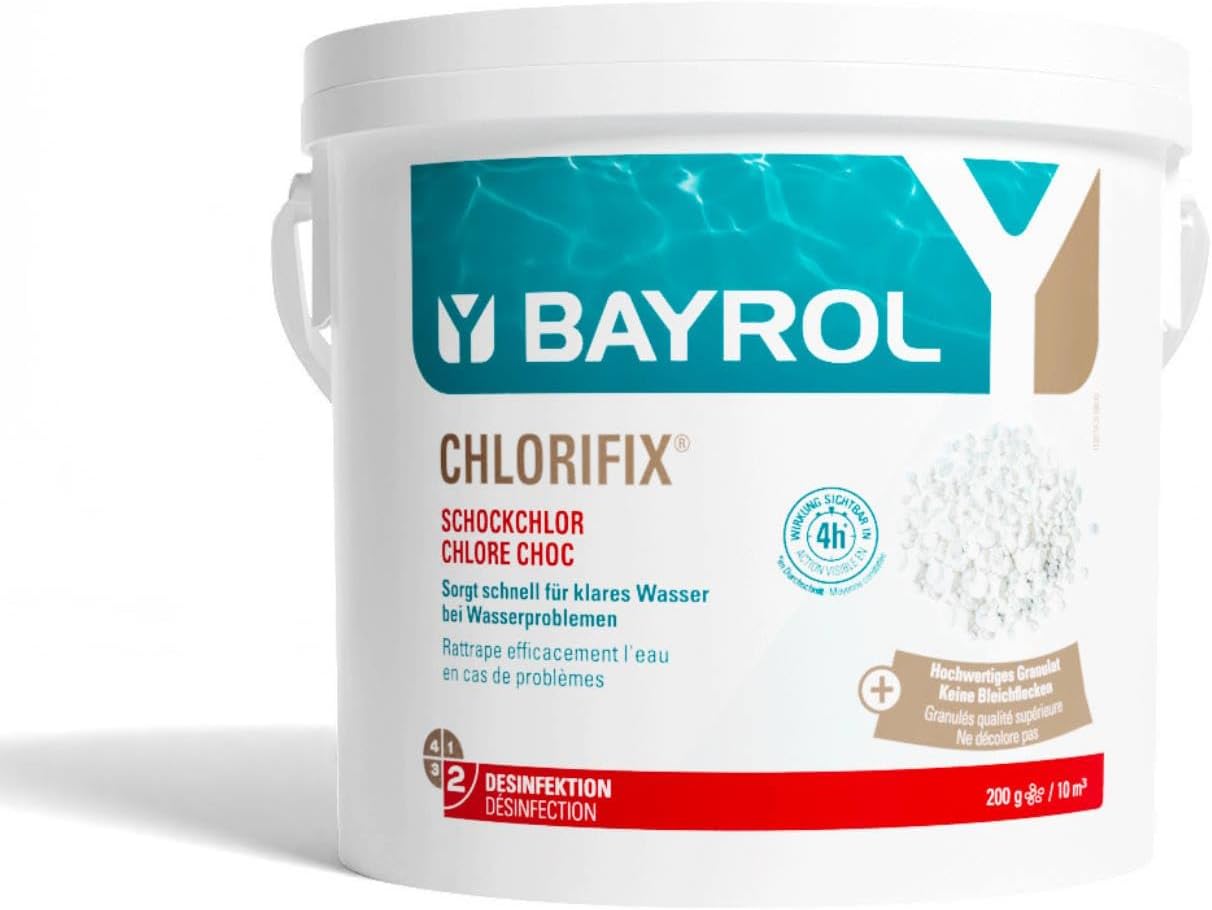
Bayrol Chlorifix Shock Chlorine Granules
BayrolFast-dissolving Bayrol Chlorifix shock chlorine granules (calcium hypochlorite 60%). Lime-free, pH-neutral and dissolves without residue. Ideal for shock treatment at pool opening, after heavy use or for green water.
- Lime-free and pH-neutral
- Dissolves completely without residue
- Fast action within 4 hours
- Premium Bayrol quality
- Always dissolve in a bucket of water before adding to pool
- Wear gloves and goggles during use
Bayrol Chloriklar Shock Chlorine Granules (1 kg)
BayrolFast-dissolving shock chlorine granules for the spring startup treatment. Dissolves completely without residues and destroys bacteria and algae spores left over from winter.
- Works within 24 hours
- Dissolves completely, no residues
- Effective against bacteria and algae spores
- Ideal first treatment at opening
- Raises pH slightly, check pH after treatment
- Wait 24 hours before swimming
Step 1: Test the water. Measure free chlorine, total chlorine (to calculate combined chlorine), pH and total alkalinity. You need these figures to calculate the correct shock dose and to make sure pH is in range before treating. For accurate readings, use a digital tester or liquid test kit rather than test strips for this initial baseline.
Step 2: Correct pH to 7.2 to 7.4. The ideal pH for shock treatment is 7.2 to 7.4, slightly lower than the normal swimming range of 7.2 to 7.6. At lower pH, chlorine is more active and the treatment is more effective. Add pH minus if needed and wait 30 minutes with the pump running before proceeding.
Step 3: Calculate the dose. For a normal shock with cal-hypo (65%): use 150 to 200g per 10,000 litres of pool water. For a green pool or severe algae: use 300 to 400g per 10,000 litres. For a very heavily affected pool: go up to 500g per 10,000 litres.
Step 4: Pre-dissolve the shock product. Fill a clean plastic bucket with pool water (never tap water, which may contain minerals that react with the shock). Add the measured shock granules to the water - always add shock to water, never water to shock, to prevent a vigorous exothermic reaction. Stir until fully dissolved.
Step 5: Add in the evening. Wait until the sun is low or down. UV radiation destroys unstabilised chlorine rapidly. Adding shock in the evening gives the product 8 or more hours to work before sunlight exposure.
Step 6: Pour slowly around the pool edges. Walk slowly around the perimeter of the pool, pouring the dissolved shock solution in a steady stream close to the water surface. This distributes the product evenly rather than creating a concentrated spot.
Step 7: Run the filter for at least 8 hours. Run the pump and filter continuously overnight. This circulates the shock through the entire pool volume and gives the filter a chance to remove dead algae, debris and the byproducts of the oxidation process.
Step 8: Test the next morning. Before allowing anyone to swim, test free chlorine. If the level is 3 mg/l or below, it is safe to swim. If chlorine is still above 5 mg/l, run the pump for another few hours and test again.
Tip
Pre-dissolve one shock product at a time, in a separate bucket, before adding to the pool. Never mix calcium hypochlorite with dichlor, algaecide or any other pool chemical in the same container. Mixing can cause a violent reaction, generating heat, toxic chlorine gas or fire. Use separate buckets for each product and add them to the pool at different times.
Green pool shock treatment
A green pool with visible algae requires a more aggressive approach than a preventive shock. Algae cells protect themselves by forming colonies on surfaces, so you need both a high chemical dose and physical disruption.
Brush first. Before adding any shock, thoroughly brush the walls, floor, steps and corners with a stiff pool brush. This breaks up algae colonies and exposes them to the chemical treatment. Without brushing, shock can kill surface algae while leaving live algae underneath, and recovery is slower.
Use a triple or quadruple dose. For visibly green water, use 300 to 600g of cal-hypo per 10,000 litres depending on severity. Severely green pools sometimes need even higher doses. It is better to over-treat than under-treat: insufficient shock will kill some algae but leave enough survivors to re-establish quickly.
Check the filter after 24 hours. Dead algae will clog the filter rapidly. Check the pressure gauge after 24 hours and backwash the sand filter or clean the cartridge if pressure has risen. A blocked filter at this stage will prevent the water from clearing.
Repeat if needed. If the water has not begun to clear visibly within 48 hours, test free chlorine. If chlorine has dropped to near zero, the algae load was too high for the first dose and a second treatment is needed. Continue brushing, maintain a shock-level chlorine concentration and backwash the filter daily until the water clears.
Tip
Once the water is clear, add a preventive algaecide dose to prevent regrowth. Do not add algaecide during the heavy shock phase: the high chlorine will simply destroy the algaecide before it can do anything useful. Add it after free chlorine has dropped back to the 1 to 3 mg/l range.
How long after shocking can you swim?
The single rule is to test before swimming. Do not rely on elapsed time alone.
For a normal shock dose with cal-hypo, free chlorine typically drops to swimming-safe levels (3 mg/l or below) within 8 to 24 hours, assuming the pump runs overnight and the pool is in sunlight the following morning (which helps burn off residual chlorine).
For a heavy algae treatment with a triple or quadruple dose, allow 24 to 48 hours and test before swimming. Heavy shock doses take longer to dissipate, particularly if the weather is cool or cloudy.
For non-chlorine shock (MPS), the wait is only 15 to 30 minutes.
| Shock treatment | Dose level | How long before swimming |
|---|---|---|
| Standard shock | 10 mg/l | 8-24 hours |
| Green pool | 20-30 mg/l | 24-48 hours |
| Non-chlorine shock (MPS) | oxidiser | 15-30 minutes |
Always test with a reliable kit, not a smell test. High chloramines can make a pool smell chemical even when free chlorine is within the safe range, while free chlorine can be dangerously high without producing an obvious odour.
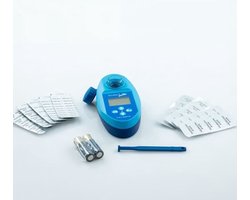
Lovibond Scuba II Digital Chlorine Tester
LovibondDigital photometer tester for free chlorine, combined chlorine and pH. More accurate than test strips for daily water quality monitoring.
- Accurate to 0.01 mg/l
- Measures free and combined chlorine
- Reusable, low cost per test
- Reagent tablets are consumables
- Higher upfront cost than test strips
How much pool shock per m3?
For a standard shock, use roughly 15g of calcium hypochlorite (65%) per m3 of water (target 10 mg/l). For a green pool, double that to 30g per m3, and for a severe outbreak go up to 46g per m3. Always pre-dissolve the granules in a bucket of pool water before adding.
Dosage table for calcium hypochlorite (65%) by pool volume:
| Pool volume | Standard shock (10 mg/l) | Green water (20 mg/l) | Severe outbreak (30 mg/l) |
|---|---|---|---|
| 10 m3 (10,000 L) | 154 g | 308 g | 462 g |
| 20 m3 (20,000 L) | 308 g | 616 g | 923 g |
| 30 m3 (30,000 L) | 462 g | 923 g | 1,385 g |
| 50 m3 (50,000 L) | 770 g | 1,540 g | 2,308 g |
Use these figures as a starting point. Test after 12 hours and repeat if the target level has not been reached.
How much pool shock for your pool size?
If you have an Intex or Bestway pool, you know the dimensions but not the volume. This table converts the common sizes straight into grams of calcium hypochlorite (65%):
| Pool (size) | Volume (approx.) | Standard shock (10 mg/l) | Green water (20 mg/l) |
|---|---|---|---|
| 300 x 200 x 75 cm | 3,400 litres | 50 g | 105 g |
| Intex round 305 x 76 cm | 3,600 litres | 55 g | 110 g |
| Intex round 366 x 76 cm | 5,400 litres | 85 g | 165 g |
| 450 x 220 x 84 cm | 5,700 litres | 90 g | 175 g |
| 400 x 200 x 100 cm | 7,000 litres | 110 g | 215 g |
| Intex round 457 x 122 cm | 16,800 litres | 260 g | 515 g |
For small above-ground pools, weigh one thing first: in a pool up to roughly 5,000 litres, partially refreshing the water is often cheaper and faster than shocking. A 50g shock costs you half a day of waiting; 2,000 litres of fresh water is ready immediately. Shock only when the pool is too large to refresh economically, or when you have a stubborn algae outbreak.
Sodium hypochlorite vs calcium hypochlorite for pool shock
Two products account for most residential shock treatments. The choice depends on what is available and the severity of the problem.
Sodium hypochlorite (liquid chlorine) Sodium hypochlorite is liquid bleach with a chlorine concentration of 10 to 15%. It dissolves instantly and contains no CYA. The downside is the lower concentration: a 20 m3 pool needs approximately 1.7 litres at 12% sodium hypochlorite to reach 10 mg/l. Liquid chlorine also degrades faster than granules, particularly in heat and light.
Dosage formula: pool volume (L) × target (mg/l) / (concentration as decimal × 1,000) = litres needed.
Calcium hypochlorite (granules) Cal-hypo at 65 to 70% available chlorine is the more efficient choice for shock treatment. It is more concentrated, stores better and is cheaper per unit of active chlorine. Always pre-dissolve in a bucket of pool water before adding to the pool.
Cal-hypo raises pH and calcium hardness slightly. If your pool already has high calcium hardness (above 300 mg/l), sodium hypochlorite is a better option.
| Property | Sodium hypochlorite | Calcium hypochlorite |
|---|---|---|
| Form | Liquid | Granules |
| Available chlorine | 10-15% | 65-70% |
| CYA (stabiliser) | None | None |
| pH effect | Raises slightly | Raises slightly |
| Calcium effect | None | Raises calcium |
| Best for | Emergency use | Standard shock treatment |
Compare pool shock products
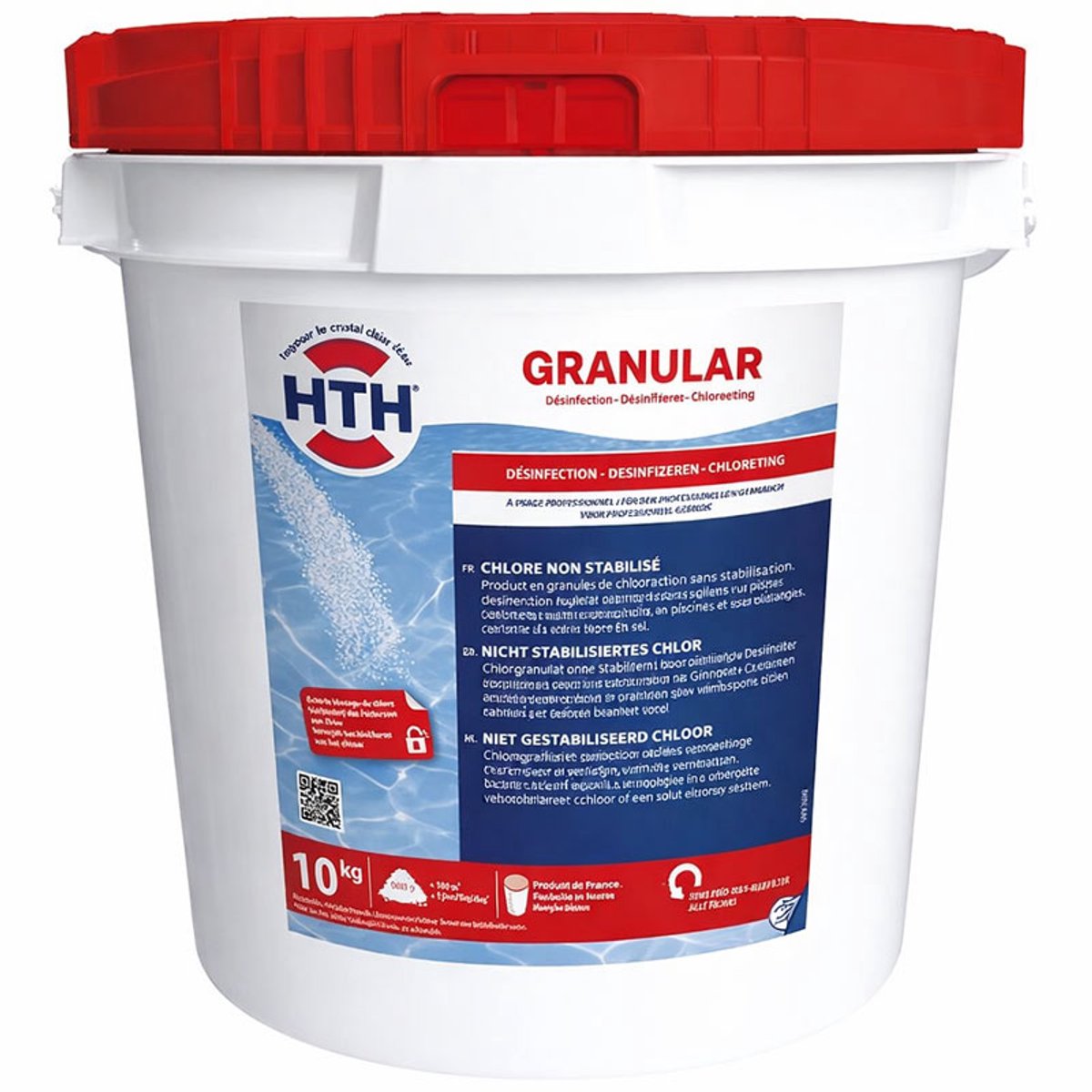
Bayrol Chloriklar Shock Chlorine Granules (1 kg)
Fastest way to get your pool swim-ready after winter
~€15.99
When pool shock does not work
If two shock treatments have not cleared the water, there is an underlying cause. The most common:
pH above 7.6 . At high pH, chlorine loses more than half its effectiveness. Always correct pH to 7.2 before shocking. This single step causes more failed shock treatments than any other factor.
Cyanuric acid (CYA) above 80 mg/l. CYA locks chlorine into an inactive form at high concentrations. Test CYA with a dedicated kit. If it exceeds 80 mg/l, dilute the pool water by partial draining (20 to 30%) before retreating. All those trichlor tablets add approximately 6g of CYA per 10,000 litres per tablet.
High phosphate levels. Phosphates feed algae growth. At very high phosphate levels, new algae can grow faster than the shock kills them. Use a phosphate remover before the next shock treatment.
Insufficient dosage. Most failed shocks are simply under-dosed. For a severe algae outbreak, you may need 500g or more of cal-hypo per 10,000 litres. It is better to over-treat than under-treat.
Inadequate filtration. Dead algae clog the filter quickly. If the pump is not running 24 hours and the filter is not backwashed daily, dead algae accumulate and the water stays murky even after the shock has worked.