Test your above-ground pool water at least 3 times per week, keep free chlorine between 1.0 and 3.0 ppm, and maintain pH between 7.2 and 7.6. Run the filter pump a minimum of 8 hours per day. These three rules keep an Intex or Bestway pool clear for the entire season.
Above-ground pool maintenance: the weekly routine
Above-ground pools demand more frequent water care than in-ground pools of comparable size. The water volume is smaller, circulation is less powerful, and water temperature rises faster in warm weather, which accelerates algae growth. A 366 cm Intex pool holding 5,600 liters goes out of balance faster than a 50,000-liter in-ground pool.
Make these steps a weekly habit:
- Test the water (3x per week): measure free chlorine and pH at the same time
- Adjust chlorine: add tablets through a floating dispenser when levels fall below 1.0 ppm
- Correct pH: add pH decreaser or pH increaser if the reading falls outside 7.2-7.6
- Check the pump: confirm the pump is running and water flow is unobstructed
- Clean the floor: use a manual vacuum or pool brush to remove sediment from the bottom
- Wipe the waterline: run a soft cloth along the liner at the waterline to remove sunscreen residue
At sustained temperatures above 25°C, increase testing to daily. Warm water consumes chlorine at twice the rate of cooler water: at 28°C, free chlorine degrades up to twice as fast as it does at 20°C.
How do you keep above-ground pool water clear?
Clear water comes from three factors working together: filtration, disinfection, and water balance. When any one of these fails, cloudy water or algae growth follows.
Filtration removes particles — algae spores, insects, sunscreen residue — from the water. Without a working filter pump running 8 hours per day, particulate matter accumulates. A 1,250 l/h cartridge pump on a 244 cm pool (1,700 liters) cycles the full water volume more than 7 times per day, which is sufficient for that size.
Disinfection via chlorine kills bacteria and algae. Free chlorine must always stay above 1.0 ppm. At chlorine levels below 0.5 ppm, waterborne illness risk rises and green algae quickly colonizes walls and floor.
Water balance centers on pH. At pH 7.8, only 33% of the chlorine present is active as a disinfectant. At pH 7.2, that rises to 63%. Keeping pH stable between 7.2 and 7.6 maximizes the chlorine you are already adding.
For a deeper look at the relationship between pH and chlorine, see our article on pH and chlorine in pool water .
Chlorine dosing in an above-ground pool: how much and how often?
Which chlorine products work best?
For routine maintenance, slow-dissolving 200g chlorine tablets (trichloro-s-triazinetrione, 90% active chlorine) are the most practical option. Float them in a dispenser; never place them directly in the skimmer basket. One 200g tablet lasts 5 to 7 days in a 5,000-liter pool under normal use.
For rapid correction or shock treatment, use chlorine granules or calcium hypochlorite. Shock treatment is needed when:
- Water turns cloudy or green
- After a storm or heavy rainfall
- After a party with many swimmers
- At the start of the season when you first fill the pool
Dosage by water volume
| Water volume | Shock dose (granules) | Weekly maintenance |
|---|---|---|
| 1,000 liters | 10g granules | 1/4 of a 200g tablet |
| 3,000 liters | 30g granules | 1/2 to 1 tablet |
| 5,000 liters | 50g granules | 1 to 2 tablets |
| 10,000 liters | 100g granules | 2 to 3 tablets |
Add chlorine in the evening or on overcast days. UV radiation degrades unstabilized free chlorine rapidly: on a sunny day, a pool without a UV stabilizer can lose up to 90% of its free chlorine within 2 hours. Use tablets with a built-in UV stabilizer (cyanuric acid) for any outdoor pool.
Setting the pH in a small pool
pH too high (above 7.6)
Add pH decreaser (sodium bisulfate). For a 5,000-liter pool, 50g lowers pH by approximately 0.2 points. Dissolve the product in a bucket of water before adding it to the pool, and keep the pump running after treatment.
pH too low (below 7.2)
Add pH increaser (sodium carbonate or sodium bicarbonate). The same 50g per 5,000 liters raises pH by 0.1 to 0.2 points depending on the water’s alkalinity.
Wait 4 hours with the pump running before re-testing after any correction. Small adjustments prevent overcorrection and minimize pH swings. In warm, sunny weather, an above-ground pool pH can shift by 0.5 units in a single day.
Filter pump setup and cleaning
How long should the pump run?
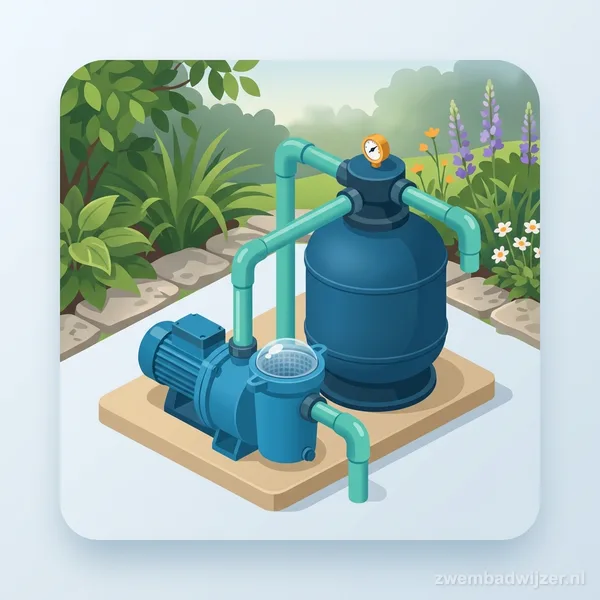
Run the filter pump at least 8 hours per day. Schedule it during the hottest hours, roughly 10:00 to 18:00, when water temperature peaks and algae grow fastest. A timer plug saves electricity and ensures consistent filtration without manual switching.
For a 366 cm Intex Power Steel (5,600 liters) with the included 2,006 l/h sand filter pump, one complete water circulation takes 2.8 hours. Running 8 hours daily means almost 3 full cycles, which is adequate for this pool size.
Cleaning a cartridge filter
Rinse the filter cartridge every 1 to 2 weeks with a garden hose. Do not unwind the filter pleats; rinse from the outside under moderate jet pressure. Replace the cartridge if it remains discolored or damaged after rinsing, or after 4 to 6 weeks of use. A worn cartridge filters less effectively than a clean one and can restrict pump flow, shortening pump life.
Backwashing a sand filter
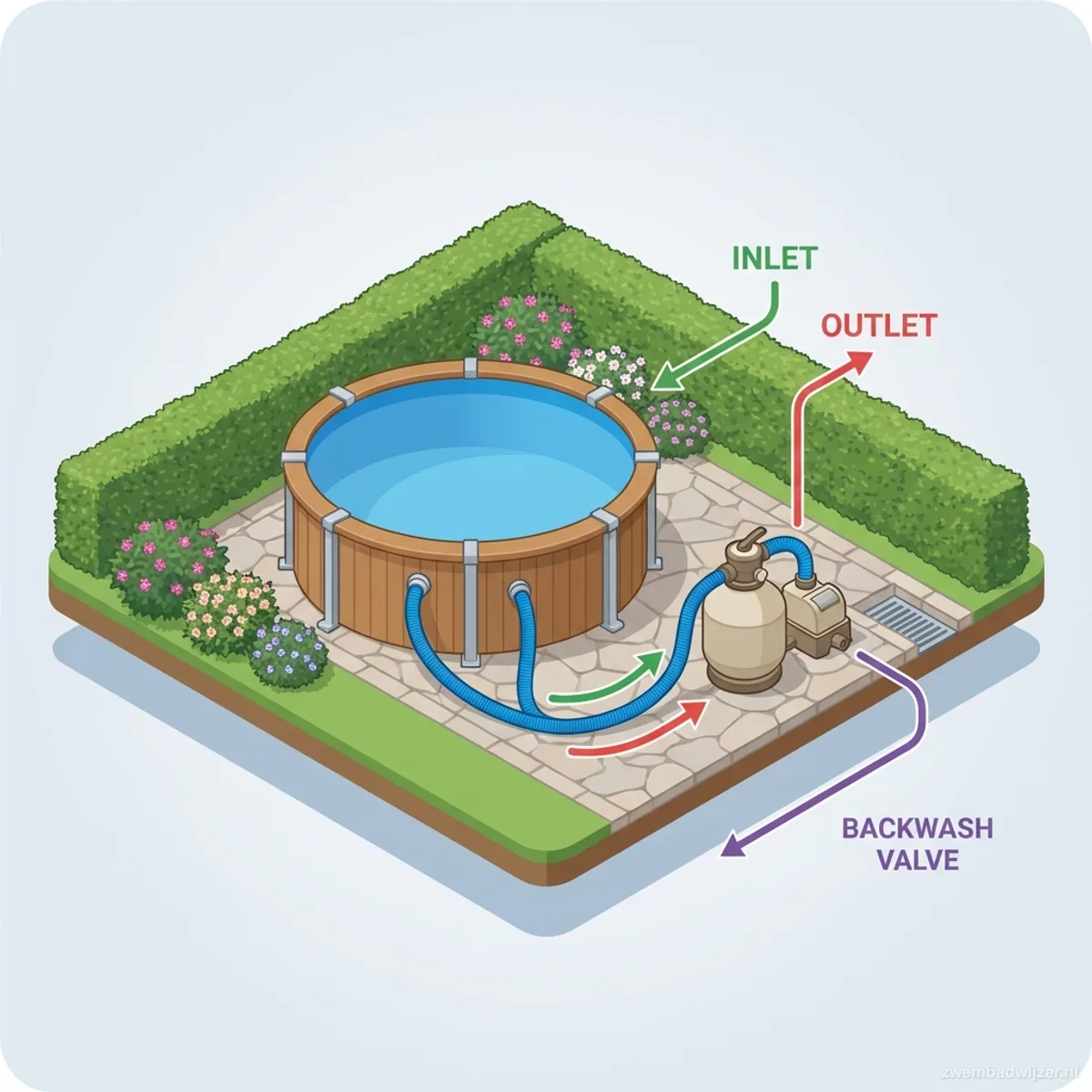
Switch the pump off, turn the multiport valve to the backwash position, and run the pump for 2 to 3 minutes until the discharge water runs clear. Switch to the rinse position for 30 seconds, then return the valve to filter. This flushes trapped debris out of the filter media.
Backwash every 1 to 2 weeks, or sooner if you notice a significant drop in flow rate from the return jets.
Cleaning the pool: floor, walls, and waterline
Floor
Use a manual above-ground pool vacuum or a compact automatic floor cleaner rated for soft-sided pools. The flexible PVC floor of an above-ground pool cannot withstand the suction force of industrial vacuum equipment. Most Intex vacuum heads operate on the water pressure of the filter pump or run on batteries.
Vacuum the floor every 3 to 5 days under normal use. Sediment on the floor feeds algae: leaving it in place accelerates algae growth significantly, especially in warm weather.
Walls and liner
Brush the walls and floor edges weekly with a soft nylon brush. Do not use abrasive pads or stiff bristle brushes — these scratch and weaken the PVC liner. Green patches on the walls signal early algae growth; treat immediately with a shock dose of chlorine.
Waterline
The waterline, the section of liner at the water surface, collects sunscreen residue, algae spores, and limescale. Wipe it weekly with a soft cloth and a mild pool surface cleaner. Prevent scale buildup by keeping pH below 7.8 and total hardness below 400 ppm.
Winterizing or storing an above-ground pool
When to drain?
Drain the pool once you stop using it for the season, typically when water temperature drops consistently below 15°C. Never leave an above-ground pool full over winter: freezing water can tear the liner and crack the pump housing.
Step-by-step storage
- Optionally add a winterizing dose of algicide to the water before draining to prevent scale deposits
- Drain the pool via the drain valve or a submersible pump
- Allow the liner to dry completely before folding
- Remove the filter pump, flush it with clean water, and store it frost-free
- Fold the liner loosely — do not roll it tightly in cold temperatures, as PVC becomes brittle below 0°C
- Store the pump, hoses, and accessories dry at room temperature
For model-specific recommendations on Intex and Bestway sets, including which pump is bundled with each size, see our comparison guide on Intex vs Bestway above-ground pools .
Frequently asked questions
How often should you test the water in an above-ground pool?
Test the water at least 3 times per week during normal use. After heavy rain, a large number of swimmers, or sustained temperatures above 25°C, test daily. Always measure both free chlorine and pH at the same time, as each affects the other.
How much chlorine does an above-ground pool need?
Keep free chlorine between 1.0 and 3.0 ppm (mg/l). At pH above 7.6, chlorine loses effectiveness rapidly. Always add chlorine while the pump is running and distribute tablets through a floating dispenser, never directly into the skimmer basket.
How do you keep a small above-ground pool clear without a lot of work?
Three things determine clear water: a working filter pump running at least 8 hours per day, a stable chlorine level of 1-3 ppm, and pH between 7.2 and 7.6. Shock the water weekly if it starts looking cloudy and rinse the filter cartridge every two weeks.
Do you need to winterize an above-ground pool?
If you are storing the pool for winter, drain it completely, clean the liner and pump, and store everything dry. Never leave water in the pump or hoses: freezing water can crack the pump housing and damage fittings. Store an inflatable pool rolled loosely at room temperature.
What is the difference between chlorine tablets and liquid chlorine for an above-ground pool?
Slow-dissolving chlorine tablets are ideal for day-to-day maintenance via a floating dispenser. Liquid chlorine or granular shock works faster and is better for shock treatments. Never mix the two types at the same time, as this can cause a dangerous reaction.