A clean pool does not have to take more than an hour a week. With the right sequence and the right tools, you can keep the water clear and prevent expensive problems before they start. The key is consistency: a few minutes each day and a proper weekly routine beats occasional deep cleans every time.
This guide walks you through the exact 7-step process, tells you what equipment you need, and shows you a realistic time schedule that works for most residential pools.
What you need to clean a pool
Before you start, make sure you have the right kit. Trying to vacuum without a proper head, or test water without a reliable tester, costs you time and often money in the long run.
| Tool | Purpose | Frequency |
|---|---|---|
| Leaf skimmer net | Remove surface debris | Daily |
| Pool vacuum / robot | Remove sediment from the floor | Weekly |
| Pool brush | Remove algae and deposits from walls | Weekly |
| Waterline sponge | Remove grease and calcium at the waterline | Weekly |
| Test strips or digital tester | Measure pH and chlorine | 2 to 3 times per week |
| pH minus or pH plus | Correct pH | As needed |
| Chlorine tablets or granules | Disinfection | Weekly |
You do not need to buy premium versions of everything at once. A reliable test kit and a good skimmer net are the most important starting points. Upgrade to a robot vacuum later once you know your pool’s routine demands.
Pool vs. small frame pool: what is different?
Not every pool requires the same approach. The main differences are filter capacity, water volume and materials.
Inground pool (fibreglass, concrete, liner):
- Continuous pump and skimmer system
- Volume: 20,000 to 60,000 litres
- Standard wall brush and vacuum via skimmer connection
- Weekly vacuuming, daily skimming
Above-ground frame pool (steel frame, round or oval):
- Smaller filter pump (800 to 3,000 litres per hour)
- Volume: 3,000 to 15,000 litres
- Smaller brush, hand vacuum or small automatic cleaner
- Weekly cleaning, more often in hot weather
Small inflatable or paddling pool:
- No pump or small cartridge filter only
- Volume: 200 to 2,000 litres
- Weekly water replacement is often simpler than chemical management
- A small dedicated vacuum helps for larger inflatables
The key difference: a small paddling pool without a filter pump gives you very little control over water quality. In hot weather and with heavy use, a weekly water change is often easier than trying to maintain stable chemistry. For larger frame pools above 5,000 litres, a proper filter pump is well worth the investment.
How to clean your pool in 7 steps
Step 1: Skim the surface
Skimming is a daily task that takes just 3 to 5 minutes and makes a significant difference. Leaves, insects, pollen and dust all land on the surface before they have a chance to sink and decompose on the floor. Once debris sinks, it requires more effort to remove and it can begin to affect water chemistry.
Use a flat leaf skimmer net on a telescopic pole. Work across the surface in smooth, slow passes to catch debris rather than push it away. Focus on the downwind end of the pool where debris tends to accumulate. Empty the net into a bin or compost after each pass.
Skimming is the single most time-efficient task in pool maintenance. Those 5 minutes each morning prevent 20 minutes of vacuuming later in the week.
Step 2: Empty the skimmer basket
The skimmer is your pool’s first line of mechanical defence. Water is drawn continuously through the skimmer opening, and debris collects in the basket before reaching the pump. A blocked basket restricts water flow, reduces filtration efficiency and makes the pump work harder, which increases energy costs and wear.
Check and empty the skimmer basket daily, or every other day at minimum. It takes under 2 minutes. Simply lift the lid, remove the basket, shake out the debris and rinse it with a garden hose if needed. While you are there, check the water level: the skimmer works best when the waterline sits in the middle of the skimmer opening. Top up if necessary.
Step 3: Vacuum the pool floor
Fine sediment, algae spores and particles too small to skim all settle on the floor. Vacuuming removes this layer before it decomposes and causes chemistry problems.
You have two options: a manual vacuum head connected to the filter pump via a vacuum hose and telescopic pole, or an automatic pool robot. The manual method is slower but gives you precise control, which is useful after algae treatment or when you need to clean specific areas. A pool robot handles routine vacuuming autonomously and suits most weekly cleaning schedules well. See our guide to the best pool robot for a comparison of current models.
For manual vacuuming, move the head slowly across the floor in straight, overlapping lines. Avoid sudden movements that stir up sediment before it can be drawn into the hose. Work from the shallow end towards the main drain.
Step 4: Brush the walls and waterline
Brushing loosens algae, biofilm and calcium deposits that cling to the pool walls, steps and corners. It is a preventive task: done weekly, it takes 10 to 15 minutes and keeps algae from establishing. Skipped for several weeks, algae can root into the surface and require chemical shock treatment to clear.
Use a nylon brush for liner and fibreglass pools, and a stainless steel brush only for concrete or plaster surfaces. Attach the brush to your telescopic pole and work from the top of the walls downward, then cover the steps and any ledges.
Tip
Always brush towards the main drain or skimmer. Loosened debris is then drawn directly into the pump and filter rather than resettling on the floor. This makes your filter do the work instead of your vacuum.
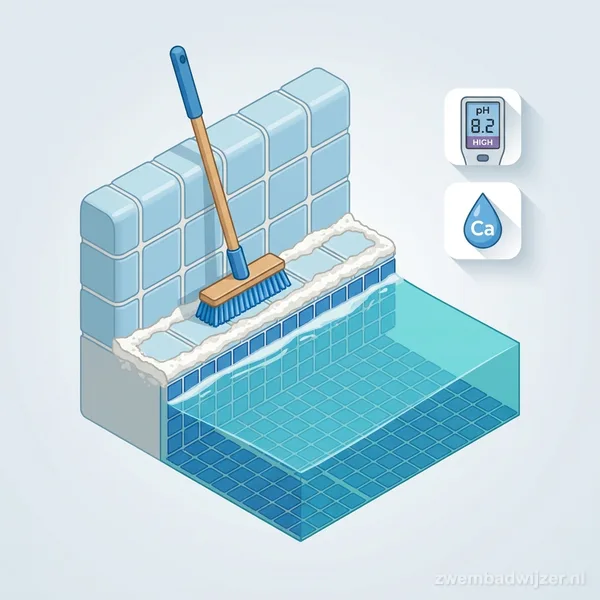
Pay particular attention to corners, steps, ladders and the waterline. These are the areas where algae and calcium tend to build up first. Clean the waterline with a dedicated waterline sponge or tile cleaner, using circular motions just at and slightly above the water surface.
Step 5: Backwash or clean the filter
The filter removes particles that the skimmer and vacuum miss. Over time, the filter media becomes clogged with dirt and its effectiveness drops. Backwashing reverses the flow of water through a sand filter to flush debris out through the waste port.
For sand filters: backwash weekly during the swim season, or whenever the pressure gauge reads 0.5 to 1 bar above its normal clean pressure. The process takes 3 to 5 minutes. After backwashing, always run the filter on the rinse setting for 30 seconds before returning to normal filtration.
For cartridge filters: remove and rinse the cartridge with a garden hose weekly, and deep clean with a cartridge cleaning solution monthly. Cartridges typically need replacement every 1 to 2 seasons depending on pool size and bather load.
Step 6: Test and balance water chemistry
Testing water tells you what adjustments, if any, are needed. The two most critical parameters are pH (target 7.2 to 7.6) and free chlorine (target 1 to 3 mg/l). Outside these ranges, chlorine loses effectiveness rapidly.
Test water 2 to 3 times per week during summer and after heavy rain or heavy use. Use test strips for a quick daily check and a liquid test kit or digital tester for more accurate weekly readings. For a full explanation of what to measure and how to interpret results, see our guide on how to test pool water .
Always add chemicals to the pool water, not the other way around. Pre-dissolve granules in a bucket of pool water before adding. Add different chemicals separately, never together, and with the pump running.
Step 7: Run the pump
After completing your cleaning routine, run the pump for at least 4 hours to filter the particles you have disturbed from the walls and floor. Ideally, run it for 8 hours per day during the swimming season. This ensures proper water circulation, thorough filtration and even distribution of any chemicals you have added.
For best results, run the pump during the warmest part of the day in summer. Warmer water consumes chlorine faster, so having the filtration running at peak times helps maintain residual levels.
Cleaning individual pool components
Some components need attention beyond the weekly routine. Here is an overview with links to detailed guides.
Cleaning the pool floor
Sediment on the pool floor consists of fine sand, algae debris, leaf fragments and skin particles. Vacuum weekly and always run an extra vacuum session after a shock treatment, as dead algae sink to the floor.
Cleaning pool walls
Algae establishes first on walls, especially in corners and around steps. Brush weekly with a nylon brush for liner and fibreglass, or a stainless steel brush for concrete. For stubborn green deposits, combine brushing with a temporarily raised chlorine level. More detail: green pool water and algae .
Cleaning the filter
The filter is the core of your water treatment. A dirty filter cannot clean the water regardless of how much chemical you add. Backwash a sand filter weekly and replace the sand every 3 to 5 years. Full procedure: how to backwash a sand filter . For pump maintenance: filter pump maintenance .
Cleaning the skimmer
Empty the skimmer basket daily, but give the skimmer body, the inside, flap and gasket, attention once a month. A clean skimmer works more efficiently and lasts longer. Full guide: how to clean a pool skimmer .
Cleaning your pool after winter
After winter storage, your pool needs a thorough clean-up. The water has been sitting for months and likely contains algae, cloudiness, leaf debris and unbalanced chemistry.
What to do when opening after winter:
- Remove and clean the cover or tarpaulin
- Remove leaves and large debris
- Reconnect and inspect the pump and filter
- Top up water to normal level if needed
- Test and correct pH
- Perform a chlorine shock (20 to 30 mg/l)
- Run the filter on high for 24 hours
- Vacuum the floor and brush the walls
- Retest water values and adjust
The full guide for opening after winter, including equipment checks and a timeline, is at opening your pool in spring .
How often should you clean a pool?
A structured schedule prevents tasks from being forgotten and keeps maintenance manageable. Here is a realistic weekly timetable:
| Task | Frequency | Time |
|---|---|---|
| Skim surface | Daily | 3 to 5 min |
| Empty skimmer basket | Daily | 2 min |
| Test pH and chlorine | 2 to 3 times per week | 5 min |
| Vacuum pool floor | Weekly | 20 to 30 min |
| Brush walls | Weekly | 10 to 15 min |
| Backwash filter | Weekly | 5 min |
| Check calcium hardness | Monthly | 5 min |
| Filter cleaner treatment | Monthly | 10 min |
Total weekly time: approximately 45 to 60 minutes, spread across the week. The daily tasks take under 10 minutes combined. The heavier weekly tasks can be done in a single session.
Using a pool robot for cleaning
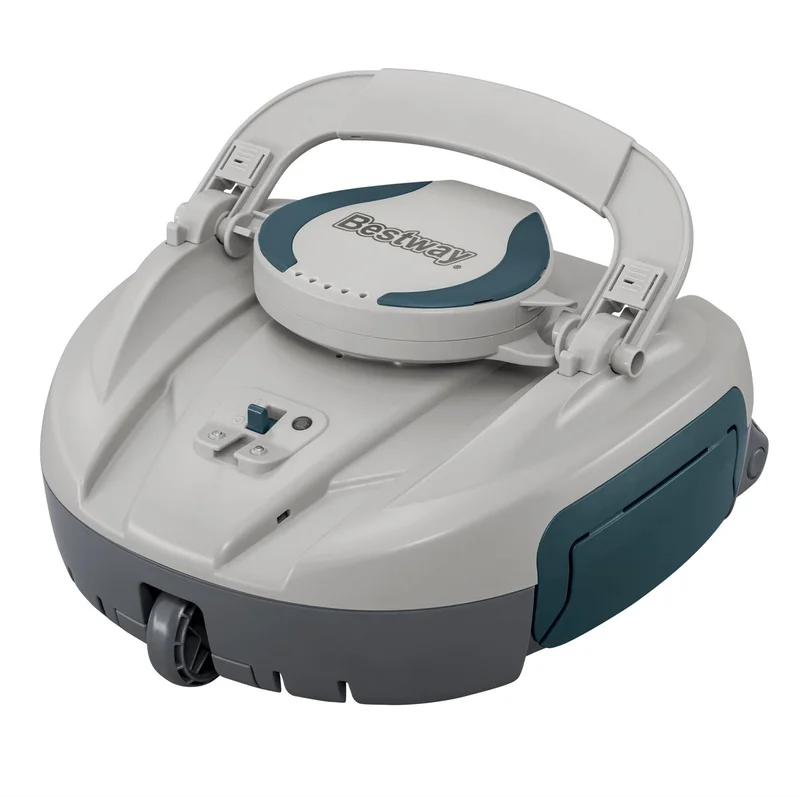
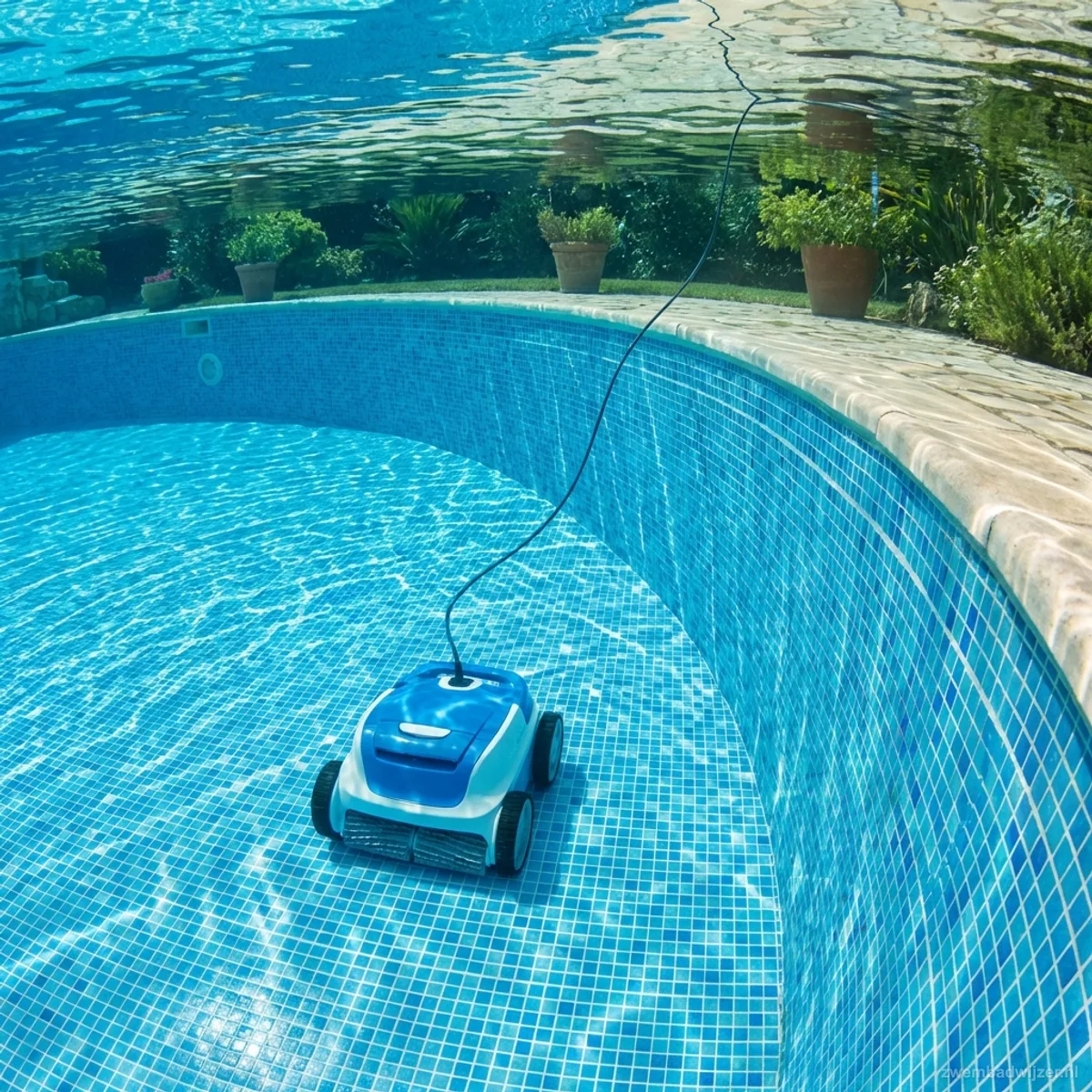
A pool robot handles the vacuuming autonomously, which removes the most time-consuming part of the weekly routine. Modern robots navigate the floor on a pre-programmed pattern, filter particles into an internal collection bin and return to the start point when finished.
The main advantages are consistency and convenience. A robot cleans the floor on a predictable schedule without any effort from you, which means sediment never builds up between sessions. Many models can also be scheduled to run overnight, so the pool is clean each morning.
That said, robots do not eliminate all manual tasks. Wall brushing still needs to be done by hand, and the skimmer basket still needs daily emptying.
Warning
A pool robot does not fully replace brushing the walls and waterline. Brush the walls yourself weekly, even if you have a robot, to prevent algae from taking hold in places the robot misses. Robots clean the floor; algae grows on the walls.
See our detailed comparison at best pool robot to find the right model for your pool size and budget.
Common cleaning mistakes
Even experienced pool owners repeat these errors. Avoiding them saves time and money:
1. Adding chemicals without testing first. Adding chlorine to water that is already high in chlorine, or adjusting pH without measuring it, wastes product and can create chemistry problems rather than solving them.
2. Neglecting to backwash the filter. A dirty filter does not clean the water effectively. If your pool stays hazy despite correct chemistry, a clogged filter is often the cause.
3. Only cleaning when the water is already cloudy. Prevention is far cheaper and faster than treatment. Weekly maintenance keeps the water clear without emergency interventions.
4. Dropping tablets directly on the pool floor. Undiluted chlorine tablets sitting on the floor can bleach and damage the liner or surface. Always use a floating dispenser or in-skimmer tablet feeder.
5. Ignoring pH and only adding chlorine. Chlorine is only effective within the correct pH range. At pH 7.8 or above, chlorine loses most of its disinfecting power. Balance pH first, then dose chlorine.
Follow this 7-step routine consistently and your pool will reward you with clear water and a longer-lasting surface, all in under an hour a week.
Recommended cleaning equipment
For automatic cleaning you need either a pump-driven automatic cleaner or an independent robot. Here are the two best options for residential pools.
Intex ZX300 Automatic Pool Cleaner
IntexAutomatic pool cleaner that connects to the filter pump and moves itself across the floor. Cleans a typical above-ground pool in 2 to 3 hours with no effort.
- Fully automatic, no separate motor needed
- Connects to any Intex filter
- Cleans floor and lower wall edge
- Good value for this category
- Does not clean walls or water surface
- Slower than a robot with its own motor
Looking for a more advanced model that also scrubs the walls?
Dolphin E20 Robotic Pool Cleaner
DolphinRobotic pool cleaner with its own motor that scrubs both floor and walls. Filters debris down to 50 microns and has a programmable timer for overnight cleaning cycles.
- Cleans floor and walls
- Independent motor, no filter pump needed
- Fine microfibre filter bag
- More energy-efficient than pump-driven models
- Significant upfront cost
- Cable can tangle if not stored properly
Skim the surface and empty the skimmer basket daily (5 minutes each). Vacuum the floor and brush the walls weekly, which takes around 30 to 45 minutes in a single session. Backwash the filter weekly and test and balance water chemistry 2 to 3 times per week. Consistent daily and weekly routines prevent expensive problems and keep the water clear without emergency interventions.
Can you clean a pool without chemicals?
You can do all the mechanical cleaning, vacuuming, brushing, skimming, without chemicals. But safe swimming water always requires some form of disinfection, whether chlorine, bromine or a saltwater system. Mechanical cleaning removes debris but does not kill bacteria or algae. Skip disinfection entirely and water quality degrades quickly, particularly in warm weather.
Is a pool robot worth it?
For pools larger than 8x4 metres or in areas with heavy leaf fall, a robot pays for itself within 1 to 2 seasons in time savings. Budget robots start at around EUR 130 and handle floor cleaning automatically. Premium models clean walls and the waterline too, which is especially useful for pools that tend to develop algae or calcium deposits on vertical surfaces.
How do I clean the waterline?
Use a dedicated waterline sponge or tile cleaner. Work with circular motions just at and above the waterline where body oils, sunscreen and calcium deposits tend to accumulate as a greasy or chalky ring. Avoid harsh chemicals that can affect water chemistry. Clean the waterline weekly to prevent stubborn build-up that requires aggressive scrubbing or acid washing to remove later.
Do I need to drain the pool to clean it?
Not for routine cleaning. Only drain when total dissolved solids (TDS) exceed 1,500 mg/l or when chemistry cannot be corrected despite multiple attempts. Most cleaning, vacuuming, brushing, chemical treatment, can be done with the pool full. A full drain is time-consuming, wastes significant water and is rarely necessary if you maintain the pool consistently throughout the season.