Every pool season you use up the same core set of chemicals: chlorine tablets for daily disinfection, pH correctors, shock granules for problem situations, flocculant for cloudy water, and filter cleaner for your installation. This guide tells you exactly what to buy and how much, based on an April-to-October season.
What are pool consumables?
Pool consumables are products you actively use up during the season. They are the counterpart to durable equipment like pumps, filters and robot cleaners. Without the right consumables on hand, you risk reacting too late: green water, irritated eyes or imbalanced pH are the usual results.
Most pool owners buy consumables reactively — only when a problem appears. A smarter approach is to stock a baseline kit at the start of the season. That way you can act immediately when values drift, without waiting for a delivery.
The five categories you always need: disinfection, pH correction, filtration, water clarity, and seasonal products for opening and closing.
Disinfection: chlorine tablets and shock granules
Chlorine is the foundation of pool water management. It kills bacteria, viruses and algae. For daily dosing, use slow-dissolving 200g chlorine tablets in a floating dispenser or the skimmer basket. They dissolve over 7 to 10 days, delivering a constant low chlorine level.
Alongside daily dosing, you need shock chlorine granules for situations where the chlorine level needs to rise fast: at pool opening, after a heatwave, after heavy use, or when water turns cloudy. Shock granules dissolve in minutes and temporarily push free chlorine to 10–20 mg/l.
Practical dosing:
- Tablets: 1 tablet per 10,000 litres per week as a starting point, adjust to measurements
- Shock: 20 grams per 1,000 litres for a standard shock treatment (up to 10 mg/l free chlorine)
- Shock for algae or green water: 30 to 40 grams per 1,000 litres
Store chlorine products dry, cool, and out of reach of children. Never mix different chlorine products — the reaction can be violent.
pH correction: pH-minus and pH-plus
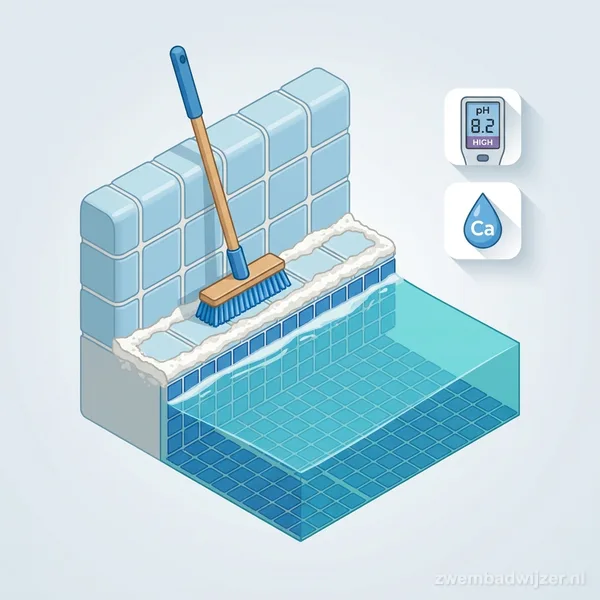
pH determines how effective your chlorine is. At a pH above 7.6, less than 20% of chlorine is active as a disinfectant. At a pH below 7.0, water irritates skin and eyes and accelerates corrosion. The ideal range is 7.2 to 7.4.
pH-minus (sodium bisulphate) is used when pH is too high, which happens regularly through evaporation, fill water composition or high calcium hardness. pH-plus (sodium carbonate) brings pH up when it drops too low, often after heavy rainfall.
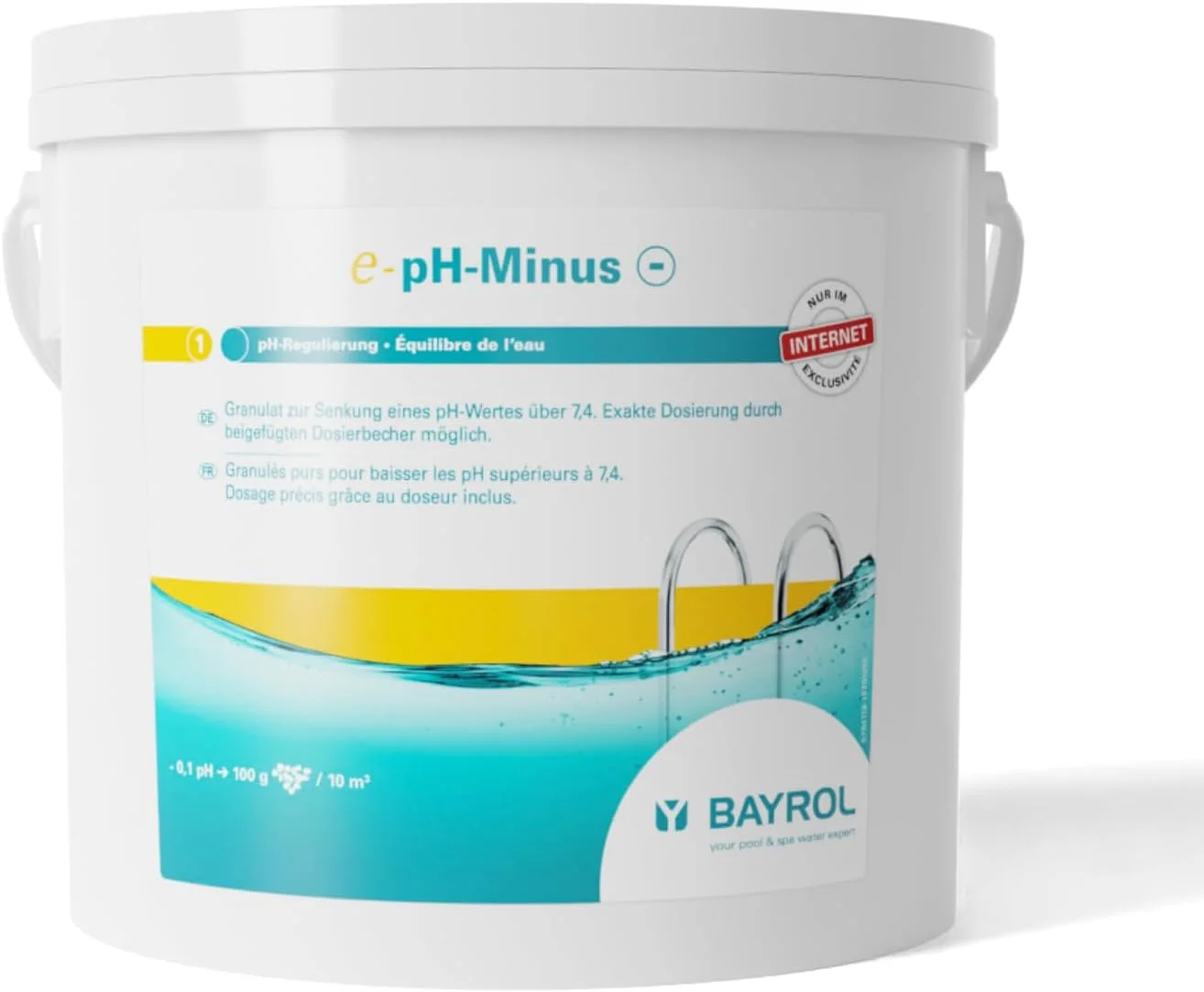
pH Decreaser Powder (5 kg)
Chloor.nlSodium bisulphate powder to lower pool pH. 5 kg for multiple treatments. Always dissolve in a bucket of water before adding.
- Fast-acting
- Good price per kg
- Easy to dose
- Creates dust when measuring, wear gloves
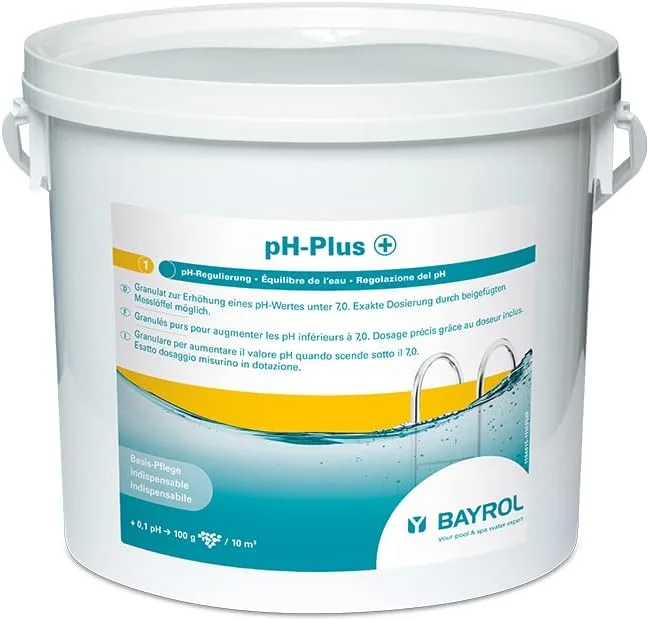
pH Increaser Granules (3 kg)
Chloor.nlSodium carbonate granules to raise pool pH. Always dissolve in water before adding. 3 kg for multiple treatments throughout the season.
- Effective
- Dissolves well
- Affordable
- Always pre-dissolve before adding to pool
Dosing for a 25,000-litre pool:
- 100 grams of pH-minus lowers pH by approximately 0.2 units
- 100 grams of pH-plus raises pH by approximately 0.2 units
Always dissolve pH products in a bucket of water before adding to the pool. Wait 4 hours after dosing before retesting and redosing.
Filtration: filter cartridges and filter cleaner
A clean filter is the foundation of clear water. What filter maintenance you need depends on your filter type.
Cartridge filter: replacement cartridges
A cartridge filter pump uses a paper filter element that you rinse every two weeks and replace every four to eight weeks. The Intex Type A cartridge fits the most common Intex filter pumps with a flow rate of 1,250 to 5,678 litres per hour. A pack of 6 covers the full season.
Sand filter: filter cleaner
A sand filter needs no cartridge replacements, but the filter sand or glass media gradually becomes saturated with grease, sunscreen and other organics that backwashing cannot remove. Once per season — ideally mid-season or at closing — clean the filter bed chemically. Dissolve the cleaner in water, pour it into the skimmer, and let it soak for 8 to 12 hours before backwashing.
For the full backwashing and chemical cleaning procedure, read how to backwash a sand filter .
Keeping water clear: flocculant
Flocculant is used when water is cloudy but chemical values are correct. Very fine particles are too small for the filter but make the water look milky or grey. Flocculant clusters those particles into larger flocs that the sand filter can catch.
Use flocculant only with a sand filter on the filter setting. With a cartridge filter you will clog the element. Add it to the skimmer basket or dilute it in a bucket and pour it into the pool. Run the filter for 8 hours, then allow the pool to rest for 24 hours without filtration.
Flocculant does not work on algae — treat algae first with a shock and algicide before adding flocculant. More on cloudy water in the clear pool water guide .
Special situations: chlorine neutraliser and winterizing kit
Too much chlorine: sodium thiosulphate
Accidentally overdosed chlorine, or is the level still too high after a shock treatment? Sodium thiosulphate neutralises free chlorine quickly. 2 grams per 1,000 litres reduces free chlorine by about 1 mg/l. Add it to the skimmer while the pump runs, then retest after 30 minutes.
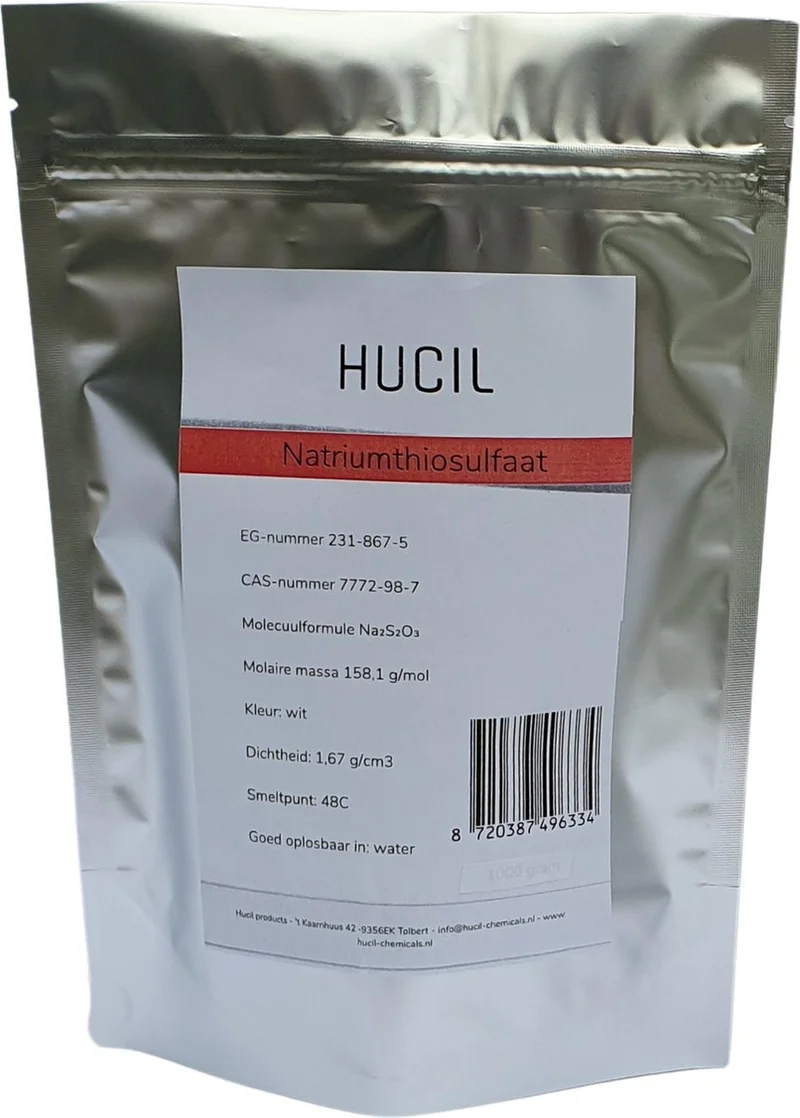
Sodium thiosulphate (chlorine neutralizer) 1 kg
GenericSodium thiosulphate (Na2S2O3) crystals quickly bring down high chlorine levels in pools or hot tubs. The 1 kg bag lasts multiple seasons.
- Neutralizes chlorine within 30 minutes
- 2 g per m3 removes 1 ppm of free chlorine
- Safe for liner and filter system
- No preventive effect
- Minor pH drop after dosing
End of season: winterizing kit
When closing the pool for winter, add a winterizing fluid that prevents bacterial growth and algae formation during the colder months. Without it, you risk opening to a green or slimy pool in spring. One bottle covers most pools up to 60,000 litres.
For the full winter closing procedure, read how to winterize your pool .
How much do you need per season?
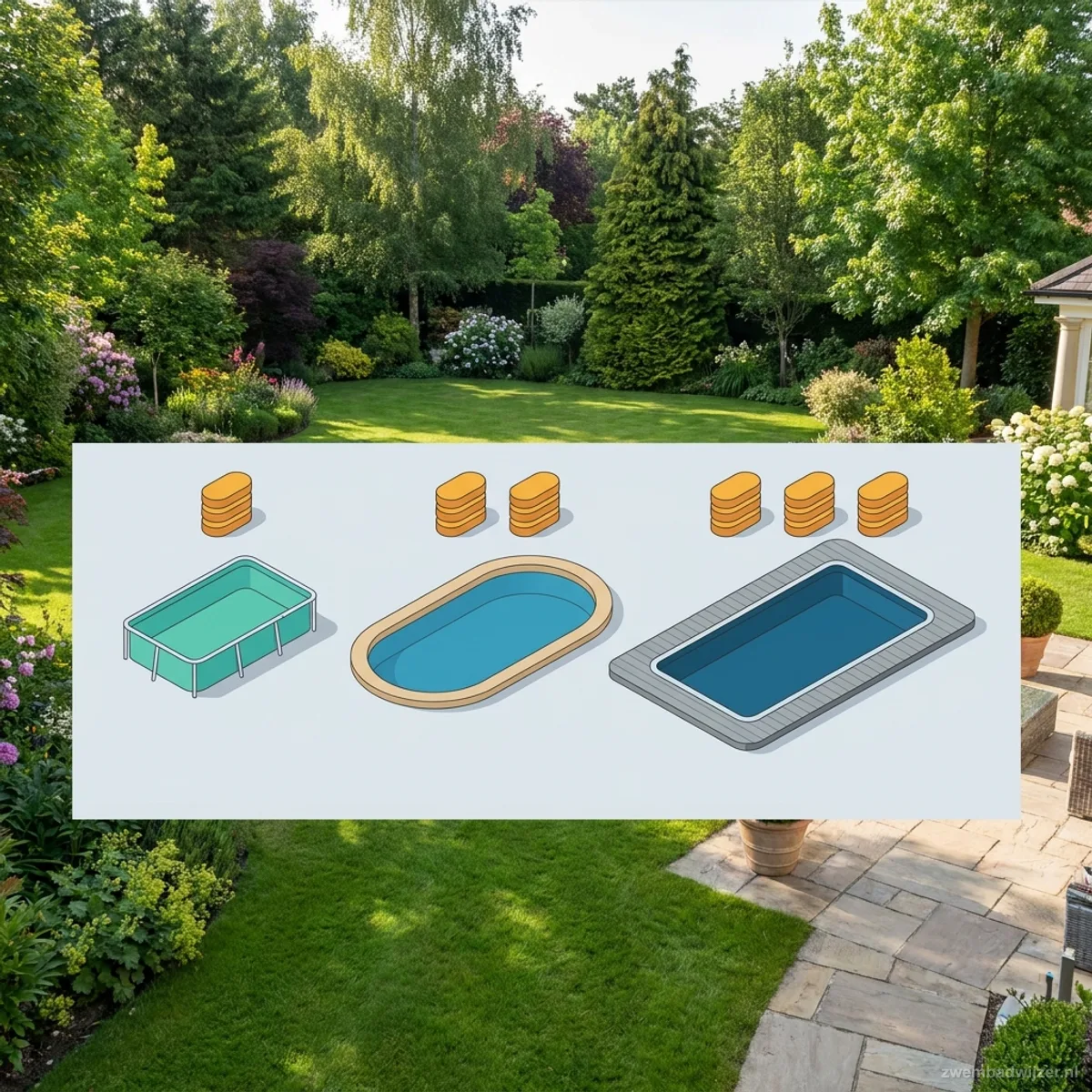
The table below is based on typical use: two to four swim sessions per week, a sunny spring and summer, and a solar cover on the pool at night. For more intensive use or extra sun hours, use the higher figures.
| Product | Small pool (10,000 L) | Medium (25,000 L) | Large (50,000 L) |
|---|---|---|---|
| Chlorine tablets 200g | 1–1.5 kg | 3–4 kg | 6–8 kg |
| Shock granules | 0.5 kg | 1–1.5 kg | 2–3 kg |
| pH-minus | 1–2 kg | 3–4 kg | 5–7 kg |
| pH-plus | 0.5–1 kg | 1–2 kg | 2–3 kg |
| Filter cartridges Type A | 6 pcs | n/a | n/a |
| Filter cleaner | 0.5 litre | 1 litre | 1–2 litres |
| Flocculant | 0.5 litre | 1 litre | 2 litres |
| Sodium thiosulphate | 0.25 kg | 0.5 kg | 1 kg |
| Winterizing kit | 1 bottle | 1 bottle | 1–2 bottles |
These are estimates. Always test before dosing. A good test kit is essential — learn more in how to test pool water .
Starter kit for new pool owners
If this is your first pool season, the easiest approach is a starter chemicals kit that bundles the most-needed products. You avoid ordering everything separately and get products that are balanced to work together.
After your first season, you will know exactly which products you use most and can reorder precisely.
Frequently asked questions
How many chlorine tablets do I need per season?
Allow 1 tablet (200g) per 10,000 litres per week. A 25,000-litre pool uses roughly 2 to 3 tablets per week — about 40 to 60 tablets over an April-to-October season. Buying a 5 kg tub (around 25 tablets) means you won’t run short mid-season.
Do I need both pH-minus and pH-plus?
Yes. Pool pH swings in both directions: rain pulls it down, heavy chlorine use or evaporation pushes it up. Keep both on hand. A 5 kg bag of pH-minus and 3 kg of pH-plus covers most private pools for a full season.
How often should I shock the pool?
Two to four times per season for a well-maintained pool: at opening in spring, after a heatwave or heavy use, when water turns cloudy or green, and just before closing for winter. Allow 1 kg of shock granules per treatment for a pool up to 50,000 litres.
How long does a bottle of filter cleaner last?
A 1-litre bottle covers 4 to 6 treatments depending on the product. With a sand filter, you backwash two to four times per season and do one chemical clean per year, so a 1-litre bottle lasts one to two seasons.
When should I use flocculant and when should I skip it?
Use flocculant when the water is cloudy but chemical values are correct. It clusters fine particles so the filter can trap them. Do not use it on green water caused by algae — treat algae with a shock first. Flocculant only works with a sand filter on the filter setting, not with a cartridge filter.