You can safely leave your pool for 1 to 2 weeks during vacation without coming home to a green swamp. The key is a 45-minute preparation routine on the day you leave. Follow these 8 steps and your pool will be ready to swim in when you return.
Why Do Pools Turn Green While You’re Away?
Algae are always present in pool water in small quantities, but they only multiply when free chlorine drops below 1 mg/L. At that point, algae grow faster than chlorine can destroy them. In warm weather above 28°C, a pool can go from crystal clear to murky green within 48 hours.
Three things happen simultaneously when you go on vacation: the pump may run less, chlorine gradually depletes, and nobody is there to notice or correct the problem. That combination is all algae need to take over.
The solution is not to dump a massive dose of chlorine before you leave. It is setting up a system that works automatically while you are away.
The 8 Steps to Do on the Day You Leave
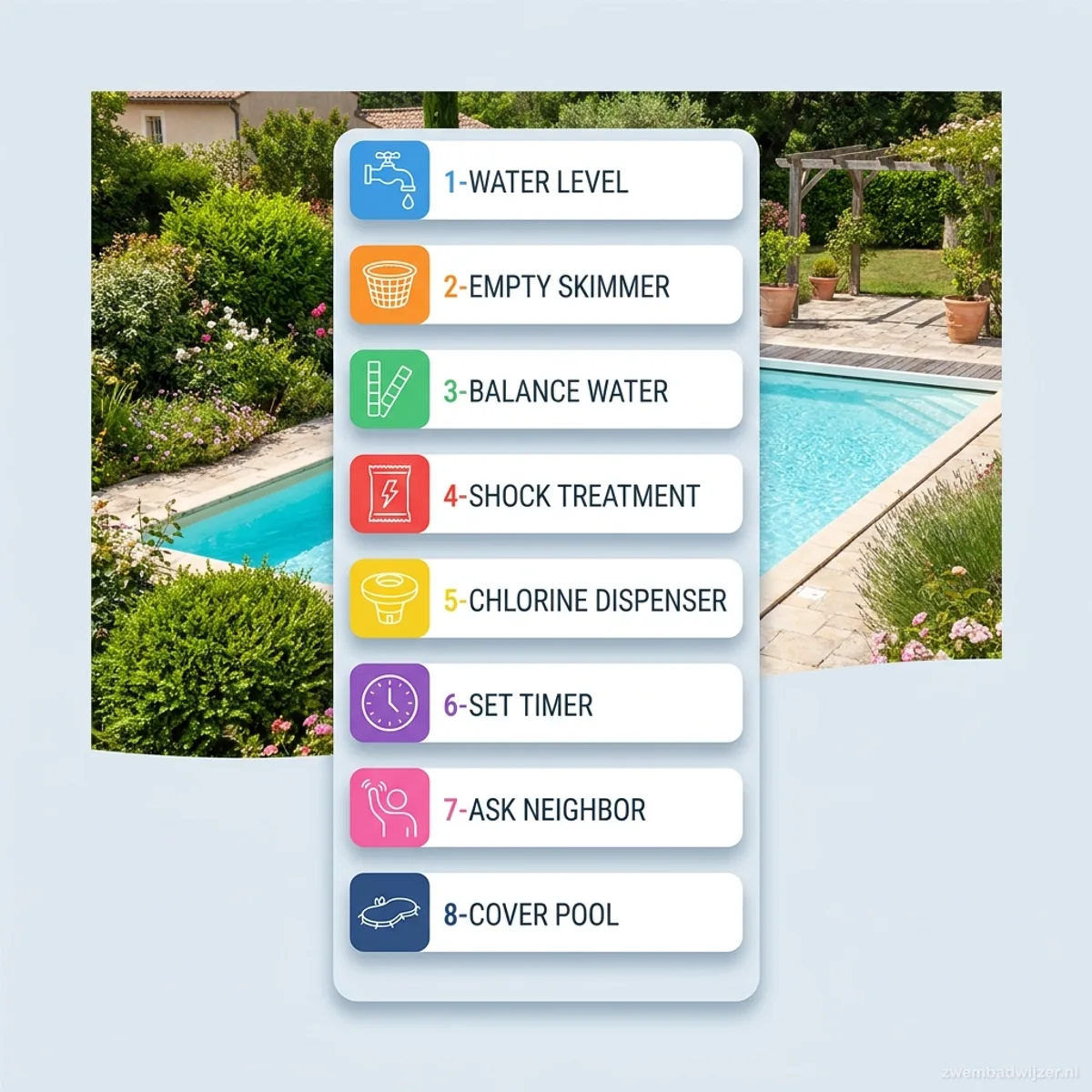
Step 1: Top Up the Water Level
Pool water evaporates faster than most people expect. At 28°C with light wind, an uncovered 30 m³ pool loses 3 to 5 centimetres of water per week. If the water level drops too low, the skimmer starts drawing in air and the pump runs dry. Before leaving, fill the pool to the top of the skimmer opening — slightly higher than usual — to give yourself a buffer.
Step 2: Empty the Skimmer and Pump Baskets
A full skimmer basket restricts water flow, raises pump pressure, and reduces filtration efficiency. Empty both baskets thoroughly and check that the skimmer weir (the floating flap) moves freely. For absences longer than one week, ask a neighbour to check and empty the skimmer basket once during your trip.
Step 3: Test and Balance the Water
Measure pH, alkalinity, and free chlorine and adjust all values to their ideal range. Target a pH of 7.2 to 7.4 — slightly lower than usual to build in a buffer against the natural pH rise that happens when no one is adjusting it. Alkalinity should be 80 to 120 mg/L and free chlorine 2 to 3 mg/L.
Check our pool maintenance schedule if you need a reference for which chemicals to add in which order.
Step 4: Shock the Pool
Shock the pool the evening before or the morning of your departure. Use at least 200 grams of calcium hypochlorite shock per 10 m³ of water — for a 40 m³ pool that is 800 grams. The shock kills any algae or bacteria already present and gives you a high starting level of free chlorine to carry you through the first days away.
Always shock with the pump running and distribute the granules along the pool edges rather than pouring everything in one spot. For a full walkthrough see our guide on how to perform a pool shock treatment .
Step 5: Place a Floating Chlorine Dispenser in the Pool
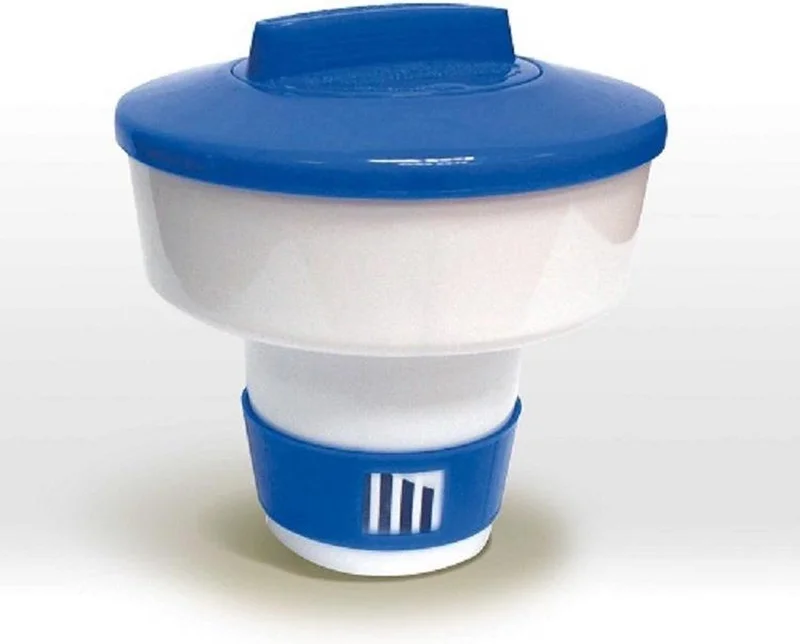
A floating dispenser (also called a chlorine floater) slowly releases chlorine from 200g tablets over 1 to 2 weeks. It drifts with the water movement, distributing chlorine evenly across the pool surface. Load it with two tablets for a two-week vacation.
Never place tablets directly in the skimmer. Tablets sitting in the skimmer dissolve at a concentrated rate and push highly corrosive chlorine directly through your pump, degrading rubber seals and O-rings over time.
Step 6: Set the Pump Timer
The filter pump must keep running while you are away. If you have a timer, set it to run at least 10 to 12 hours per day. Split this across two sessions if possible: for example 7:00 to 13:00 and 20:00 to 02:00. This way the pump filters after the hottest part of the day and again overnight when temperatures drop.
No timer? Leave the pump running continuously. The extra electricity cost over two weeks is far lower than the cost of chemicals and labour to fix a green pool when you return.
Step 7: Ask a Neighbour to Check In for Longer Trips
For absences longer than 7 days, having someone look in is a worthwhile safeguard. Ask a neighbour or family member to:
- Check that the pump is running
- Empty the skimmer basket if it is full
- Add a fresh chlorine tablet to the dispenser if it looks empty
They do not need to test water or add chemicals. A visual check and an empty skimmer basket is enough to prevent most problems.
Step 8: Consider a Pool Cover
A solar or safety cover slows evaporation, keeps leaves and insects out, and blocks UV radiation that breaks down chlorine. Less UV degradation means your chlorine supply lasts longer — a real advantage when no one is topping it up.
The downside is that you cannot see the water colour from a distance, so visual monitoring becomes harder. If you prepare the water correctly before leaving, this is not a major concern. Choose a cover that fits snugly so rainwater cannot seep under the edges.
Read more about choosing the right cover in our guide on keeping your pool clean through the season .
What to Do If You Come Home to a Green Pool
Even with proper preparation, the pool can turn green if there is a heat wave or if the pump stops unexpectedly. Do not panic — green water is recoverable.
| Condition on return | Action |
|---|---|
| Slightly hazy, still blue | Check pH, add chlorine, run pump 24 hours |
| Green but still see the floor | Double shock (400g per 10 m³), brush, run pump non-stop |
| Dark green, floor not visible | Triple shock, add flocculant, vacuum to waste |
| Black or brown-green | Full drain and restart or professional help |
Always test before treating. Knowing your pH and free chlorine level lets you dose precisely. Adding chemicals blindly wastes money and solves nothing.
After any shock treatment, wait at least 8 hours before swimming — or until free chlorine drops back to 1 to 3 mg/L.
How Much Chlorine Does a Pool Use at 30°C?
High temperatures accelerate everything. UV degrades chlorine faster, bacteria multiply more quickly, and evaporation increases. A practical reference:
- Below 25°C: approximately 100 to 150 grams per week per 10 m³
- Between 25°C and 30°C: approximately 150 to 200 grams per week per 10 m³
- Above 30°C: 200 grams or more per week per 10 m³
A floating dispenser loaded with two 200g tablets provides a 30 m³ pool with baseline protection for 10 to 14 days at 28°C. In a heat wave, add a third tablet for extra safety margin.
Frequently Asked Questions
How long can you leave a pool unattended without problems?
A well-prepared pool can handle 1 to 2 weeks without supervision. Longer than 2 weeks becomes risky as chlorine depletes and algae take over. For 3 weeks or more, ask someone to check in weekly and top up chlorine if needed.
Should the pool pump run 24 hours a day while you’re on vacation?
Not necessarily, but more than usual is wise. Set a timer for at least 10 to 12 hours per day, split across two sessions ideally. If you have no timer, simply leave the pump running continuously.
Can I just drop chlorine tablets in the skimmer before I leave?
No. Tablets in the skimmer dissolve in concentrated form and pump corrosive chlorine straight through your filter pump, damaging O-rings and the pump housing. Always use a floating dispenser.
What do I do if I come home to a green pool?
Shock immediately with at least 200 grams of calcium hypochlorite per 10 m³. Brush walls and floor, run the pump continuously for 24 hours, and add flocculant to settle dead algae. Test pH and free chlorine before swimming.
Is a pool cover a good idea when going on vacation?
Yes. A cover slows evaporation, keeps debris out, and blocks UV light that degrades chlorine — your chlorine supply lasts longer. Choose one that fits snugly to prevent rainwater seeping underneath.
How much chlorine does a pool use in 2 weeks?
An average 30 m³ pool with no swimmers uses roughly 150 to 250 grams of chlorine per week in normal summer conditions. Above 30°C this rises to 400 grams per week. Two 200g tablets in a floating dispenser provide about 10 to 14 days of baseline protection.