The best test strips for your pool are 6- or 7-in-1 strips from a recognised brand such as AquaChek, AquaChek Select or Bayrol: EUR 12 to EUR 32 for 100 strips. They read pH, free chlorine, total chlorine, alkalinity, hardness and cyanuric acid with sharp colour contrast and ship in a resealable tube with a desiccant capsule. Avoid loose generic strips - the colour readings are unreliable.
Why strip quality matters more than price
There is a lot of junk on the test strip market. Loose pouches with no desiccant from discount stores, bargain buys and generic Temu or Aliexpress strips give faded or shifted colours. The result: you think your chlorine is at 3 mg/l when it is actually at 1 mg/l - or the other way around. An extra EUR 5 of chlorine per week to “be sure” the water is safe adds up to EUR 100 over a season. At that point, EUR 20 extra for a proper branded strip is the better investment.
Comparison: strip quality tiers
| Product | Parameters | Accuracy | Cost per strip | Season cost (60 tests) |
|---|---|---|---|---|
| AquaChek 511244A 6-in-1 | 6 | +/- 0.2 pH | EUR 0.13 | EUR 8 |
| AquaChek Select 7-in-1 | 7 | +/- 0.2 pH | EUR 0.32 | EUR 19 |
| Bayrol QuickTest 6-in-1 | 6 | +/- 0.2 pH | EUR 0.20 | EUR 12 |
| Budget 5-in-1 (Lifetastic) | 5 | +/- 0.3 pH | EUR 0.16 | EUR 10 |
| Hardware store / loose generic | 3-5 | +/- 0.5-1.0 pH | EUR 0.08-0.15 | Unreliable |
Our winner: AquaChek 511244A 6-in-1
The AquaChek 511244A 6-in-1 is the best all-round strip for private pool owners. It measures pH, free chlorine, total chlorine, alkalinity, calcium hardness and cyanuric acid in 15 seconds. Consistently highly rated on Amazon, the colour chart is well spaced and the tube ships with a desiccant capsule. 100 strips cover a full season at 2 to 3 tests per week.
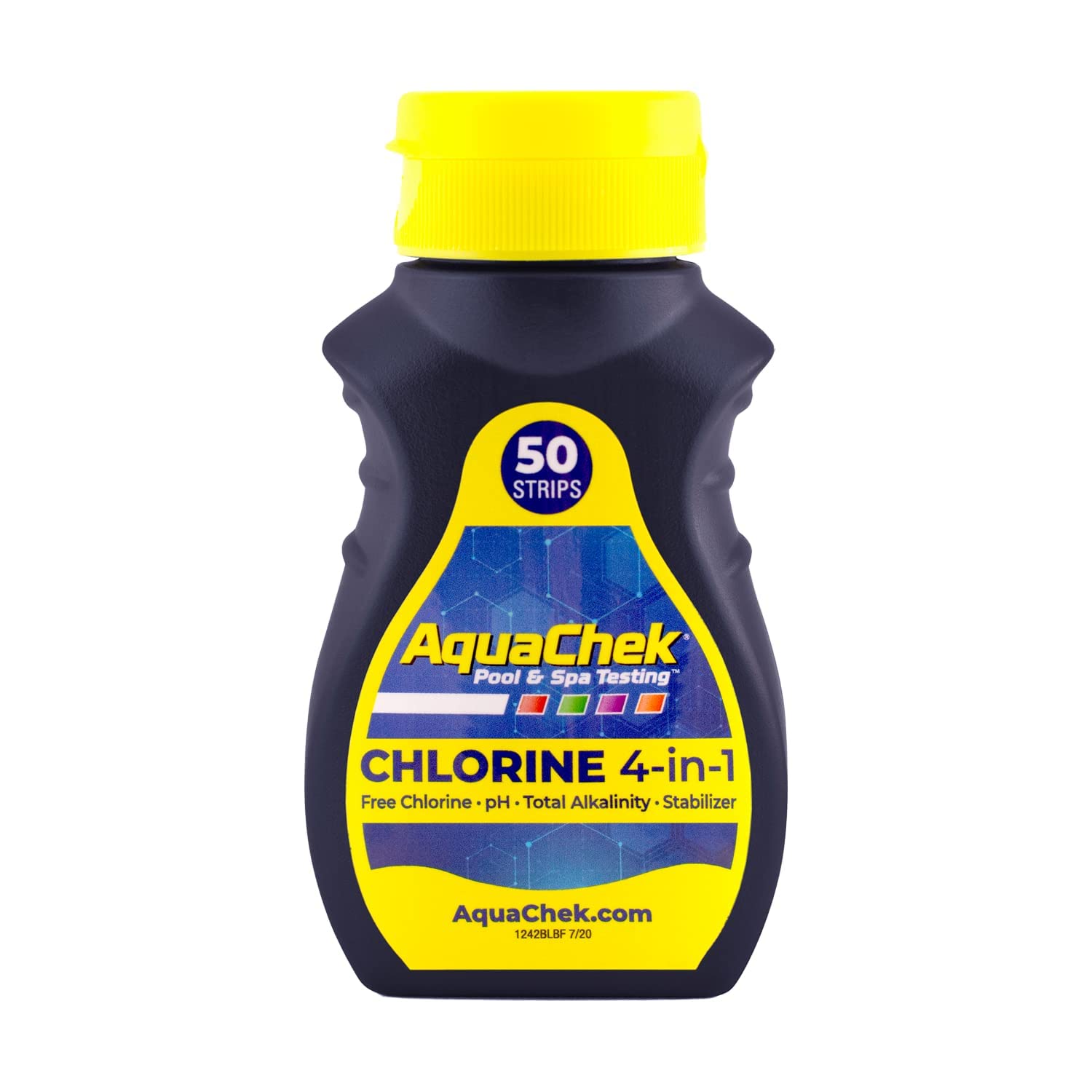
AquaChek 511244A Test Strips 6-in-1 (100 strips)
AquaChekTest pH, chlorine, alkalinity, hardness and more in one go. 100 strips per pack.
- Fast results
- 6 parameters in 1 strip
- Affordable
- Less accurate than digital testers
Premium alternative: AquaChek Select 7-in-1
Dutch and Belgian pool shops use the AquaChek Select line behind the counter themselves. The refill pack contains 100 strips with seven parameters (including bromine, for hot-tub owners) and an even sharper colour contrast per pad. You pay EUR 0.32 per strip instead of EUR 0.13, but the readings are clearer - especially in artificial light or borderline cases. This refill comes without its own tube: store the strips in an empty AquaChek container or a resealable jar with a desiccant capsule.
AquaChek Select 7-in-1 Test Strips Refill (100 strips)
AquaChekPremium strips from the US AquaChek Select line, the brand most Dutch pool shops use on the counter. Reads 7 parameters (free chlorine, total chlorine, bromine, pH, alkalinity, hardness, cyanuric acid) with high colour contrast.
- High colour contrast per pad
- 7 parameters in a single strip
- Used by pool shops too
- More expensive per strip (EUR 0.32)
- Refill only — reuse an empty tube
Budget but not junk: Lifetastic 5-in-1
If you want the lowest price without falling for generic hardware-store strips, the LT Lifetastic 5-in-1 strips are a solid baseline. They measure five parameters (no cyanuric acid) and ship in a resealable tube with a desiccant capsule - the minimum for reliable storage. Do not expect AquaChek colour contrast, but for daily spot checks they are usable. Skip loose pouches or open packaging from unknown brands.
LT Lifetastic 5-in-1 Pool Test Strips (100 strips)
LT LifetasticBasic test strips that read pH, free chlorine, total chlorine, alkalinity and hardness. 100 strips in a resealable tube with an included manual.
- Low cost per strip (EUR 0.16)
- 100 strips per pack
- Resealable tube protects against moisture
- No cyanuric acid (CYA) pad
- Colour chart is less fine than premium strips
How to spot junk strips
Do not buy strips that match any of these markers:
- Loose packaging or pouch without a desiccant - reagents absorb moisture from the air and lose colour potency within weeks
- Washed-out or blurry colour chart on the packaging - if you are already squinting in the shop, you will squint at the poolside too
- No printed expiry date - strips are valid for 12 to 18 months; a product without a date is a red flag
- “14-in-1” or “16-in-1” all-round strips for drinking water, soil and pool - these measure lead, iron and nitrate (irrelevant for pools) and score poorly on the parameters that actually matter
- Generic unbranded packaging from Aliexpress, Temu or discount stores - no brand accountability, no batch-to-batch consistency
- Vertical reagent pads (strips you hold upright during colour development) - liquid runs between the pads and contaminates the reading
Rule of thumb: if a pack of 100 strips sells for under EUR 6, you are not paying for reagents - you are paying for the printing. That is not a deal.
Which methods pair well with strips?
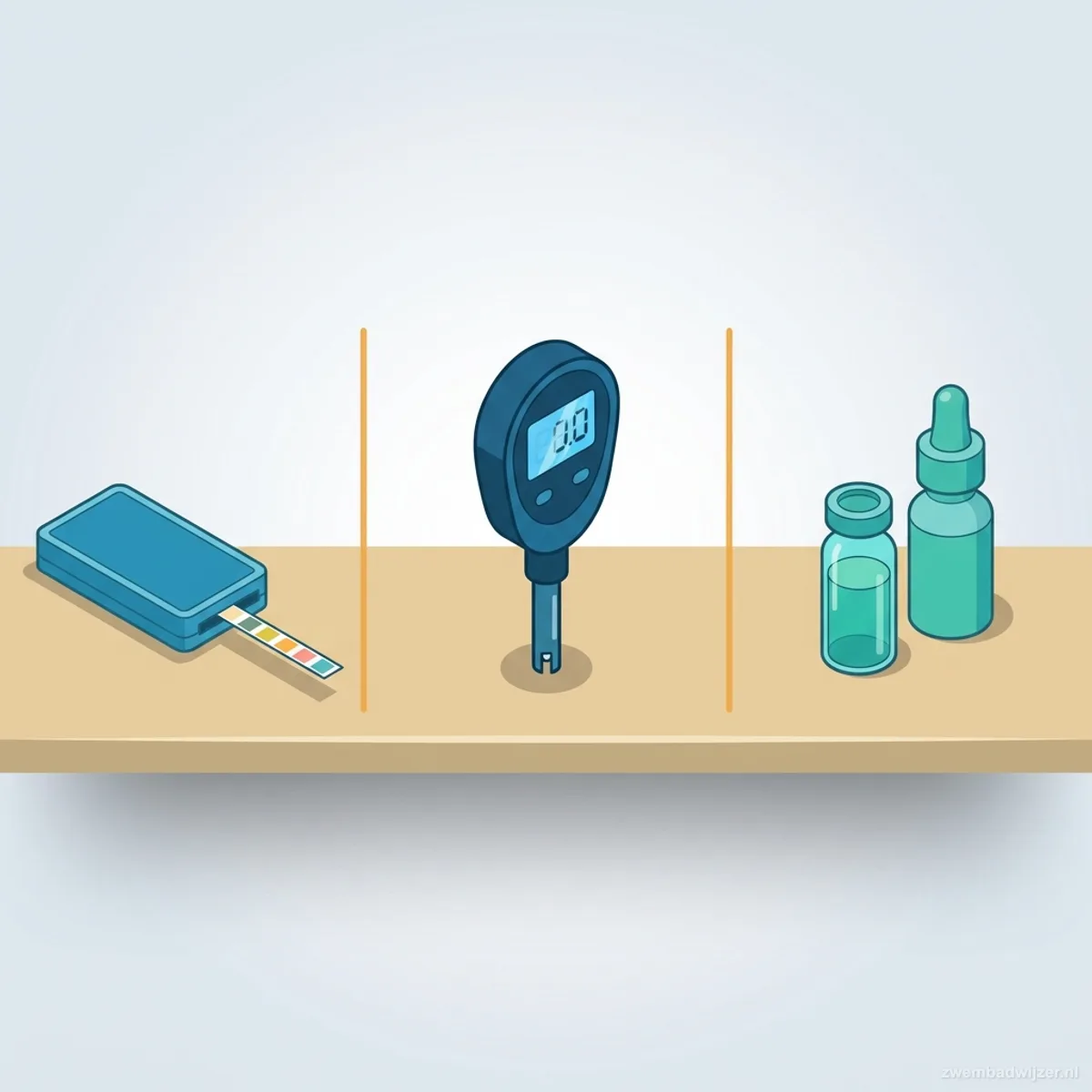
For more precise pH readings or a photometer comparison: see our overview in test strips vs digital tester . It covers when a digital pH meter, photometer or electronic tester is worth the step up.
How to use test strips correctly
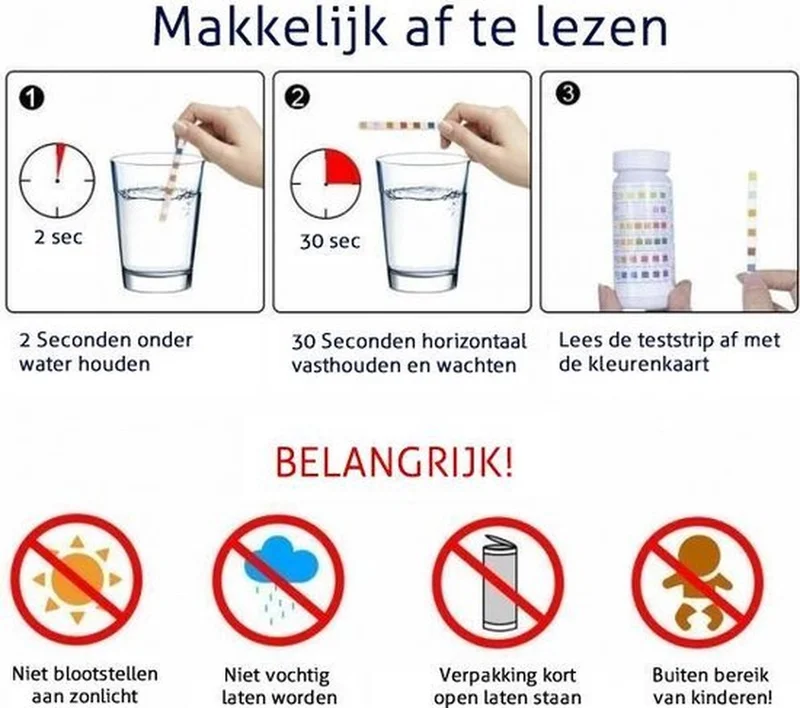
- Hold the strip in the water for 1 second (no longer) at 30 cm depth
- Remove the strip and hold it horizontally
- Wait exactly 15 seconds (not more, not less)
- Compare the colours against the chart in natural daylight (not shade or artificial light)
- Read from one end to the other without going back
Common mistakes:
- Holding the strip in the water too long (colours wash out)
- Holding the strip vertically (liquid runs across the colour pads)
- Reading in artificial light (colours appear shifted)
- Using expired strips
Storage
Store strips dry and cool. Never in the bathroom (humid) or in direct sunlight. Replace the lid immediately after use. Never touch the reagent pads - skin oils contaminate the chemistry. The desiccant capsule stays in the tube, even if it looks saturated.
How do test strips work?
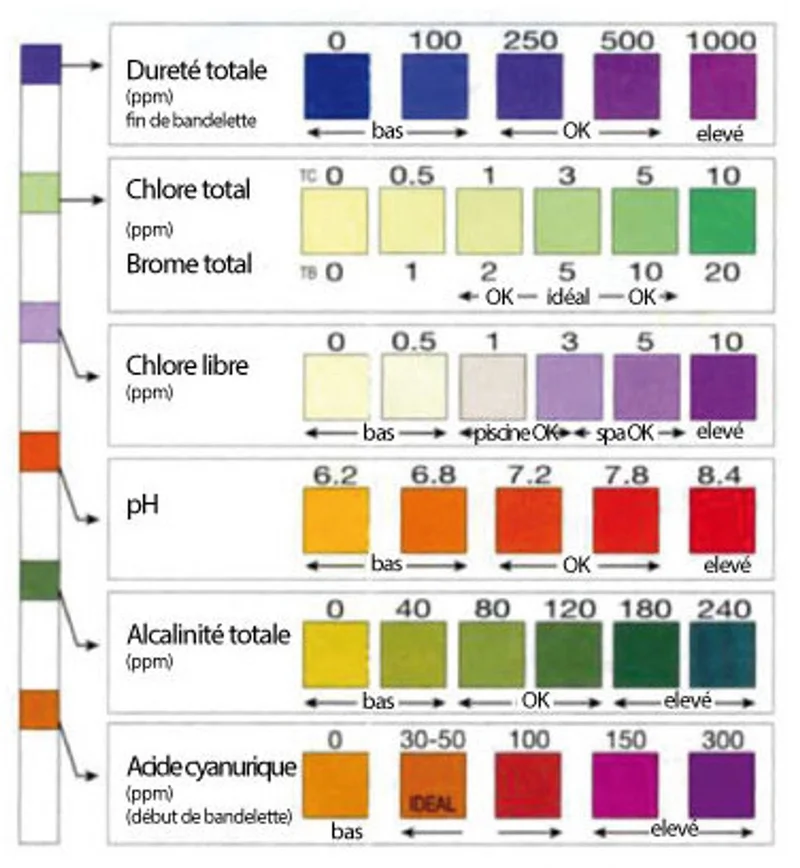
Each strip has one or more reagent pads, each impregnated with a dried chemical compound. When you dip the strip in water, the reagents dissolve and react with the target parameter (chlorine, pH, etc.) and change colour. You compare that colour to the chart on the container after exactly the specified wait time.
The colour reaction begins immediately on water contact. Holding the strip in the water longer than 2 to 3 seconds washes out some reagent: the reading will be too low or unclear. Too short gives incomplete colour development. Follow the instructions on the label exactly.
Always read strips in natural daylight, not in direct sun and not under yellow artificial lighting. The colour of artificial light shifts your perception. For anyone with colour vision deficiency a digital tester is the better choice.
What parameters should you test?
Free chlorine: the active disinfecting form. Target: 1.0 to 3.0 mg/l. Below 1.0 mg/l: bacteria and algae can grow. Above 5.0 mg/l: not safe to swim.
Total chlorine: free chlorine + combined chlorine (chloramines). If total minus free chlorine exceeds 0.5 mg/l, there are too many chloramines. This causes the typical “chlorine smell” and eye irritation. Solution: shock treatment.
pH: target 7.2 to 7.6. Outside this range chlorine works less effectively and the water becomes irritating to eyes and skin.
Total alkalinity (TA): the pH buffer. Target 80 to 120 mg/l. Too low: pH swings wildly. Too high: pH is difficult to adjust.
Cyanuric acid (CYA): the stabiliser that protects chlorine from UV breakdown. Target 30 to 50 mg/l for outdoor pools. Above 80 mg/l, chlorine loses effectiveness. Indoor pools: 0 mg/l (no UV, no stabiliser needed).
Calcium hardness: target 200 to 400 mg/l. Too low: water dissolves calcium from surfaces and fittings. Too high: white scale at the waterline and inside the heater.
Testing frequency
Test at least 2 to 3 times per week during peak season (June to August). Always test after:
- Heavy rainfall (dilution and pH drop)
- High bather load (more than 5 people per day)
- A shock treatment (24 hours after)
- Topping up with tap water (different baseline values)
Have the water professionally analysed once per season at a pool shop or by a postal water test service. A full mineral analysis costs EUR 15 to EUR 30 and gives values that test strips cannot measure, including total dissolved solids (TDS) and boron levels.