For pools up to 25,000 litres, a complete 4 m3/h sand filter system is the best choice. Price: EUR 120 to EUR 200 for a full kit including pump, filter vessel, sand and hoses. For larger pools, choose the 6 or 8 m3/h model.
What capacity do you need?
Calculate the minimum capacity using: pool volume (m3) divided by 8 hours. The filter cycle must turn over the full pool volume at least once every day.
| Pool volume | Calculation | Minimum capacity | Recommended |
|---|---|---|---|
| 12,000 litres | 12/8 | 1.5 m3/h | 2 m3/h |
| 20,000 litres | 20/8 | 2.5 m3/h | 4 m3/h |
| 32,000 litres | 32/8 | 4 m3/h | 6 m3/h |
| 48,000 litres | 48/8 | 6 m3/h | 8 m3/h |
Always choose the next size above the calculated minimum: pipe resistance reduces actual flow rate in practice. For the rationale behind sizing and how the filter and pump must match, see our sand filter vs. cartridge filter guide .
Complete kit vs. individual components
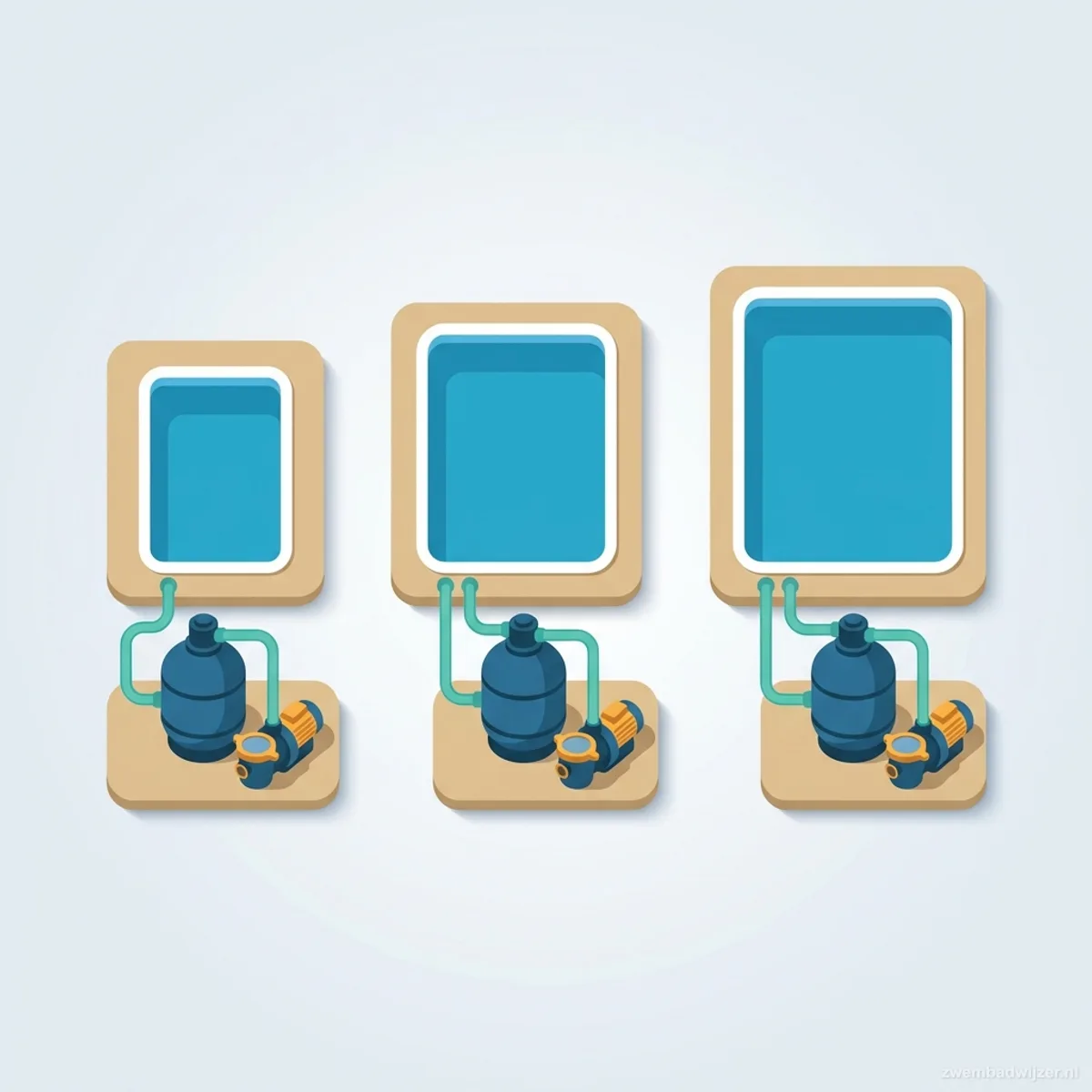
Complete kit (recommended for first-time buyers):
- Pump and filter are matched from the factory
- Simpler to install
- Better value as a starter pack
- Price: EUR 100 to EUR 300
Individual components (recommended for replacement):
- Choosing the pump separately gives more flexibility (e.g. a variable speed pump)
- Choosing a larger filter vessel extends intervals between backwashes
- Higher total cost but better tailored to your specific setup
Our pick for 10,000 to 25,000 litres
For the majority of above-ground pools in this size range, an Intex or Bestway 4 m3/h sand filter system is a solid and affordable choice. They are straightforward to install and spare parts (hoses, O-rings, multiport valves) are widely available.
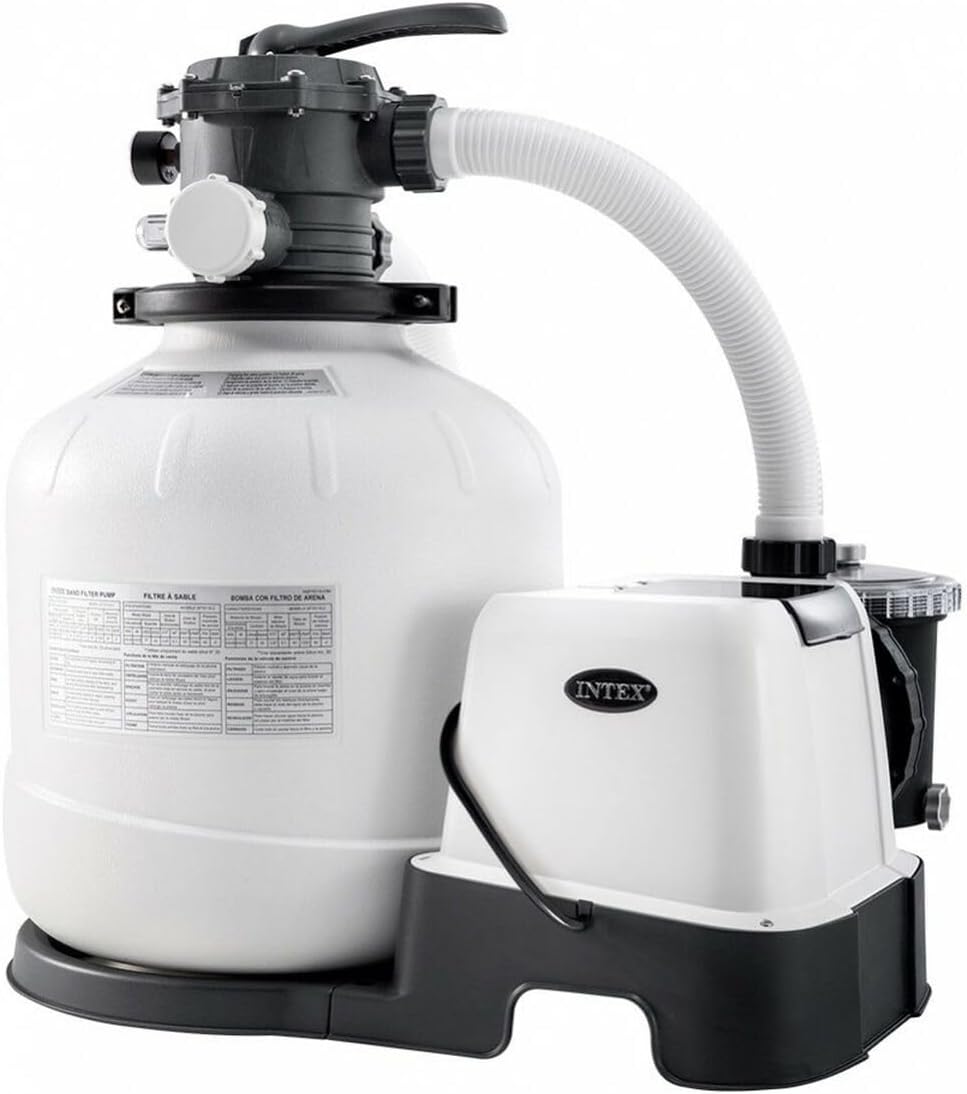
Intex Krystal Clear 26646GS SX2100 Sand Filter Pump 6 m3/h
IntexSand filter pump 6 m3/h (6,000 l/h) with 6-way valve for pools up to 19 m3. Requires 12 kg filter sand. Model 26646GS SX2100.
- Complete kit with 6-way valve
- Sand lasts 3 to 5 years
- Good filtration down to 20 microns
- Widely available Intex spare parts
- Pump is audible during operation
- Larger pools need the 6 m3/h model
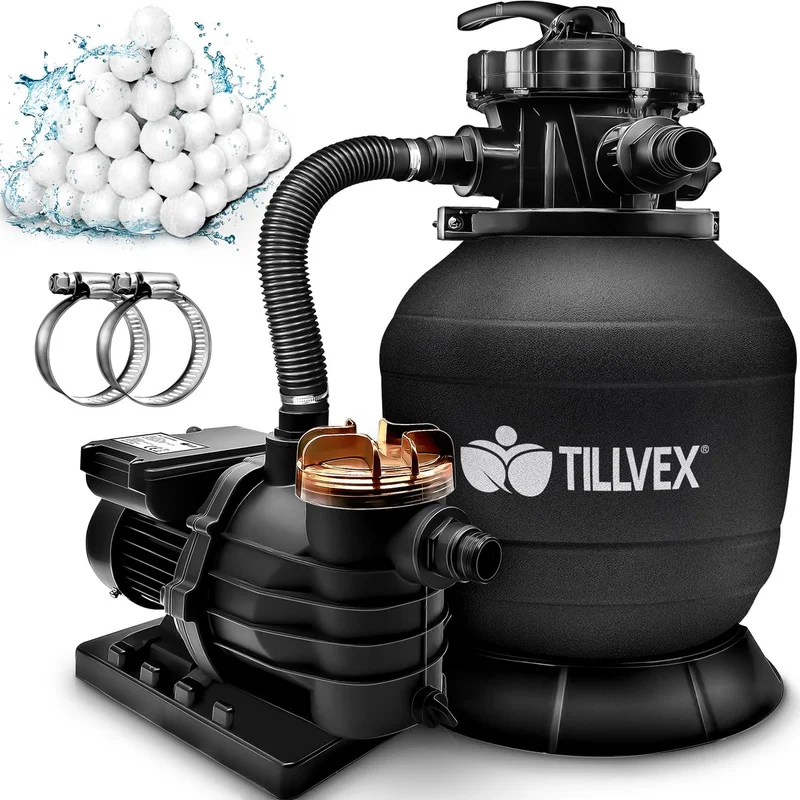
tillvex Sand Filter System 10 m3/h (7-way valve, filter balls)
tillvexComplete sand filter system, 10 m3/h, with 7-way valve, 2-in-1 adapter Ø32–38mm and 800g filter balls. Suitable for above-ground pools up to approx. 30,000 litres.
- Complete set including filter balls and 2-in-1 adapter for Intex and Bestway
- 7-way valve with backwash, rinse and winter positions
- Pressure gauge for filter monitoring
- Available on both Amazon and bol.com
- Lesser-known brand compared to Intex or Bestway
- Plastic filter tank, less durable than stainless steel
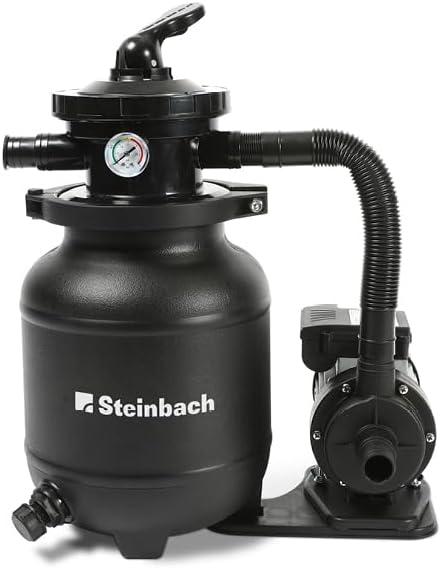
Steinbach Filter System Classic 250N (3.8 m3/h)
SteinbachComplete sand filter system for pools up to 19 m3. 3.8 m3/h capacity with pre-assembled connections. Solid alternative to Intex.
- Pre-assembled connections
- Suits pools up to 19 m3
- Competitive price
- Sturdy vessel
- Slightly lower capacity than 4 m3/h models
- Fewer spare parts available than Intex
If you have a small pool under 10,000 litres and want the lowest upfront cost, a cartridge filter pump is an option. Seasonal running costs are higher than a sand filter, but the purchase price is a fraction.
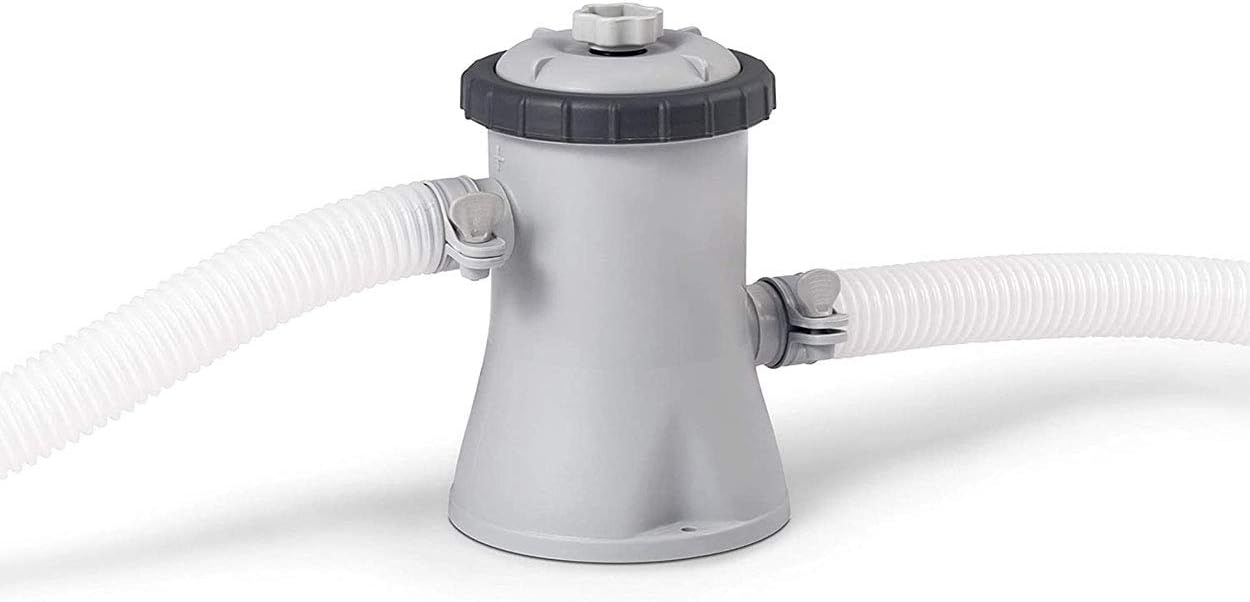
Intex Pool Filter Pump 28602GS C330 1,250 l/h
IntexCompact cartridge filter pump with 1,250 l/h capacity. Energy-efficient entry-level option for small pools up to 10,000 litres. Model 28602GS C330.
- Lowest purchase price
- Energy efficient
- Compact size
- Easy installation
- Cartridges need replacing every 4-6 weeks
- Not suited for pools over 10,000 litres
- Higher seasonal cost than sand filter
What you need for installation
- Hose clamps (usually included)
- Screwdriver and pliers
- Filter sand (quartz sand 0.4 to 0.8 mm), approximately 25 kg for a standard vessel
- PTFE thread tape for threaded connections
- A flat, stable surface for the installation
Installation time: 2 to 4 hours for an above-ground pool.
Maintenance after purchase
- First backwash after installation: rinse for 5 minutes to flush out fine sand dust
- Weekly backwash during the season
- Annual: inspect impeller and strainer basket
- Every 3 to 5 years: replace filter sand
Flow rate calculation: more precise sizing
The required flow rate depends on three factors: pool volume, the number of turnovers per day you want and the number of hours the system runs daily. A pool should achieve at least 3 turnovers per day in warm summer weather.
Formula: pool volume (m3) x 3 turnovers / daily run hours = required capacity (m3/h)
Example: a 30 m3 pool that filters for 10 hours per day: 30 x 3 / 10 = 9 m3/h. Choose a system rated at 10 m3/h.
| Pool volume | Target turnovers | Run hours | Required capacity |
|---|---|---|---|
| 15 m3 | 3 per day | 10 hours | 4.5 m3/h |
| 25 m3 | 3 per day | 10 hours | 7.5 m3/h |
| 40 m3 | 3 per day | 12 hours | 10 m3/h |
| 50 m3 | 3 per day | 12 hours | 12.5 m3/h |
Filter vessel size and surface loading
The diameter of the filter vessel determines how much water can flow through the sand bed per hour without reducing filtration quality. Maximum surface velocity is 25 to 30 m/h.
A vessel with a 400 mm diameter has a filter surface of 0.126 m2. At 30 m/h surface velocity: 0.126 x 30 = 3.8 m3/h maximum throughput. A 500 mm vessel (0.196 m2): 0.196 x 30 = 5.9 m3/h.
Never install a vessel smaller than the pump can handle: sand will be forced through the laterals and filtration quality drops dramatically. Vessel and pump must be matched to each other.
Quartz sand vs. glass media
Quartz sand filters particles down to 20 to 40 microns and lasts 3 to 5 years. Over time the grains round off, lose their sharp edges and begin to clump. Filtration performance drops and backwash frequency increases.
Recycled glass media (such as Waterco AFM or similar glass beads) filters down to 5 to 10 microns: two to four times finer than standard sand. Glass has a smooth surface that algae and bacteria adhere to less readily. Lifespan: 8 to 10 years. Cost: EUR 80 to EUR 150 for a standard charge for a 400 to 500 mm vessel.
For an above-ground pool of 15,000 litres used over 5 seasons, the extra investment in glass media (approximately EUR 60 more than sand) pays back through less filter cleaner, less backwash water and clearer pool water.
Installation requirements
A sand filter system works best when the pump can build adequate suction pressure. For self-priming pumps: the maximum suction head is 3 metres. If the pump sits more than 3 metres above the water level, it will fail to prime or draw air.
Minimum operating pressure is 0.5 bar at normal filtration. Make sure the pipework to the pool has no unnecessary bends: each 90-degree bend is equivalent to approximately 0.5 metres of pipe resistance.
Backwash water can go to the household drain. Check with your local authority: in most municipalities pool backwash water is permitted in the household sewer system for occasional use. Discharge to surface water (ponds, streams) is not permitted in most areas.
Backwash frequency and water consumption
Backwash weekly during peak season (June to August) and every two weeks in the shoulder months. After an algae treatment: backwash daily until the water is clear.
Each backwash uses 300 to 500 litres depending on vessel size and pump flow. Over a 20-week season with weekly backwash: 20 x 400 litres = 8,000 litres, roughly equal to the evaporation top-up for the same period.
For the step-by-step backwash procedure, see our sand filter backwash guide .
Energy cost per year
A standard single-speed pump rated 0.37 kW at 4 m3/h, running 10 hours per day: 0.37 x 10 = 3.7 kWh per day. At EUR 0.40 per kWh over a 150-day season: 3.7 x 150 x 0.40 = EUR 222 per season.
A variable speed pump at the same installation running at average 40% speed uses approximately 0.06 kW average: 0.06 x 10 x 150 x 0.40 = EUR 36 per season. Saving: EUR 186 per season. The price premium of a VS pump (EUR 200 to EUR 400) pays back in 1 to 2 seasons.
Replacing filter sand
Replace sand every 3 to 5 years or when water remains cloudy after a correct backwash. Signs of worn sand: filter pressure rises quickly after a fresh backwash, water is still not clear after 24 hours despite correct chemistry.
Quartz sand (0.4 to 0.8 mm grain size) costs EUR 5 to EUR 8 per 25 kg bag. A standard 400 mm vessel needs 25 kg; a 500 mm vessel takes approximately 50 kg. Total sand replacement cost: EUR 15 to EUR 50 depending on vessel size.