A pool cover is one of the best investments you can make for your pool. A solar bubble cover heats water by 3 to 8°C and reduces evaporation by up to 70 percent. A winter cover protects the pool from leaves, rain, and UV damage during the off-season. Which type you need depends on the season and your safety requirements.
Why a pool cover pays for itself
An uncovered pool loses 2 to 5 millimeters of water per day through evaporation. For an 8 x 4 meter pool that’s 64 to 160 liters per day — and along with the water go the chemicals you just added. A pool cover cuts evaporation by 80 to 95 percent.
Beyond water savings, a cover keeps the pool cleaner. Fewer leaves, pollen, and insects in the water means 30 to 50 percent less chemical use. A covered pool is simply a lower-maintenance pool.
Solar pool covers: free heat from the sun
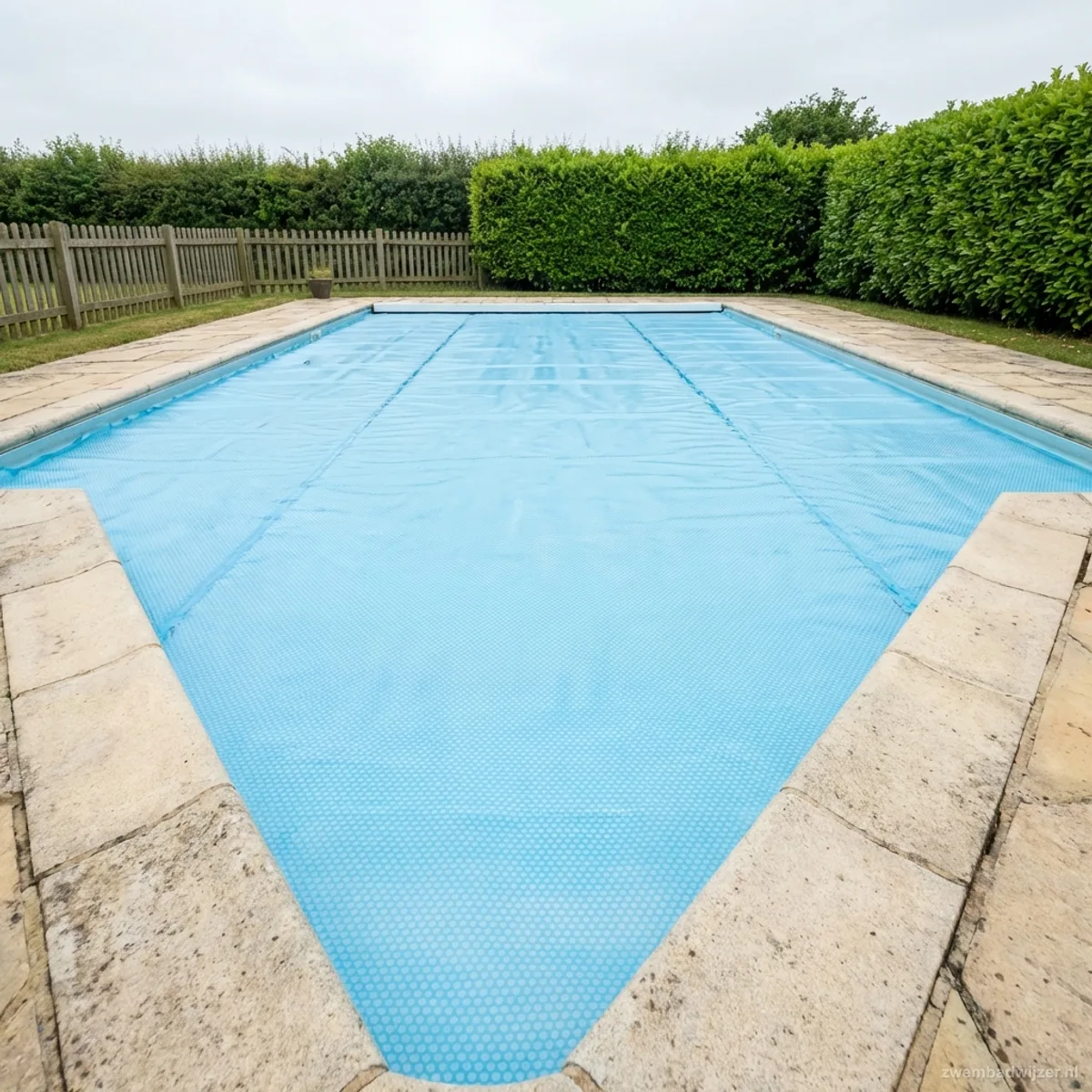
A solar cover, also called a bubble cover or solar blanket, is the most popular cover type for summer. The double layer of air bubbles acts like bubble wrap: it lets sunlight through to warm the water while blocking heat loss to the air.
How a solar pool cover works
The transparent or light blue film lets direct sunlight reach the water while the trapped air in each bubble provides insulation. On a sunny day, the water temperature rises 3 to 5°C more than an uncovered pool. Over a full swimming season, a solar cover averages a 5 to 8°C warmer pool.
Solar cover: color and thickness guide
| Color | Heating effect | Nighttime insulation | Lifespan | Price per m² |
|---|---|---|---|---|
| Transparent | +++ | + | Shorter | €4-€8 |
| Blue | ++ | ++ | Medium | €5-€10 |
| Blue/silver | ++ | +++ | Medium | €6-€12 |
| Green/black | + | +++ | Longer | €7-€14 |
Choose transparent or light blue for maximum heating in Northern Europe. Choose blue/silver if you want to retain heat overnight as well as gain it during the day. Minimum thickness should be 400 microns for acceptable durability.
Summer pool covers without solar heating
Beyond solar bubble covers, plain summer covers made from PE (polyethylene) protect against leaves and UV chemical degradation without a heating function. They cost €1 to €4 per m² and are a low-cost option for debris protection only.
Winter pool covers: protecting your pool off-season
A winter cover is used from September/October through April/May when the pool is not in use. The goal is protection from leaves, weather, and UV — not heating.
Types of winter pool covers
Polyethylene (PE) winter tarp: The most affordable option at €2 to €6 per m². Suitable for above-ground and frame pools. Typical weight is 90 to 200 grams per m². Not designed to support body weight.
PVC winter cover: Heavier and more durable than PE at €5 to €12 per m². The right choice for in-ground pools. PVC coating resists chemicals and UV better over the long term.
Safety cover: The heaviest type, designed to support the weight of a child while giving time for a rescue. Costs €800 to €3,000 for a custom-made cover with ground anchors. Strongly recommended for any pool where young children have access.
Always secure a winter cover with a tensioning system: an elastic cord for round above-ground pools, ground anchors or water tubes (weighted bags around the edge) for in-ground pools. The full winterizing process is covered in our guide to winterizing your pool .
Sizing a pool cover: round and rectangular
Always buy a cover 20 to 40 centimeters larger than the outside dimension of the pool to allow sufficient overlap for securing.
| Pool diameter | Recommended cover size | Overlap |
|---|---|---|
| 300 cm | 330-340 cm | 30-40 cm |
| 366 cm | 390-400 cm | 24-34 cm |
| 396 cm | 420-430 cm | 24-34 cm |
| 457 cm | 480-500 cm | 23-43 cm |
For rectangular pools the same principle applies: buy a cover that overlaps 20 to 30 centimeters on all four sides. Custom sizing is available for non-standard shapes.
Cover reels and roller systems
A cover reel (roller system) makes placing and removing a solar cover much easier. The cover winds onto an aluminum tube on a stand beside the pool. Manual roller systems cost €150 to €400. Electric roller systems cost €800 to €2,500 and are operated with a switch.
Automated under-terrace storage systems cost €3,000 to €8,000 but give a clean, uncluttered look and maximum convenience.
Price comparison: cover types side by side
| Type | Price per m² | Total 8x4m | Lifespan | Benefits |
|---|---|---|---|---|
| Solar bubble cover (standard) | €4-€10 | €128-€320 | 3-5 years | Heats water, cuts evaporation |
| Solar bubble cover (premium) | €10-€16 | €320-€512 | 5-7 years | Better insulation, longer life |
| Summer cover PE | €1-€4 | €32-€128 | 3-7 years | Budget, debris protection |
| Winter cover PE | €2-€6 | €64-€192 | 5-10 years | Winter protection |
| Winter cover PVC | €5-€12 | €160-€384 | 8-15 years | Durable, chemical resistant |
| Safety cover (custom) | POA | €800-€3,000 | 10-20 years | Child safety, premium look |
The best approach is to combine a solar cover for summer with a separate winter cover. They serve different functions and typically need replacing on different schedules. If you are still deciding on which pool to buy, read our pool buying guide to understand which pool types work best with which cover systems.
Frequently asked questions
What is the best pool cover to buy?
For summer use, a solar bubble cover (bubble wrap-style) is the best choice: it heats water by 3 to 8°C and cuts evaporation by up to 70%. For winter, a polyethylene winter tarp with a securing system is the most practical option. A safety cover is essential if young children have access to the pool.
How thick should a solar pool cover be?
Solar bubble covers range from 300 to 500 microns (0.3 to 0.5 mm) thick. Thicker film is more durable and provides slightly better insulation. Choose at least 400 microns for a reasonable lifespan. Transparent film lets in more sunlight; blue-silver reflects more heat back at night.
How long does a pool cover last?
A solar bubble cover lasts 3 to 7 years under normal use. UV exposure and pool chemicals — especially chlorine — degrade the film over time. A winter tarp made from PVC or PE lasts 5 to 15 years depending on quality. Always store covers dry and away from direct sunlight when not in use.
Can I leave a pool cover on while swimming?
No, a solar cover must be removed before anyone enters the water. It floats freely and can be a drowning hazard. A safety cover is only safe when it is fully secured with its anchor system and must never be used as a free-floating cover.
What is the difference between a pool cover and a pool enclosure?
A pool cover sits on or just above the water surface and is used when the pool is not in use. A pool enclosure is a permanent structure of aluminum and polycarbonate that stands over the pool, allowing year-round access and swimming.