Testing your pool water correctly is the foundation of good pool chemistry. An inaccurate reading leads to an inaccurate correction - adding pH minus to water that is already at the right pH, or dosing chlorine when the reading was skewed by a contaminated strip. The result is wasted product at best and a chemistry spiral at worst.
The good news is that accurate pool water testing does not require expensive equipment. Understanding what each type of tester measures, how it works and where it can mislead you is more important than spending more money on a premium device.
Comparison overview
| Tester type | Cost | Parameters | Accuracy | Learning curve | Best for |
|---|---|---|---|---|---|
| Test strips (budget) | EUR 10 to 16 per 100 | 5 | +/- 0.3 pH | Very low | Cheapest daily checks |
| Test strips (premium 6-in-1) | EUR 12 to 25 per 100 | 6 to 7 | +/- 0.2 pH | Very low | Daily quick checks |
| Digital pH meter (entry) | EUR 15 to 25 | pH | +/- 0.01 pH | Low | Budget precision for pH |
| Digital pH meter (pro) | EUR 25 to 40 | pH | +/- 0.01 pH | Low | Accurate pH correction |
| Electronic 7-param tester | EUR 150 to 200 | 7 | +/- 0.05 pH | Low to medium | App trends and alerts |
| Digital photometer | EUR 130 to 180 | 6 | +/- 0.05 pH | Low to medium | Multi-parameter precision |
| Liquid drop test kit | EUR 15 to 40 | 2 to 4 | Very high | Low to medium | Accurate baseline readings |
Each type has a legitimate role. Many experienced pool owners use test strips 2 to 3 times a week for routine checks and keep a liquid or digital tester for weekly accurate readings and for confirming results before making significant chemical adjustments.
Test strips - how to use correctly
Test strips are the most widely used pool testing method and the most frequently misused. When used correctly, they are accurate enough for routine maintenance. Small user errors, however, can produce readings that are significantly off.
The correct technique:
- Dip the strip in the pool water for exactly 1 second. Do not wave it around or leave it submerged longer.
- Remove and hold horizontally (do not shake off excess water - the water on the pads is part of the reaction).
- Move immediately to a location with natural daylight but not direct sunlight.
- Read the colour against the reference chart on the bottle within 15 seconds of removing from the water. After 15 seconds, the colour continues to develop and the reading becomes unreliable.
Common mistakes:
Handling strips with wet fingers is the most damaging habit. The moisture from your fingers transfers to the remaining strips in the tube, slowly degrading the reagent pads. Always handle strips with dry fingers, hold them at the non-reagent end and replace the cap immediately after removing a strip.
Using expired strips gives unreliable results. Check the expiry date on the bottle. Most strips are valid for 12 to 18 months from the manufacture date when properly stored.
Reading in direct sunlight makes colour comparison difficult and can make the pads appear lighter. Always read in natural indirect light.
Tip
Heat and humidity are the enemies of test strips. Do not store them in a pool shed that gets very hot in summer, and never store them near the pool itself. A cool, dry indoor location significantly extends their accuracy and shelf life. Some brands include a desiccant capsule in the tube - keep it there.
Which test strips to choose
Not all test strips are equal. Premium strips from established brands (such as Aquachek, Lovibond and Bayrol) give more consistent results than generic strips. The key specifications to look for are: at least 6 parameters (free chlorine, total chlorine, pH, total alkalinity, calcium hardness and CYA), a wide enough chlorine range to detect post-shock levels (up to at least 10 mg/l) and reagent pads that are individually sealed or in a well-sealed tube with a desiccant.
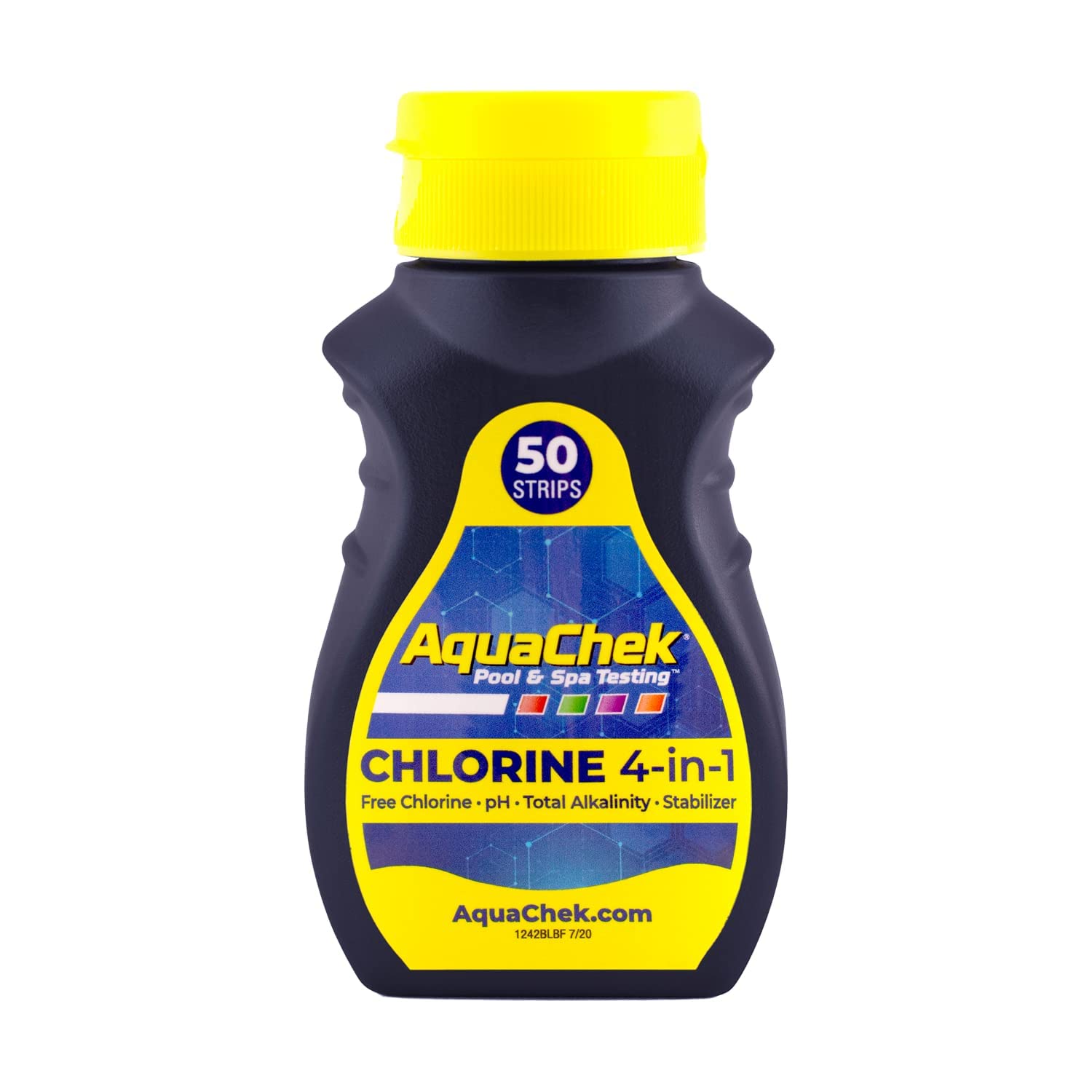
AquaChek 511244A Test Strips 6-in-1 (100 strips)
AquaChekTest pH, chlorine, alkalinity, hardness and more in one go. 100 strips per pack.
- Fast results
- 6 parameters in 1 strip
- Affordable
- Less accurate than digital testers
If you want the cheapest route, the LT Lifetastic 5-in-1 strips on bol.com give you 100 strips in a resealable tube with a desiccant for around EUR 0.16 per test. They measure pH, free chlorine, total chlorine, alkalinity and hardness - enough for routine checks if you pair them with a separate digital meter for fine pH correction.
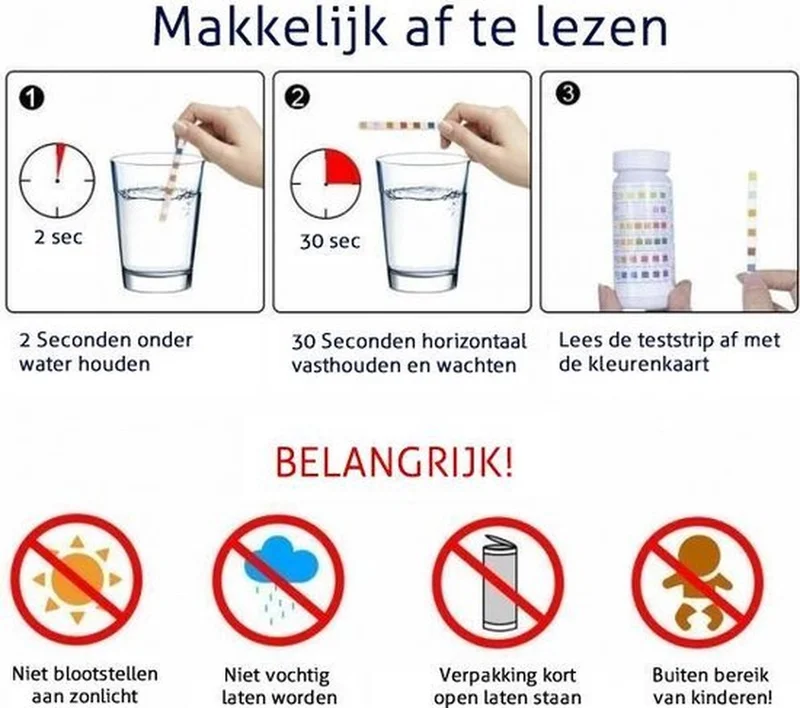
LT Lifetastic 5-in-1 Pool Test Strips (100 strips)
LT LifetasticBasic test strips that read pH, free chlorine, total chlorine, alkalinity and hardness. 100 strips in a resealable tube with an included manual.
- Low cost per strip (EUR 0.16)
- 100 strips per pack
- Resealable tube protects against moisture
- No cyanuric acid (CYA) pad
- Colour chart is less fine than premium strips
Digital pH meters - fast and accurate pH correction
A digital pH meter uses an electrode to read pH directly from pool water, accurate to within 0.01 pH units. That is roughly 20 times more precise than a test strip. The difference shows up when you dose pH-minus: knowing the exact reading is 7.52 rather than “somewhere in the 7.4 to 7.6 range” means you add the right amount the first time.
A pH meter measures only pH, however. For chlorine, alkalinity and CYA you still need strips or a drop test. Budget for an extra EUR 5 per year for calibration buffer solution and store the electrode wet in the supplied cap.
The Apera Instruments PH20 is the strongest home-use pH meter in its class. It reads to 0.01 accuracy, has automatic temperature compensation and ships with two buffer solutions (pH 4.0 and pH 7.0). Battery life runs to around 2000 hours of use.
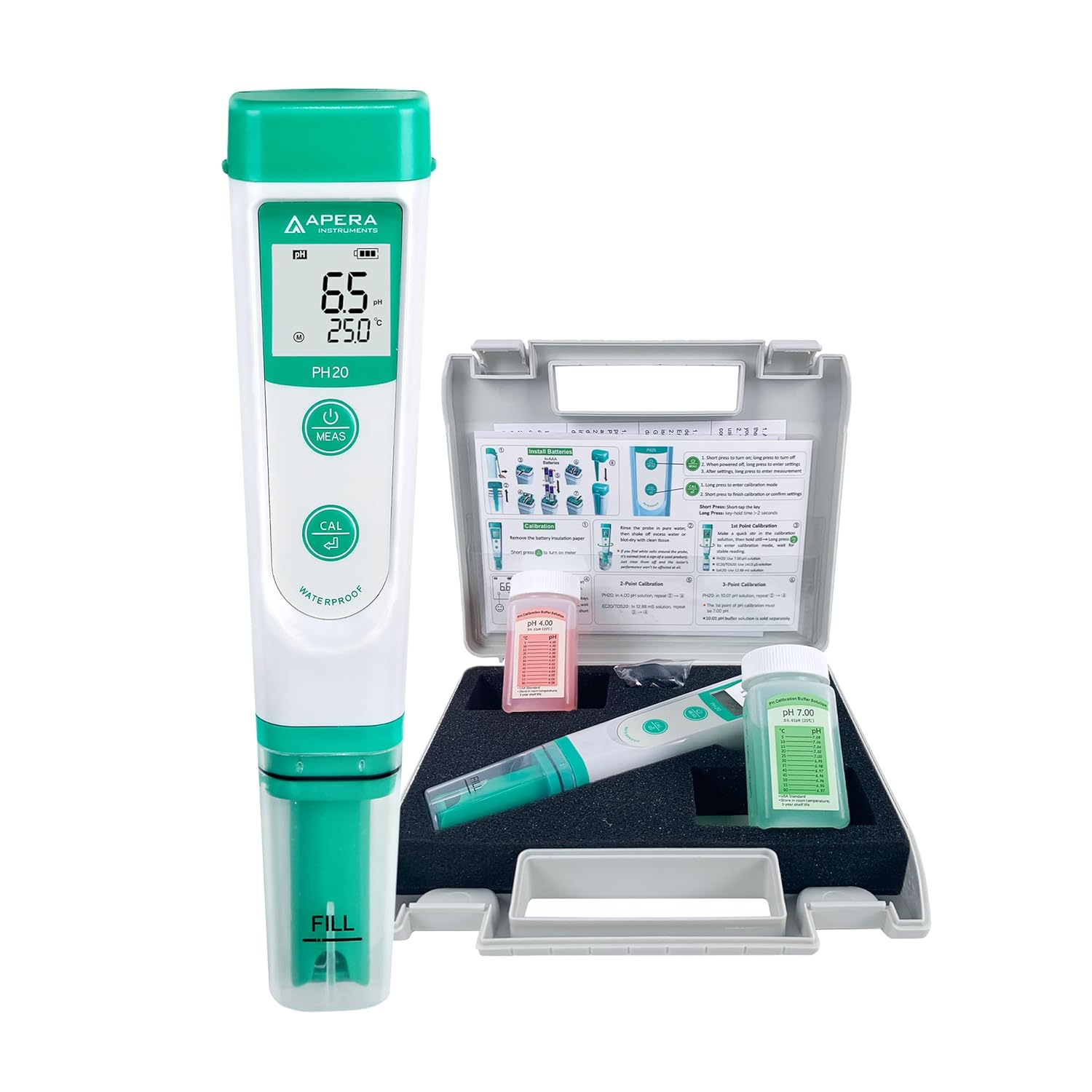
Apera Instruments PH20 pH Meter
Apera InstrumentsAccurate digital pH measurement to 0.01 precision. Includes calibration solution.
- High accuracy
- Fast readings
- Reusable
- Higher upfront cost
- Needs regular calibration
Want to test whether a digital meter fits your routine before spending more? The Aqua-Loui digital pH meter lists at EUR 19.99 on bol.com. It also offers 0.01 resolution and ships with calibration powder and batteries, but the build quality is lower than the Apera. It is fine for a first season of use.
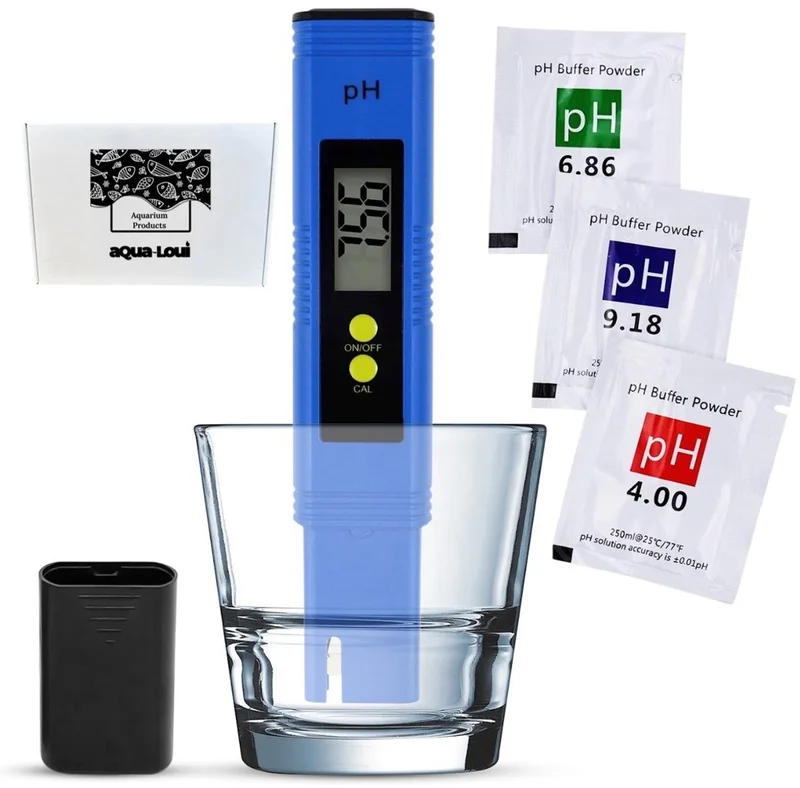
Aqua-Loui Digital pH Meter (with calibration powder and batteries)
Aqua-LouiEntry-level digital pH meter with 0.01 resolution for pool, aquarium and plant soil use. Comes with calibration powder and batteries in the box.
- Low price under EUR 20
- 0.01 pH resolution
- Calibration powder included
- Measures pH only, no chlorine
- Electrode must be stored wet
Digital photometers and electronic testers
A digital photometer (also called a colorimeter) measures pool water chemistry by detecting the colour intensity of a chemical reaction. You add a reagent tablet (supplied separately) to a sample of pool water, wait for the colour to develop, insert the cuvette (sample vial) into the device and read the numeric result on a display.
The main advantage is precision. A digital photometer is accurate to within approximately 0.05 pH units for pH and 0.1 mg/l for chlorine - significantly better than test strips. This precision matters when you are making fine corrections to water that is slightly outside range, or when you need to verify that free chlorine has dropped below 3 mg/l before allowing swimming after a shock treatment.
Running costs: the device itself is a one-time purchase, but reagent tablets are a recurring expense of approximately EUR 20 to 60 per year depending on how frequently you test. DPD No.1 reagent tablets are used for free chlorine; DPD No.3 for total chlorine; phenol red for pH. Tablets have a shelf life and must be stored correctly (cool and dry).
Calibration: most consumer photometers are factory calibrated and do not require regular recalibration. If your device gives readings that seem inconsistent with your water’s appearance, use a calibration check solution (supplied by the manufacturer) to verify the device is reading correctly.
Digital photometers are the right tool for pool owners who dose chemicals frequently, have had recurring chemistry problems or want a more reliable confirmation reading than test strips can provide.
The PoolLab 2.0 complete set is the most popular home photometer. It measures pH, free chlorine, total chlorine, alkalinity, cyanuric acid and calcium hardness to 0.05 accuracy, pairs with the free PoolLab app over Bluetooth and ships as a full kit with 100 reagent tablets, sample cuvettes and a carrying case.
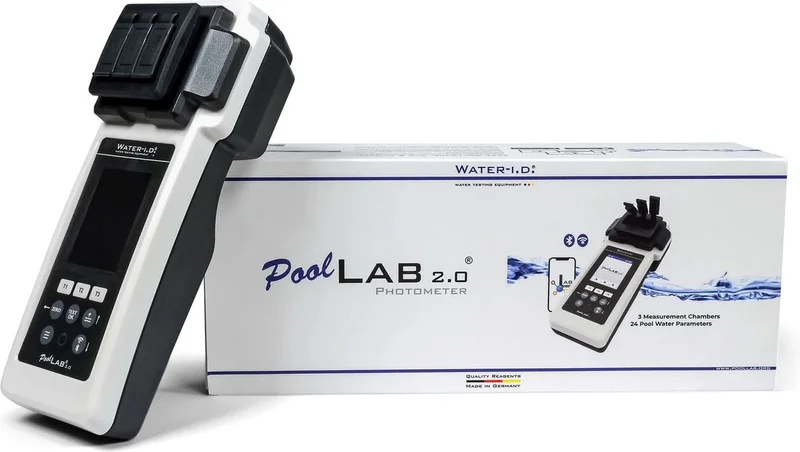
Water-I.D. PoolLab 2.0 Digital Photometer (Complete Set)
Water-I.D.Professional tablet-based photometer that reads pH, free chlorine, total chlorine, alkalinity, cyanuric acid and hardness to 0.05 accuracy with Bluetooth app sync. Ships in a case with reagent tablets and sample cuvettes.
- Measures 6 parameters photometrically
- Bluetooth pairing with PoolLab app
- Complete kit in carrying case
- High upfront cost
- Reagent tablets are a recurring cost
For a similar budget the Bayrol Electronic Pool Tester offers 7 parameters (including bromine for bromide-treated pools) with a companion app that calculates dosing directly from your pool volume. Its built-in pump flushes sample water through the reagent chamber automatically - you only add a tablet. Useful if you already use Bayrol chlorine and pH products, since the app’s dosing tables match their product line.
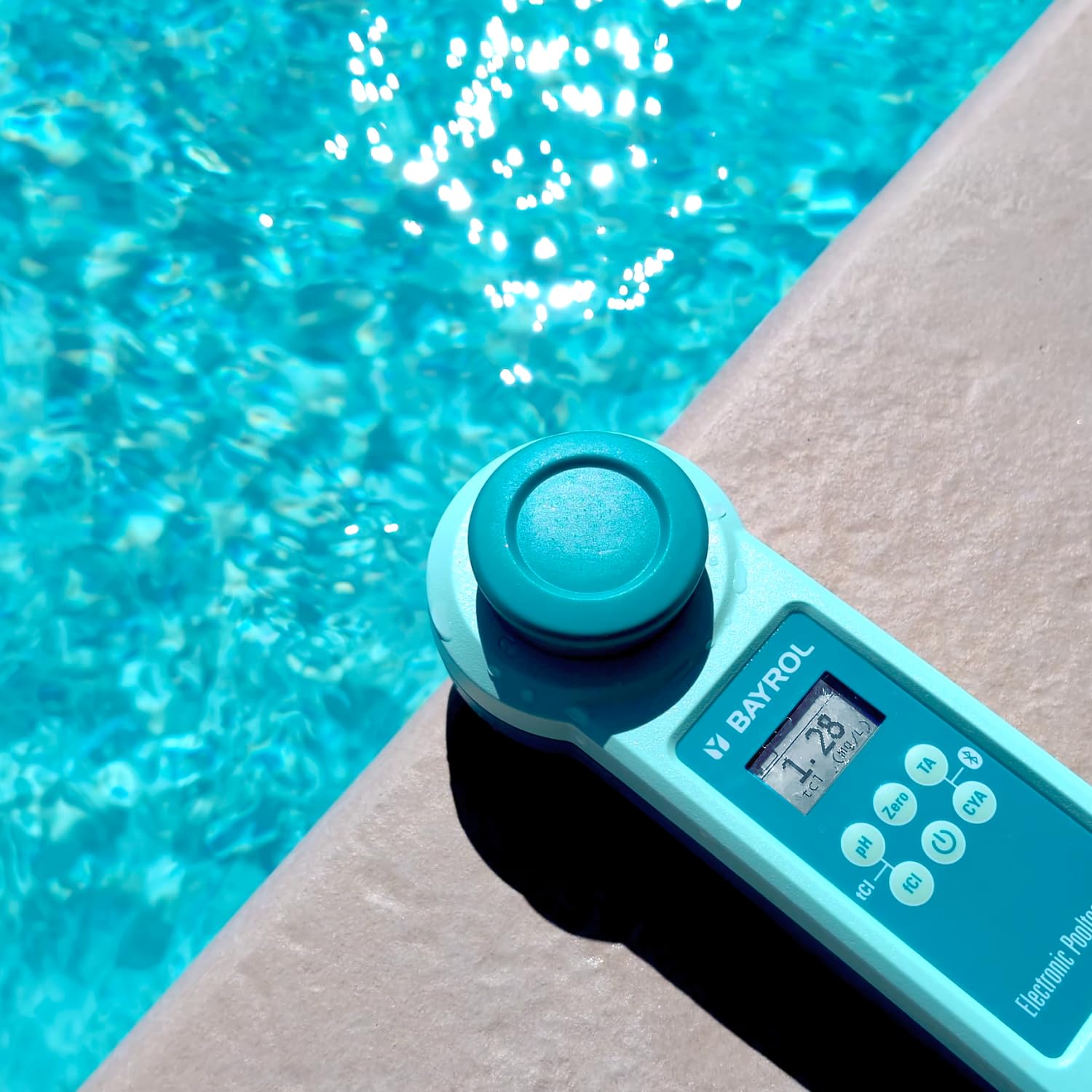
Bayrol Electronic Pool Tester (7 parameters, Bluetooth)
BayrolBayrol electronic pool tester covering 7 parameters (pH, free chlorine, total chlorine, alkalinity, cyanuric acid, hardness and bromine). Bluetooth connection with a companion app for trend graphs and dosing advice.
- 7 parameters in a single device
- Bluetooth app with dosing calculations
- Bayrol brand reliability
- Reagent tablets required per test
- On the expensive side for home pools
Drop test kits - the gold standard for accuracy
Liquid drop test kits use chemical reagent drops (rather than pads or tablets) to produce a colour change in a water sample. The colour is compared visually against a printed reference chart. When used correctly, they are the most accurate consumer testing method available and are used by pool professionals for routine water analysis.
DPD testing for chlorine: DPD (N,N-diethyl-p-phenylenediamine) reacts with free chlorine in the water to produce a pink colour. The intensity of the pink corresponds to the chlorine concentration. DPD No.1 measures free chlorine; adding DPD No.3 after DPD No.1 allows you to measure total chlorine. The difference between the two readings is combined chlorine (chloramines).
Phenol red for pH: phenol red produces a colour ranging from yellow (low pH) through orange and red to pink-red (high pH). The range typically covers pH 6.8 to 8.2, which encompasses the full range of normal pool water pH.
OTO testing (orthotolidine): OTO is a faster alternative for chlorine that produces a yellow colour. It measures total chlorine rather than free chlorine, which is less precise for troubleshooting but adequate for a quick check.
The learning curve for drop test kits is low. The main challenge is accurate colour comparison: interpreting shades of pink against a reference chart under artificial light can produce slightly different readings than in natural light. Consistent technique and a clean, dry comparator block make a significant difference.
If you want the drop-test precision but prefer a digital readout, a photometer (such as the PoolLab 2.0 recommended above) uses the same DPD and phenol red chemistry in tablet form and removes the colour-matching step entirely.
What to test and how often
| Parameter | Target range | Minimum frequency | Why |
|---|---|---|---|
| Free chlorine | 1 to 3 mg/l | 2 to 3 times per week | Primary disinfectant - must stay in range |
| pH | 7.2 to 7.6 | 2 to 3 times per week | Affects chlorine effectiveness dramatically |
| Total alkalinity | 80 to 120 mg/l | Weekly | Buffers pH from swings |
| Calcium hardness | 200 to 400 mg/l | Weekly | Prevents corrosion and scaling |
| Cyanuric acid (CYA) | 30 to 50 mg/l | Twice per season | Prevents chlorine lock if too high |
| Combined chlorine | Under 0.5 mg/l | Weekly | Indicates chloramine build-up |
| Total dissolved solids | Under 1,500 mg/l | Monthly | High TDS reduces treatment efficiency |
Test free chlorine and pH most frequently - they are the parameters that change fastest and have the most immediate impact on water safety and quality. Total alkalinity and calcium hardness are more stable and a weekly check is sufficient during normal operation. CYA accumulates slowly and a check at the start of the season plus one in midsummer is adequate for most pools.
After any chemical treatment or significant event (heavy rain, party, shock treatment), always test before allowing swimming. Do not rely on elapsed time alone.