Green pool water means algae growth and is not safe to swim in. Algae consume chlorine and create conditions where bacteria multiply. The fix is a chlorine shock of 10 to 30 mg/l, daily backwashing and 24-hour pump operation. In 3 to 5 days the water is clear — unless your CYA level is too high, in which case no shock dose will work until you address it.
Diagnose first: how bad is it?
The treatment differs depending on severity. Check before reaching for the chemicals.
Light green water — you can still see the pool floor, water has a green tint. Early algae growth, probably less than 48 hours old. Treatment: 10 mg/l shock dose, single algicide application, daily backwashing. Recovery: 2 to 3 days.
Dark green or opaque water — the floor is not visible. Active algae growth, several days old. Treatment: 20 to 30 mg/l shock dose, strong algicide, daily backwashing. Recovery: 4 to 7 days.
Green deposits on walls, water looks normal — algae have attached to the surface. This is a precursor to green water. Fix: brush the walls thoroughly, then apply a preventive shock at 10 mg/l. See green algae on pool walls .
Black spots on tiles or concrete? That is black algae, the hardest type to treat. See types of pool algae .
Is green pool water dangerous?
Yes. Two specific risks:
Bacteria: algae are not harmful themselves, but they create conditions where pathogens like E. coli, Pseudomonas and Legionella can reach harmful concentrations within 24 hours in water with no active chlorine.
No disinfection: when water is green, free chlorine is almost always at or near zero. The water offers no protection against bacteria and viruses that swimmers introduce.
Do not swim in green pool water. Wait until the water is clear, free chlorine is between 1.0 and 3.0 mg/l, and pH is between 7.2 and 7.6.
Step-by-step: how to fix a green pool
Step 1: Test pH and CYA before anything else
Test two values before adding any chemicals.
pH: bring it to 7.2. At this level chlorine is at peak effectiveness for shock treatment. Above pH 7.8, less than 10% of your chlorine is in the active form (HOCl).
CYA (cyanuric acid / stabiliser): this is the step most pool owners skip, and the reason most shock treatments fail when they do. CYA protects chlorine from UV degradation — useful in small doses, destructive when it accumulates. Above 80 ppm, CYA binds chlorine so tightly that the active form (HOCl) is effectively unavailable even when your test strip shows 3 mg/l. If CYA is above 80 ppm, replace at least 30% of the pool water before shocking. There is no chemical way to lower CYA — dilution is the only option.
Step 2: Calculate the shock dose
Based on calcium hypochlorite (70%):
| Pool volume | Light green (10 mg/l) | Dark green (20 mg/l) | Severe / black (30 mg/l) |
|---|---|---|---|
| 10,000 litres | 140 g | 280 g | 420 g |
| 20,000 litres | 280 g | 560 g | 840 g |
| 30,000 litres | 420 g | 840 g | 1,260 g |
| 50,000 litres | 700 g | 1,400 g | 2,100 g |
Don’t know your pool volume? Calculate it as: length × width × average depth × 1,000 = litres.
Step 3: Apply the shock treatment
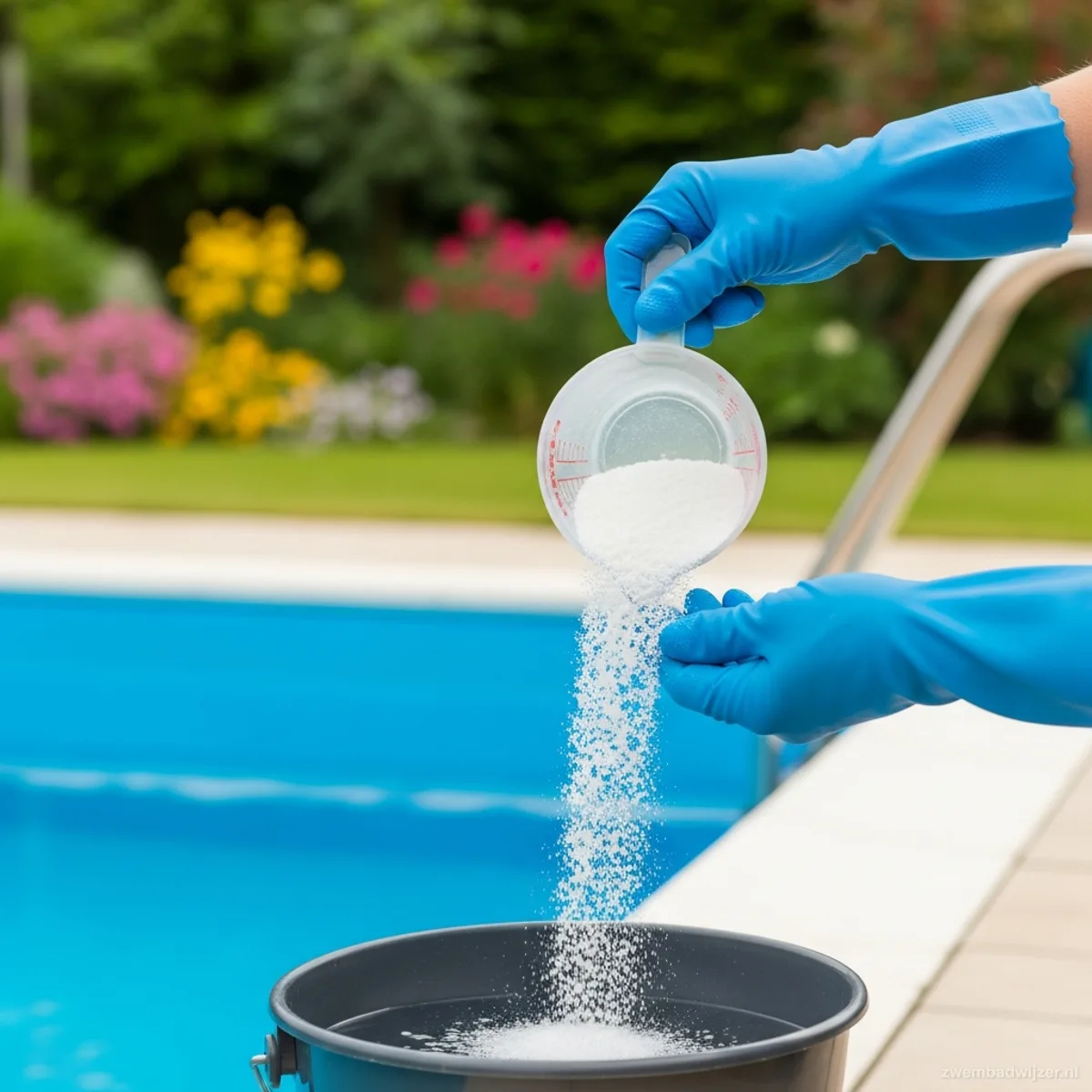
Always dissolve granules in a bucket of water first — never scatter directly into the pool. Add the solution while the pump is running, pouring slowly at multiple points around the pool edge.
Shock in the evening. UV light destroys extra chlorine within a few hours in direct sunlight. Run the pump at full capacity through the night after dosing.
For the full shock treatment procedure including liquid chlorine dosing, see our pool shock treatment guide .
Step 4: Add algicide
Wait at least 4 hours after shocking, then add algicide per the label dosage. Algicide does not disinfect — it helps dead algae clump together so the filter can capture them.
Never add algicide at the same time as chlorine. Chlorine oxidises the algicide and renders it ineffective.
Step 5: Brush walls and floor
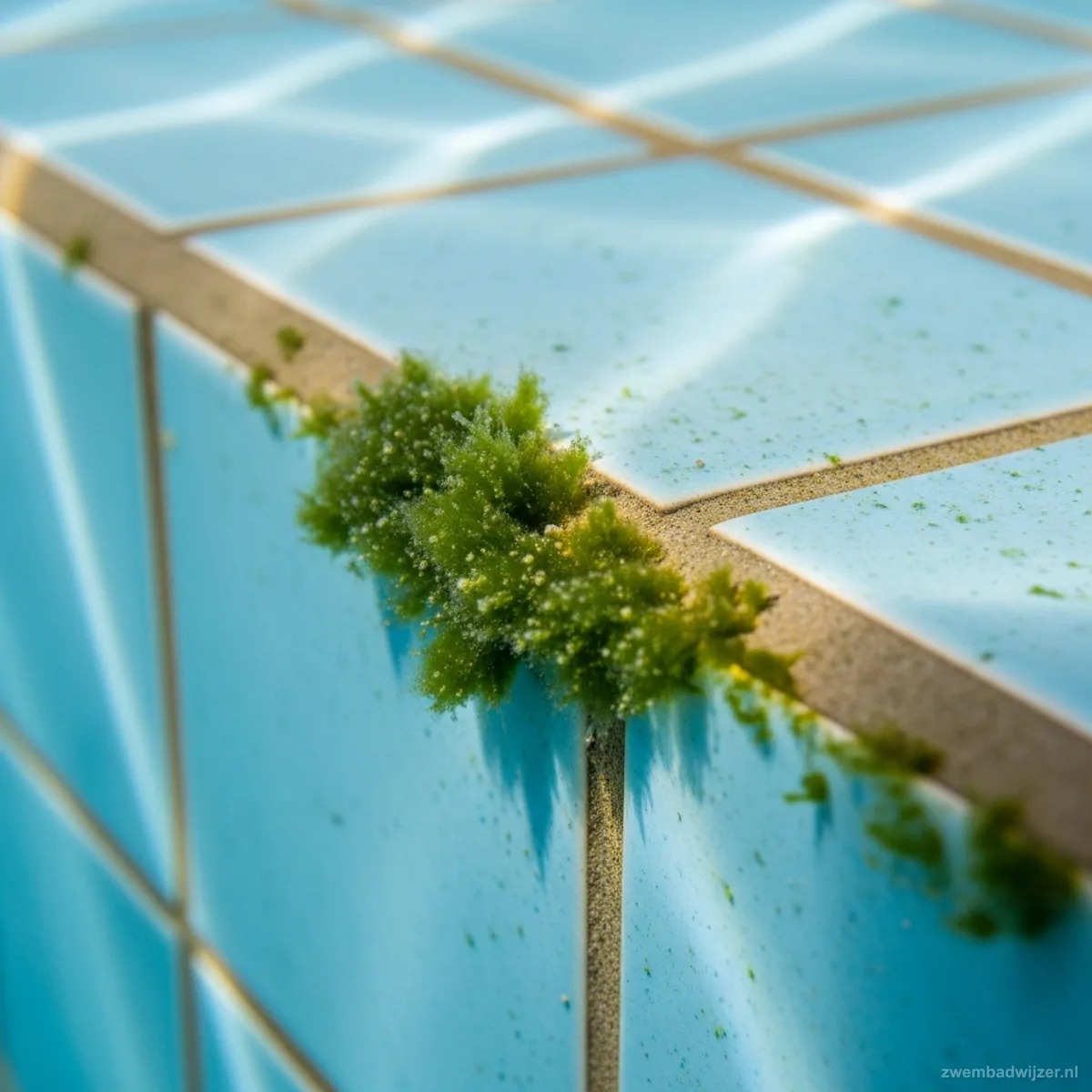
Brush all walls, the floor and especially corners and steps. This brings algae into suspension where the chlorine can reach them. Use a nylon brush for green and yellow algae on vinyl liners or fibreglass; use a stainless steel wire brush for black algae on concrete or tiles.
Step 6: Run pump 24 hours and backwash daily
Run the pump continuously until the water is clear. Standard operation is 8 to 12 hours per day, but during algae treatment 24-hour circulation is necessary to give the filter enough time to process the dead algae.
Backwash the sand filter every day for 3 to 5 minutes. A filter loaded with dead algae loses filtration capacity quickly — without daily backwashing the water stays hazy even after the algae are dead.
Step 7: Assess after 24 hours
- Water lightening or turning blue-grey and cloudy: treatment is working. Blue-grey is normal — it is dead algae in suspension. Continue filtering.
- Water remains dark green: repeat the shock dose. Test pH and CYA again before repeating.
- Still hazy after 4 to 5 days: add a dose of pool flocculant to clump remaining fine particles for vacuuming.
When shock doesn’t work: 4 causes
If your pool is still green after a full shock treatment, something is blocking the chlorine.
1. CYA too high (most common)
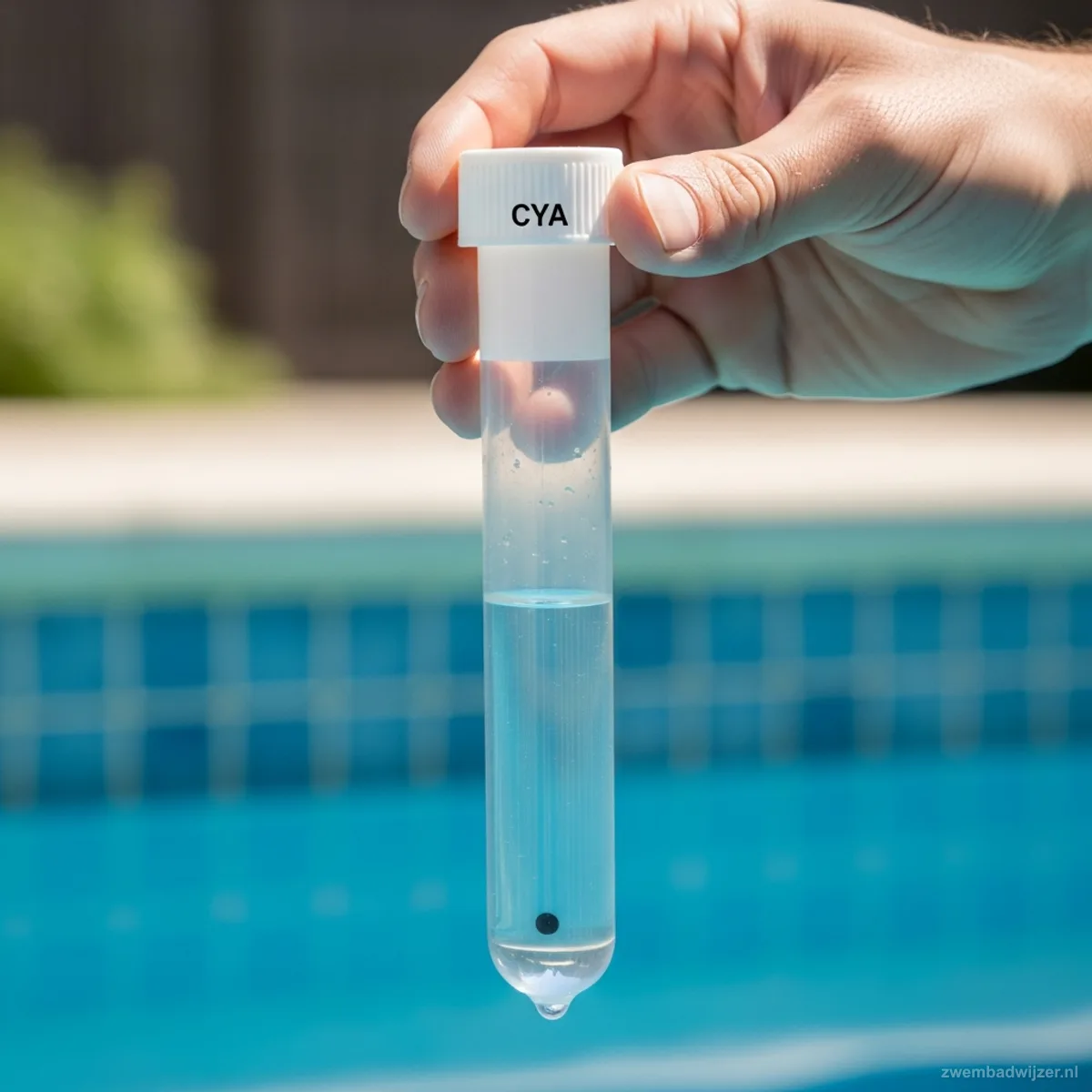
Accumulated cyanuric acid is the most overlooked reason shock treatments fail. Every trichlor tablet or granule you add also adds roughly 6 grams of CYA to the water. Over a season, CYA easily climbs above 100 ppm in pools that rely entirely on stabilised chlorine.
At CYA 100 ppm, effective free chlorine activity drops by roughly 85% compared to water with no CYA. A pool testing 3 mg/l free chlorine with CYA at 100 ppm has almost no algicidal power.
Fix: test CYA with a turbidity test kit (the black-dot test). If you cannot see the black dot at the bottom of the tube, CYA is above approximately 50 ppm. Above 80 ppm, replace 30 to 50% of the pool water before attempting another shock.
2. pH too high
At pH 7.8, less than 20% of your chlorine is in the active HOCl form. At pH 8.0, it drops to around 3%. You can add 30 mg/l and see almost no algicidal effect. Bring pH to 7.2 before every shock treatment — not 7.4, not 7.6.
3. Clogged filter
A filter packed with dead algae cannot move enough water to distribute the chlorine or remove debris. Backwash thoroughly before starting treatment. If the filter pressure is 0.5 bar above the normal operating pressure, backwash before shocking.
4. Wrong chlorine type
Slow-dissolving trichlor tablets are not appropriate for shock treatment — they are designed for steady background chlorination, not emergency doses. Use calcium hypochlorite granules (70%) or sodium hypochlorite solution (12 to 15%) for effective shock treatment.
Types of pool algae
Green algae (most common)
Colour the water light to deep green. Float in the water or cling to walls. Green algae respond well to a standard shock of 10 to 20 mg/l. Recovery in 3 to 5 days with consistent treatment.
Yellow algae (mustard algae)
Look like sand or yellowish dust deposited on the walls — not as a water colour change. Yellow algae are more chlorine-resistant than green: they have a protective coating that standard chlorine penetrates less easily. Treatment: brush thoroughly before shocking, use 20 to 30 mg/l, and add an algicide specifically rated for yellow algae. Treat any equipment or accessories that have been in contact with the water at the same time.
Black algae
Deep blue-black spots on tiles, concrete or fibreglass. The most persistent type: they have multiple protective layers and embed themselves into rough surfaces. Standard shock at 10 mg/l is insufficient. Treatment: scrub daily with a stainless steel wire brush to break the protective layer, apply 20 to 30 mg/l to the water, and concentrate high-strength liquid chlorine directly onto the spots with a brush. Repeat daily for at least one week. Black algae will return if treatment stops before all spots are gone.
Green algae on pool walls
Green deposits on pool walls without green water in the pool are a separate problem — algae that have attached to the surface and formed a biofilm layer.
Green water vs. green wall deposits:
- Green water: algae suspended in the water. Treat with shock.
- Green wall deposits: algae attached to the surface. Requires brushing first, then shock.
How to remove:
- Brush all deposits firmly, working from top to bottom. Nylon brush for liners, stainless steel for concrete and tile.
- Apply shock treatment at 10 to 20 mg/l.
- Backwash after 24 hours.
- Repeat brushing and backwash after 48 hours if deposits remain.
For persistent deposits on tiles or concrete: apply concentrated algicide directly onto the surface with a sponge (switch off the pump first, work quickly).
How to prevent green pool water
Prevention costs 2 to 5 times less effort than treatment.
- Keep free chlorine above 1.0 mg/l; test 2 to 3 times per week
- Check pH weekly: above 7.6 chlorine loses effectiveness fast
- Test CYA once per month; keep it below 80 ppm
- Add preventive algicide weekly during warm, sunny periods (above 25°C / 77°F)
- Run the pump at least 8 hours per day; 12 hours when temperatures exceed 25°C
- Brush walls and floor weekly to disrupt early algae attachment
- Cover the pool during extended absence (rain lowers pH and dilutes chlorine)
- After heavy use or a party, always run a preventive shock dose
For more on chlorine levels and dosing schedules, see pool chlorine: how much and when . For the role of pH in keeping chlorine effective, see pool pH levels explained .