Non-chlorine shock — sold as MPS (potassium monopersulfate) or active oxygen — is an oxidising treatment that destroys organic waste in pool water without adding any chlorine. You can swim again in 15 to 30 minutes after treatment. It does not replace chlorine as a sanitiser, but it dramatically reduces the organic load that causes chlorine to be consumed rapidly.
What Is Non-Chlorine Shock?
Most products labelled as “non-chlorine shock” or “active oxygen” for pools contain potassium monopersulfate (MPS or KHSO₅). This is an inorganic oxidiser that reacts rapidly with nitrogen compounds, oils, sweat, sunscreen, and other organic substances in the water and breaks them down into harmless compounds.
The result is a restoration of the water’s oxidation potential — its ability to stay clean and clear — without any chlorine being added. MPS is commonly used in:
- Pools with salt chlorinators or UV systems that deliberately maintain low chlorine levels
- Hot tubs and spas where low-irritation treatment is preferred
- Swimmers with sensitive skin or eyes who want to minimise chlorine exposure
- As a weekly maintenance boost alongside conventional chlorination
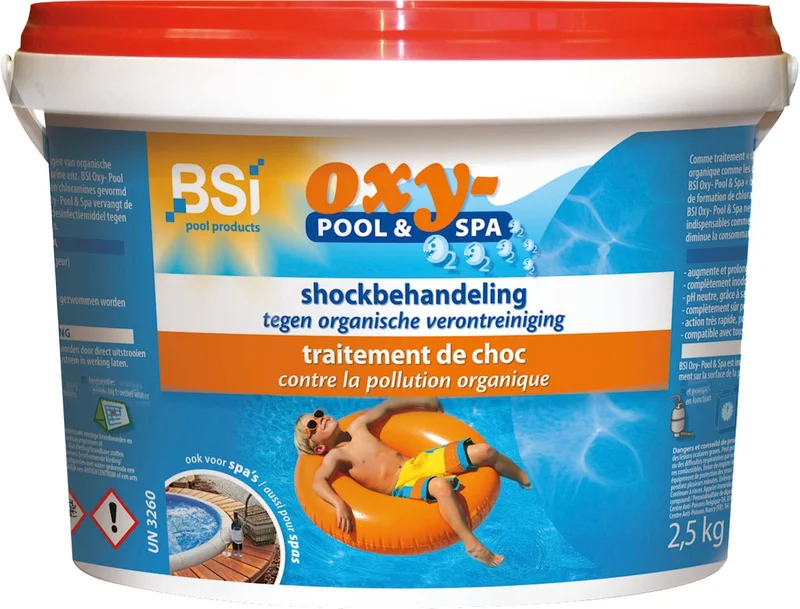
BSI Oxy-Pool & Spa Schokbehandeling Actief Zuurstof (2,5 kg)
BSIChloorvrije schokbehandeling op basis van actief zuurstof (MPS). Vernietigt organische verontreiniging zoals zonnecrème, oliën en ureum in zwembad- en spawater. Zwemmen mogelijk na 15-30 minuten. 2,5 kg volstaat voor circa 12 behandelingen in een zwembad van 30 m³.
- Zwemmen na 15-30 minuten
- Verhoogt chloorgehalte niet
- Geschikt voor zwembad én spa
- Werkt naast UV- en zoutchlorator
- Doodt geen actieve algen
- Duurder per behandeling dan chloorshock
A second form of active oxygen is hydrogen peroxide (H₂O₂), typically in concentrations of 35 to 50%. This sees limited use in residential pools because of the additional handling and storage precautions required. MPS powder is considerably safer and more practical.
How Does MPS Work in Pool Water?
Chlorine plays two roles in a pool: oxidation (burning off organic waste) and disinfection (killing bacteria and algae). Both consume free chlorine. In a heavily used pool, as much as 70% of the chlorine added can be used up on oxidation alone — reacting with sweat, urine, and sunscreen — before it has the chance to kill a single pathogen.
MPS takes over the oxidation role. When you add a weekly MPS dose, you burn off the organic waste before chlorine has to deal with it. The chlorine you then maintain in the water goes directly toward disinfection.
In practice:
- Organic waste (sweat, urine, sunscreen residue) accumulates in the water
- MPS reacts with that waste and breaks it down
- The water is cleaner and carries less combined chlorine (chloramines)
- Chlorine added afterward stays active as free chlorine for longer
- Fewer chloramines means less pool smell and less eye irritation
This is why a pool that “smells strongly of chlorine” actually has a water quality problem, not too much chlorine. The smell comes from combined chlorine (chloramines). MPS eliminates the organic load that creates those chloramines in the first place.
When to Use Non-Chlorine Shock — and When Not To
When MPS Works Well
Weekly maintenance dose: add 150 to 200 grams of MPS per 10 m³ (15 to 20 grams per m³) every 5 to 7 days, even when the water looks clear. This is preventive oxidation that keeps organic load from building up.
After heavy use: after a busy weekend with many swimmers, the water contains high levels of sweat, sunscreen, and other organic matter. An MPS treatment that evening clears it without leaving high chlorine levels the next morning.
With low-chlorine systems: if you run a UV or salt chlorinator and maintain chlorine at 0.5 to 1 mg/L intentionally, a weekly MPS treatment is almost essential. UV destroys bacteria effectively but does not oxidise organic waste. That waste accumulates and creates chloramines over time.
For sensitive swimmers: swimmers who experience skin or eye irritation from chlorine can often swim more comfortably when chlorine levels are maintained lower and MPS handles the weekly oxidation duty.
When MPS Does Not Work
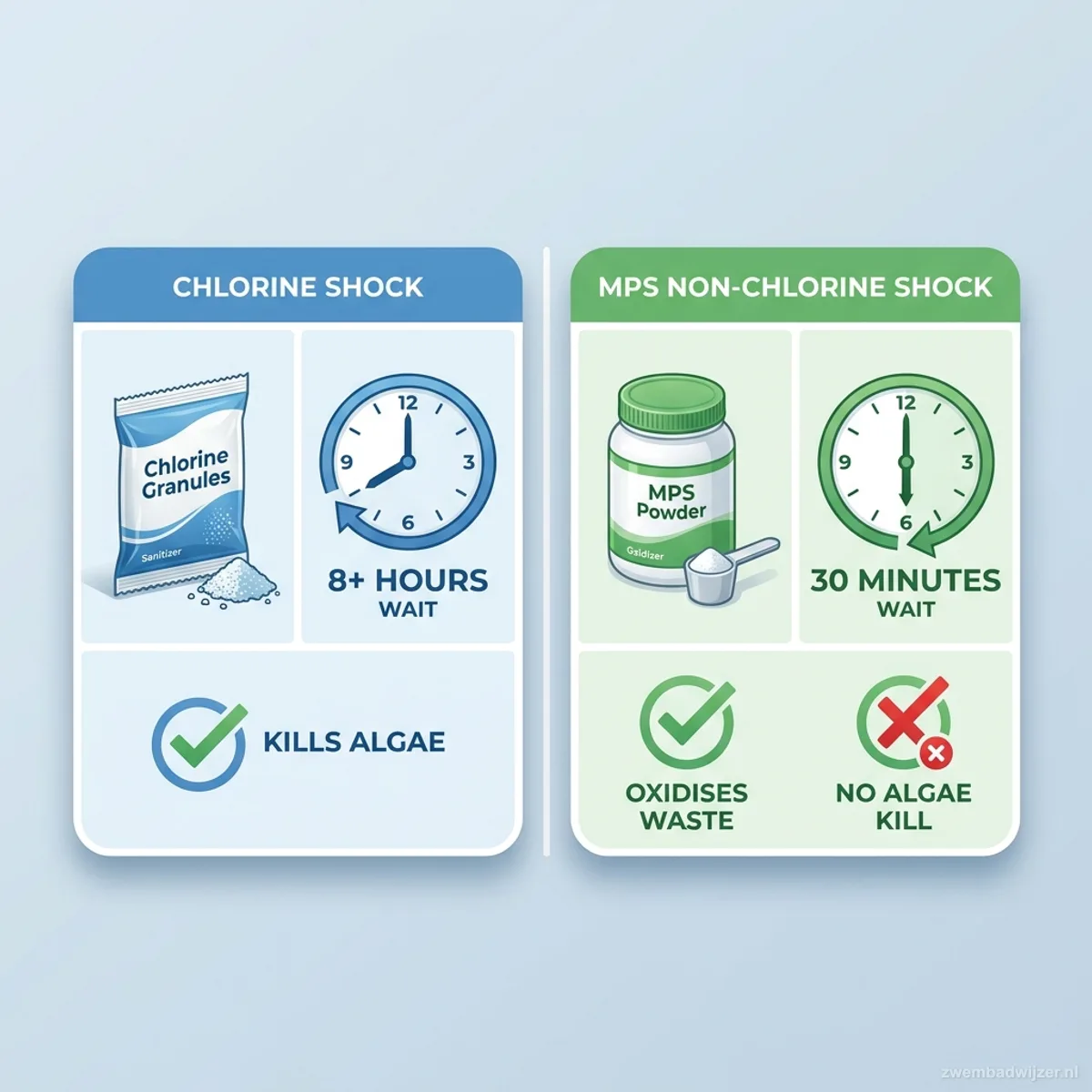
Active algae growth: MPS does not kill algae. If your pool has turned green or cloudy with algae, you need a chlorine shock. Use MPS only once the water is clear again.
As a chlorine replacement: MPS is not a sanitiser. Bacteria, viruses, and parasites are not killed by MPS. A pool without an active sanitiser — chlorine, bromine, or UV — is not safe to swim in.
At pH outside range: MPS oxidises most efficiently at pH 7.0 to 7.8. Outside this range, the reaction slows significantly. Always check and correct pH before adding MPS.
Dosage: How Much MPS and How to Add It
Basic Guidelines
150 to 200 grams of MPS per 10 m³ per week as a maintenance treatment. For a 40 m³ pool, that is 600 to 800 grams.
| Situation | Dose per 10 m³ | Wait before swimming |
|---|---|---|
| Weekly maintenance | 150 to 200 grams | 30 minutes |
| After heavy bather load | 250 to 300 grams | 30 minutes |
| Water refill or reopening | 300 grams | 45 minutes |
| Active algae bloom | Do not use — use chlorine shock | 8+ hours (chlorine) |
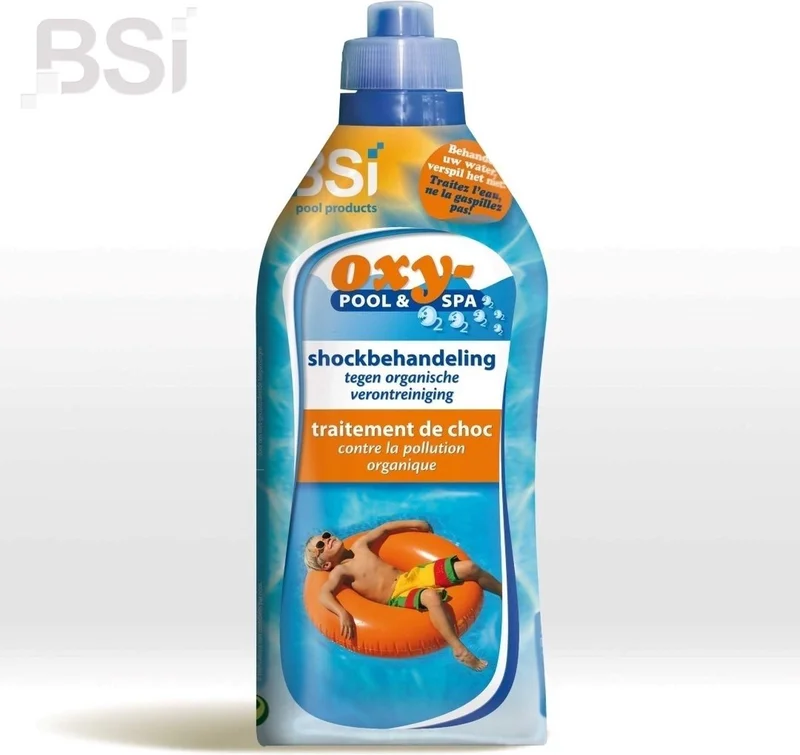
BSI Oxy-Pool & Spa Schokbehandeling Actief Zuurstof (1 kg)
BSIChloorvrije MPS-schokbehandeling voor zwembad en spa. Oxideert organisch afval (zonnecrème, zweet, urine) zonder chloor toe te voegen. Snel oplosbaar poeder, geur- en kleurloos. 1 kg voor circa 5 behandelingen in 30 m³.
- Betaalbare kleinere verpakking
- Snel oplosbaar
- Geen chloorlucht of oogirritatie
- Kleinere verpakking, vaker bestellen
- Doodt geen actieve algen
Step-by-Step Application
- Test pH first: confirm pH is between 7.0 and 7.8. Adjust if needed and wait 30 minutes before proceeding.
- Dissolve in water: fill a clean bucket with 5 litres of lukewarm water. Add the MPS powder to the water (not the other way around) and stir until fully dissolved.
- Add at the return jets: pour the solution slowly near the return inlets. This distributes the treatment quickly throughout the pool volume.
- Keep the pump running: run the filter pump for at least 2 hours after treatment.
- Test after 30 minutes: use dedicated MPS test strips. Standard chlorine test strips will give a falsely elevated chlorine reading when MPS is present. A correct MPS level should read 30 to 100 mg/L.
- Wait 30 minutes after treatment before swimming.
Why Standard Chlorine Test Strips Don’t Work With MPS
This is one of the most common mistakes made with non-chlorine shock. After adding MPS, a standard chlorine test strip turns dark, leading the user to believe there is now high chlorine in the water. There is not — the strip is reacting to MPS, not chlorine. Always use specific MPS test strips (such as AquaChek White) when working with non-chlorine shock products.
Combining MPS and Chlorine: the Most Effective Approach
The most effective strategy for a clear, odour-free pool is to use both MPS and chlorine:
- Chlorine provides ongoing disinfection — target 1 to 2 mg/L free chlorine
- MPS weekly handles oxidation of organic waste
Never add MPS and chlorine at the same time. They partially neutralise each other when mixed directly. Wait at least 30 minutes between a chlorine addition and an MPS treatment, or schedule MPS in the morning and chlorine in the evening.
See our guide on pool chlorine for target free chlorine levels and dosing rules.
MPS With Salt Chlorinators and UV Systems
A salt chlorinator continuously produces low-level chlorine through electrolysis. The chlorine level is kept deliberately low — 0.5 to 1 mg/L. On hot days with heavy swimmer use, organic waste can accumulate faster than the electrolysis cell can oxidise it. A weekly MPS dose is the ideal complement: it handles oxidation without requiring you to turn up the chlorine output or adjust salt levels.
UV systems work by passing water past an ultraviolet lamp that destroys pathogens. UV has no residual action in the water and does not oxidise organic waste. Swimmers in a UV-primary system generate chloramine load rapidly without supplemental oxidation. Weekly MPS prevents this build-up.
Read more about how salt electrolysis works in our article on saltwater pools .
Safety and Storage
MPS is a powerful oxidiser. Handle it with appropriate care:
- Wear rubber gloves and avoid skin and eye contact
- Store in a cool, dry place away from flammable materials and chlorine products
- Never mix MPS directly with chlorine granules or shock powder — the reaction can be violent
- Always use a clean bucket when dissolving MPS — residues from other chemicals can react
- Shelf life: up to 2 years unopened in dry storage; use within one season once opened
MPS is approved as a biocide for pool use in the EU. Check that your product carries the relevant EU authorisation for use as a swimming pool oxidiser.
Frequently Asked Questions
What is the difference between non-chlorine shock and chlorine shock?
Non-chlorine shock (MPS) is an oxidiser that burns off organic waste without adding chlorine. Chlorine shock raises free chlorine to 10 mg/L or above to kill algae and bacteria. MPS does not replace chlorine as a sanitiser — it removes the organic load that otherwise consumes your chlorine.
How long after non-chlorine shock can I swim?
You can swim again 15 to 30 minutes after adding MPS, as long as it has dissolved and the pump has been running. Chlorine shock requires at least 8 hours before free chlorine drops back to a safe level.
Does non-chlorine shock kill algae?
No. MPS is an oxidiser, not a sanitiser. It does not kill algae or bacteria. If you have active algae growth, you need a chlorine shock first.
Can I use non-chlorine shock with chlorine?
Yes — this is the most effective combination. Use MPS weekly for oxidation alongside a chlorine level of 1 to 2 mg/L. Never add them at the same time: wait at least 30 minutes between treatments.
Can I use non-chlorine shock with a salt chlorinator or UV system?
Yes. This is one of the best applications of MPS. Salt and UV systems keep chlorine low, making weekly MPS oxidation almost essential to prevent organic waste accumulation and chloramine build-up.
How much MPS do I add per week?
150 to 200 grams per 10 m³ of water as a weekly maintenance dose. Dissolve in a bucket first, add near the return jets, and run the pump for at least 2 hours. Measure with MPS-specific test strips only.