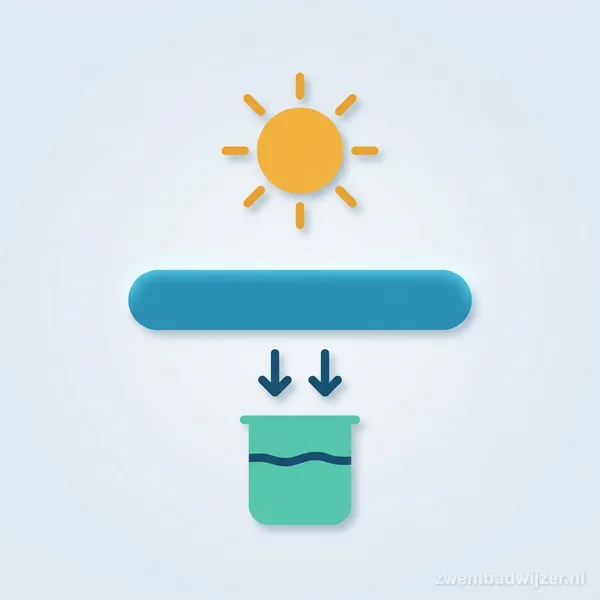
The ideal free chlorine level for your pool is 1.0 to 3.0 mg/l (ppm). Use slow-dissolving 200g tablets in a floating dispenser or the skimmer. Test 2 to 3 times per week and top up when the level drops below 1.0 mg/l.
How chlorine works in a pool
Chlorine kills bacteria, viruses and algae by damaging cell walls. In water, chlorine forms hypochlorous acid (HOCl), the active form that actually disinfects.
Chlorine effectiveness is strongly dependent on pH. At pH 7.4, approximately 48% of chlorine is active. At pH 8.0 only 21%. Always check pH (7.2 to 7.6) before evaluating the chlorine level.
Free chlorine vs. combined chlorine
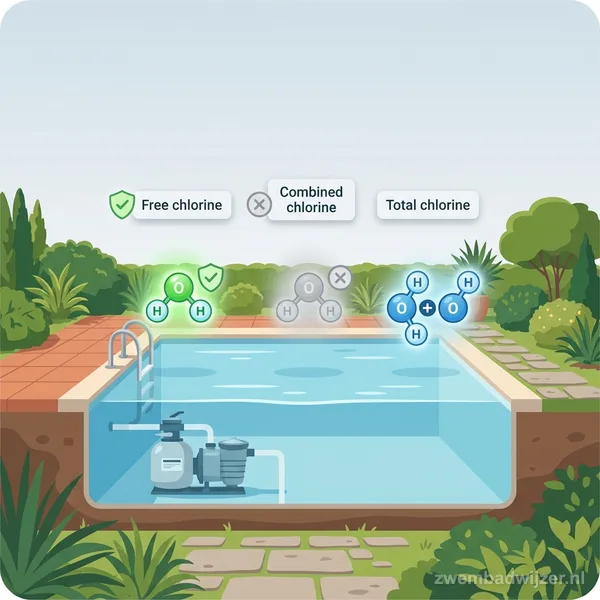
Free chlorine (FC): the active chlorine available for disinfection. This is what you measure and maintain. Ideal: 1.0 to 3.0 mg/l.
Combined chlorine (CC): chlorine that has already reacted with nitrogen compounds from sweat and urine, forming chloramines. These cause irritation and that unpleasant pool smell. Ideal: as low as possible, maximum 0.2 mg/l.
Total chlorine (TC) = free chlorine + combined chlorine. Most test strips measure the total. Use a DPD test or digital tester to measure free and combined chlorine separately.
Did you know
That typical “pool smell” is not from chlorine itself. It is from chloramines, combined chlorine formed from dirty water. A well-maintained pool barely smells of chlorine.
Pool chlorine levels: ideal range and how to test
The ideal free chlorine level varies by pool type and use:
| Pool type | Ideal free chlorine | Maximum |
|---|---|---|
| Private outdoor pool | 1.0 to 3.0 mg/l | 5.0 mg/l |
| Hot tub or spa | 3.0 to 5.0 mg/l | 10.0 mg/l |
| Indoor pool | 1.0 to 2.0 mg/l | 3.0 mg/l |
| Inflatable/frame pool | 1.5 to 3.0 mg/l | 5.0 mg/l |
Hot tubs require higher levels because of elevated water temperature (30 to 38°C) and the greater bather load per litre of water.
How often to test:
- Regular use: 2 to 3 times per week
- Hot weather (above 25°C): daily
- After heavy use or rain: immediately afterwards
Testing methods compared:
- Test strips (quick): cheap and convenient, measure total chlorine. Less accurate than DPD.
- DPD tablets (accurate): measure free and combined chlorine separately. Better for diagnosing problems.
- Digital tester (most reliable): reads the DPD reaction electronically, eliminating colour interpretation errors.
More on choosing the right test method: how to test pool water .
Types of pool chlorine
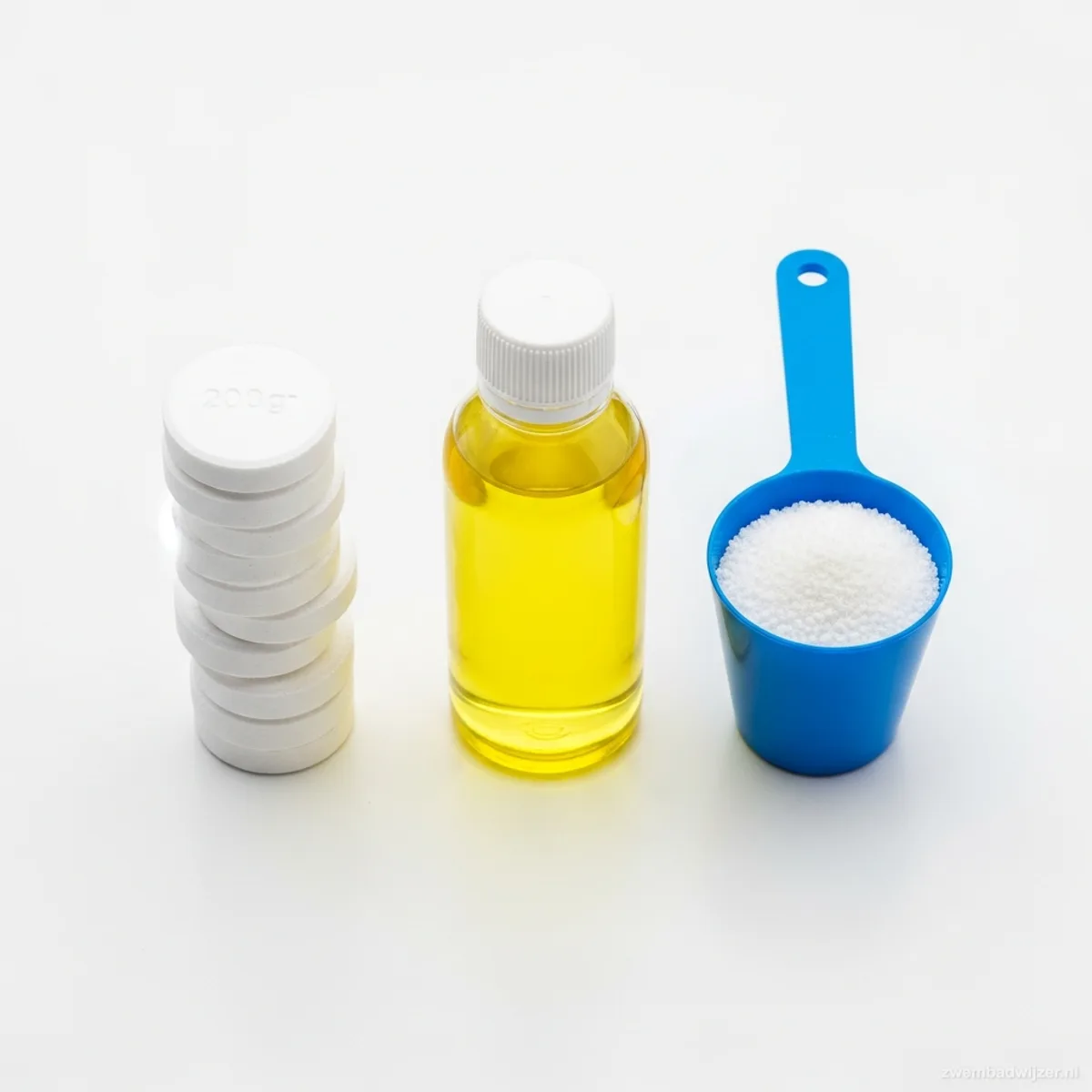
Chlorine tablets (200g, 20g)
The most common form for private pools. 200g tablets dissolve slowly (7 to 10 days) and are easy to dose via a floating dispenser or the skimmer basket.
Note: chlorine tablets (trichloroisocyanuric acid, trichlor) also contain cyanuric acid. This protects chlorine from UV breakdown, but at high concentrations (above 75 mg/l) it reduces chlorine effectiveness. Partially replace the water if cyanuric acid climbs too high.
Liquid chlorine (sodium hypochlorite)
Fast-acting, inexpensive and contains no cyanuric acid. Ideal for shock treatments. Downside: loses strength quickly and must be stored cool and dark. Average concentration: 12 to 15%.
Chlorine granules (calcium hypochlorite)
Fast-dissolving, suitable for shock treatment and daily use. Much stronger than tablets (65 to 70% active chlorine): dose carefully. Always pre-dissolve in a bucket of water before adding to the pool.
Slow-release chlorine (dichlor)
Similar to trichlor but slightly less acidic. Less common in the Netherlands and Belgium.
Chlorine dosing chart: how much per 1,000 litres?
Rough guide for 200g chlorine tablets:
| Pool volume | Tablets per week | Grams per 1,000 litres per day |
|---|---|---|
| Up to 10,000 litres | 0.5 to 1 tablet | 1.5 to 3 grams |
| 10,000 to 25,000 litres | 1 to 2 tablets | 1 to 2 grams |
| 25,000 to 50,000 litres | 2 to 3 tablets | 0.8 to 1.5 grams |
In hot weather, after heavy use or with lots of sun, test more frequently. UV radiation breaks down free chlorine quickly.
How many chlorine tablets by pool size (Intex and Bestway)?
If you have an Intex or Bestway pool, you usually know the dimensions rather than the exact volume. This table converts the common sizes to litres and the number of chlorine tablets per week:
| Pool (size) | Volume (approx.) | Chlorine tablets per week |
|---|---|---|
| 300 x 200 x 75 cm | 3,400 litres | 2 to 4 tablets of 20g |
| 400 x 200 x 100 cm | 7,000 litres | 1 tablet of 200g (or 6 to 8 x 20g) |
| 450 x 220 x 84 cm | 5,700 litres | 1 tablet of 200g |
| Intex round 305 x 76 cm | 3,600 litres | 2 to 4 tablets of 20g |
| Intex round 366 x 76 cm | 5,400 litres | 1 tablet of 200g (or 5 to 7 x 20g) |
| Intex round 457 x 122 cm | 16,800 litres | 1 to 2 tablets of 200g |
Important for small above-ground pools: in a pool up to roughly 5,000 litres (most Intex and Bestway pools), use small 20g tablets rather than a full 200g tablet. A single 200g tablet dissolves too much chlorine and cyanuric acid into a small water volume, pushing the level too high. Test 2 to 3 times per week and keep free chlorine at 1.0 to 3.0 mg/l.
Read the full step-by-step in how to add chlorine to your pool .
When should you add chlorine tablets?
Add chlorine tablets when free chlorine drops below 1.0 mg/l. Test 2 to 3 times per week. Above 25°C, test daily.
Practical guide by situation:
- Start of season: add 1 to 2 tablets immediately and test after 24 hours
- Regular use: 1 tablet per 10,000 litres per week via a floating dispenser is a good starting point: adjust based on measured values
- After heavy use: test immediately afterwards and top up if the level drops below 1.0 mg/l
- Above 28°C: UV breaks down chlorine 2 to 3 times faster: increase dose or test daily
Always use a floating dispenser or place tablets in the skimmer basket. Never throw tablets directly onto pool surfaces.
How to add chlorine correctly
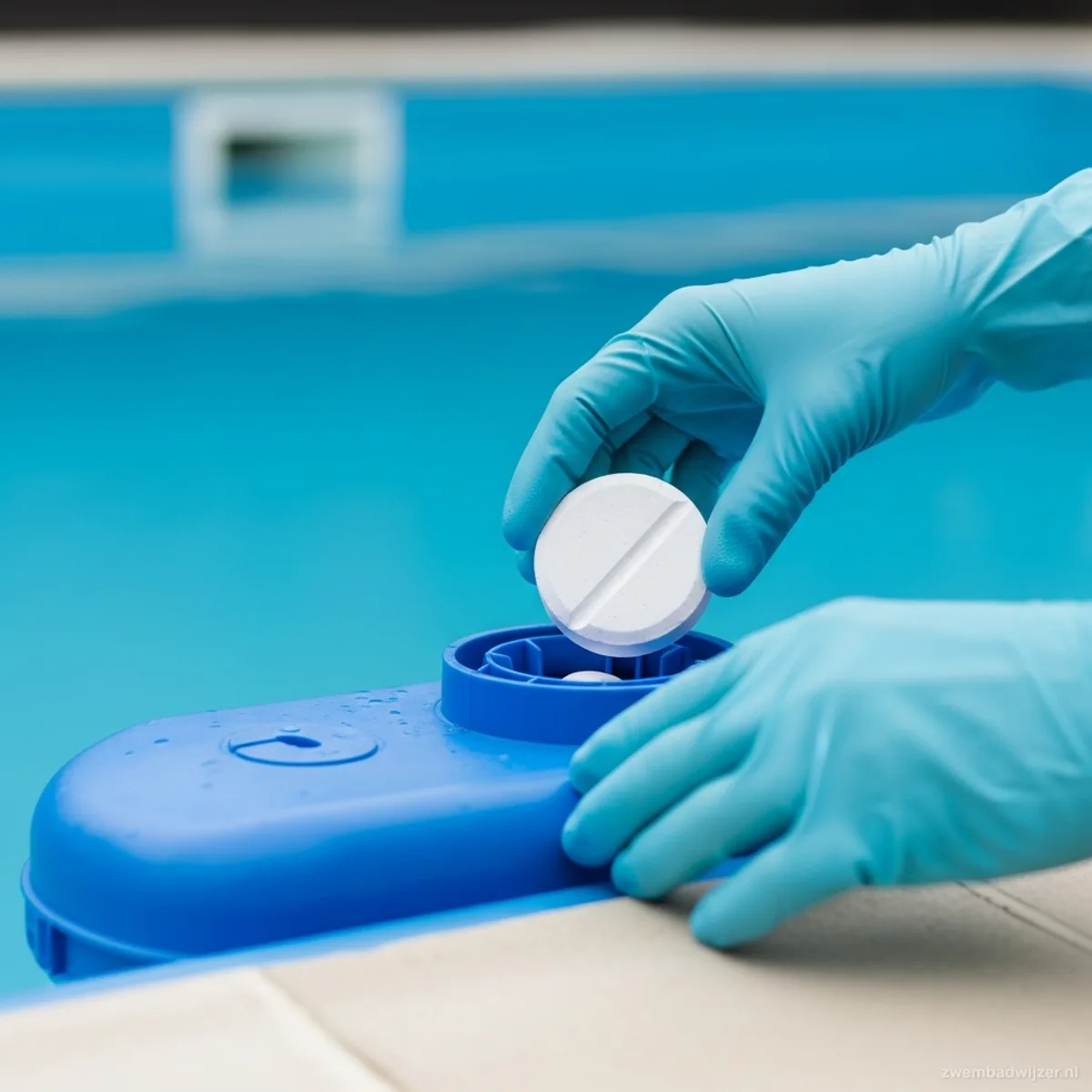
Via a floating dispenser (recommended):
- Place 1 or 2 tablets in the dispenser
- Set the opening to ‘half’ for an average dose
- Let the dispenser float while nobody is swimming
- Always remove the dispenser before swimming
- Test the chlorine level every 2 to 3 days
Via the skimmer:
- Place a tablet in the skimmer basket
- Check regularly whether the tablet is dissolving too fast or too slow
- Adjust pump run time if needed
Warning
Never throw chlorine tablets directly onto pool surfaces. Concentrated chlorine damages vinyl liners, foil, and concrete coatings on contact.
Too much chlorine in the pool: effects and solutions
A chlorine level above 3.0 mg/l is uncomfortable and at sustained high concentrations it can damage pool materials.
Symptoms of too much chlorine:
- Burning, red eyes after swimming
- Dry and irritated skin
- Strong chlorine smell above the water surface
- White spots or discolouration on pool surfaces at persistently high levels
- Bleach spots on swimwear
Chlorine levels and recommended action:
| Chlorine level | Situation | Action |
|---|---|---|
| 1.0 to 3.0 mg/l | Normal | No action needed |
| 3.0 to 5.0 mg/l | Too high | Do not swim, run pump, remove cover |
| 5.0 to 10.0 mg/l | Very high | Do not swim, partially replace water |
| Above 10.0 mg/l | Dangerously high | Close pool, use neutraliser or large water change |
How to fix too much chlorine:
Wait and ventilate: run the pump and remove the pool cover. UV light and circulation break down excess chlorine. At 5 mg/l in strong sunlight, the level typically drops to the normal range in 4 to 8 hours.
Partially replace water: replace 20 to 30% of the water with fresh tap water. Effective and fast for heavily elevated levels.
Chlorine neutraliser (sodium thiosulphate): a chemical option that neutralises chlorine immediately. Use sparingly: too much neutraliser drops the level too low. Dosage: 1 gram of sodium thiosulphate neutralises approximately 0.7 mg/l chlorine in 10,000 litres.
How to prevent too-high chlorine levels:
- Always test before adding more: do not dose by guesswork
- Test the level after a shock treatment before reopening the pool
- Do not overfill the dispenser with more tablets than needed
Free chlorine too low: causes and how to top up
A free chlorine reading below 1.0 ppm means your pool is under-disinfected. Below 0.5 ppm, bacteria and algae can multiply rapidly. Searching for “free chlorine too low”? That refers to the same thing: free chlorine (FC) is the measurement of active, available chlorine.
The most common causes of low free chlorine:
UV breakdown: sunlight degrades unstabilised chlorine within 1 to 2 hours. Above 28°C, chlorine disappears 2 to 3 times faster. Fix: use trichlor tablets (which contain CYA as a UV shield) or add cyanuric acid separately when using liquid chlorine.
CYA too high (chlorine lock): above 80 ppm cyanuric acid blocks the release of active chlorine. Your test strip shows a normal chlorine reading but the chlorine is not active. Fix: partial water change to bring CYA back to 30–50 ppm. See pool cyanuric acid guide .
pH too high: above pH 7.8 only around 20% of chlorine is active as hypochlorous acid. Lower pH to 7.2–7.6 before topping up chlorine.
High bather load or contamination: sweat, sunscreen and body oils consume free chlorine rapidly. After a busy swim weekend, test and top up immediately.
Gaps in dosing: tablets in the dispenser run out, or the dispenser is set too low. Check weekly.
How to top up free chlorine:
- Test with a DPD test kit (more accurate than strips at low levels)
- Calculate dosage: one 200-gram trichlor tablet raises free chlorine in a 25,000-litre pool by approximately 0.7 mg/L
- Add tablets via the dispenser, or fast-dose with liquid chlorine (sodium hypochlorite)
- Retest after 4 hours and repeat if needed
If chlorine stays low despite regular dosing: always check pH and CYA first. More about the interaction in pool cyanuric acid: what it does and when it becomes a problem .
Pool shock: when and how
A shock treatment is needed for cloudy or green water, a strong chlorine smell, or after heavy use. For the complete guide with dosing tables and step-by-step instructions, read pool shock treatment: dosing and how-to .
In short: temporarily raise free chlorine to 10 to 30 mg/l depending on the situation. Always shock in the evening and wait 12 to 24 hours before swimming.
Chlorine and other pool chemicals
Never add chemicals at the same time. The correct order:
- First check and correct pH (wait 4 hours)
- Then add chlorine
- Wait at least 4 hours before adding other products
Chlorine and hydrogen peroxide are incompatible. Never use both in the same pool.
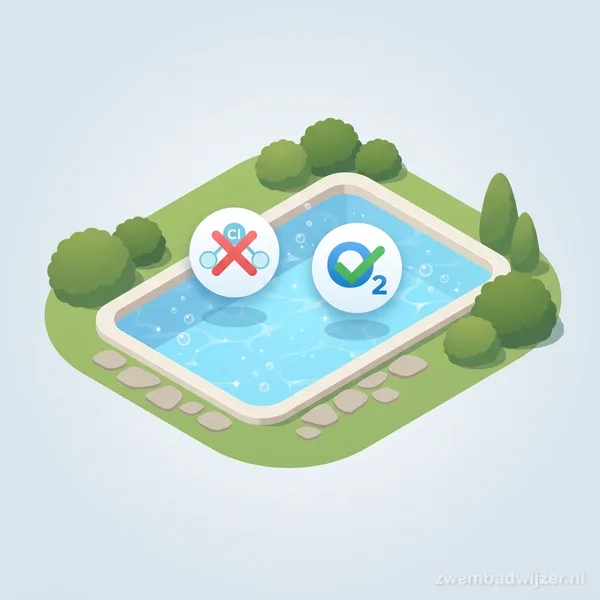
Considering an alternative to chlorine? Salt water, UV or active oxygen systems each have different pros and cons. Read more in pool without chlorine: alternatives compared .