Cyanuric acid (CYA) is the UV shield for chlorine in your pool. Without CYA, free chlorine in direct sunlight breaks down within 1 to 2 hours. The ideal level is 30 to 50 ppm. Above 80 ppm, it blocks chlorine from working — a phenomenon known as chlorine lock or CYA lock.
What is cyanuric acid and why do you need it?
Cyanuric acid (CYA) — also called stabilizer or conditioner — protects free chlorine (hypochlorous acid) from UV degradation. UV radiation is chlorine’s main enemy: in direct sunlight, 90% of your free chlorine disappears in under 2 hours.
CYA binds to chlorine to form a temporary compound. That compound is less immediately active, but also breaks down far more slowly in UV light. With CYA at the right level (30–50 ppm), chlorine lasts hours instead of minutes in bright sun.
Practical result: an outdoor pool without CYA needs daily chlorine top-ups. With CYA at the right level, you retain chlorine 4 to 8 times longer. That’s a significant saving on chemical costs.
How does CYA get into your pool?
There are two ways:
1. Via chlorine tablets (most common) Standard 200-gram trichlor tablets contain both chlorine and CYA. Each tablet delivers roughly 57% active chlorine along with a small CYA contribution. Use tablets all season without partial water changes and CYA accumulates steadily. In a closed system with minimal splash-out, you can reach 100+ ppm after a single season.
2. Added directly as stabilizer If you use liquid chlorine or calcium hypochlorite granules (which contain no CYA), add cyanuric acid separately as powder or granules at the start of the season. Approximately 2 grams per 10,000 litres raises CYA by 0.2 ppm.
Ideal CYA level by pool type
| Pool type | Ideal CYA | Maximum |
|---|---|---|
| Outdoor pool (private) | 30–50 ppm | 80 ppm |
| Indoor pool | 0–20 ppm | 30 ppm (UV irrelevant) |
| Saltwater pool (outdoor) | 30–50 ppm | 80 ppm |
| Hot tub / spa | 0–30 ppm | 50 ppm |
For indoor pools and spas, CYA is largely irrelevant since UV isn’t a factor. Too much CYA in a hot tub just reduces chlorine effectiveness for no benefit.
How to test cyanuric acid levels
Test for CYA
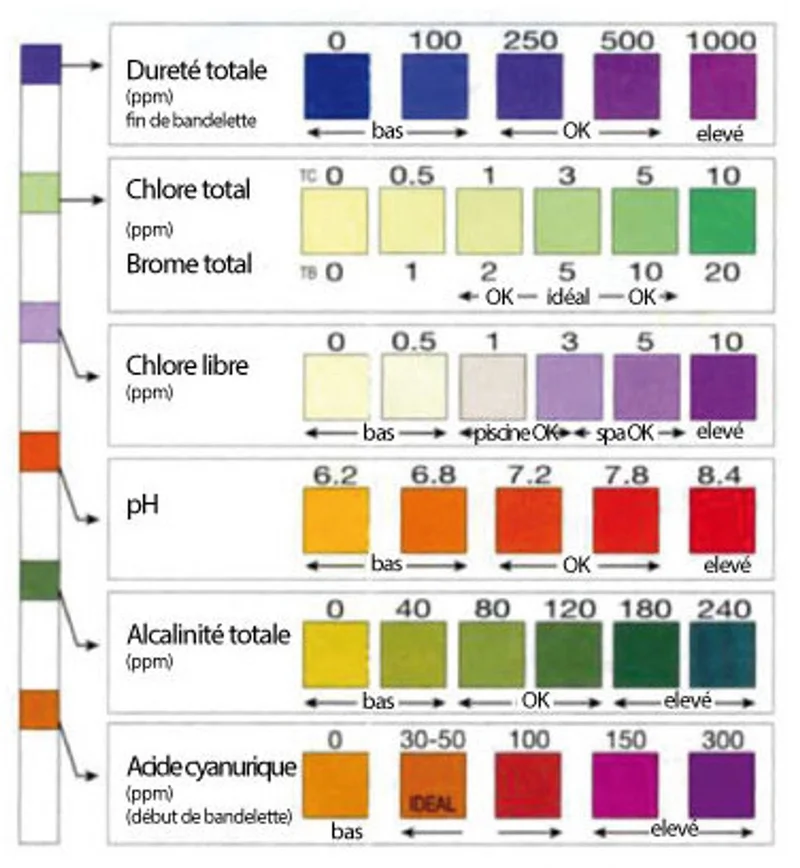
AquaChek Select 7-in-1 Test Strips Refill (100 strips)
Best premium strip for daily precise readings
~€32.00
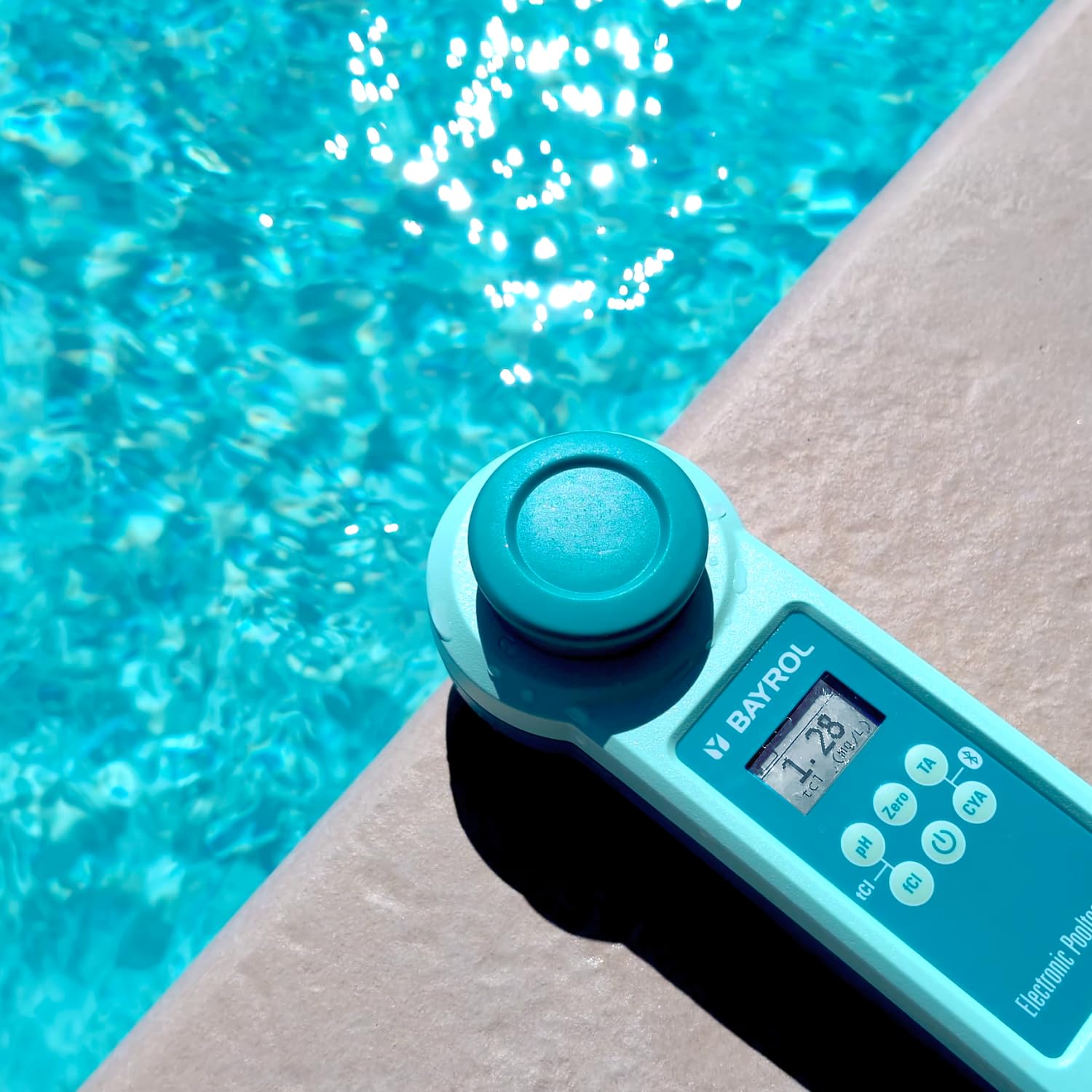
Bayrol Electronic Pool Tester (7 parameters, Bluetooth)
Best electronic tester with app integration
~€169.00
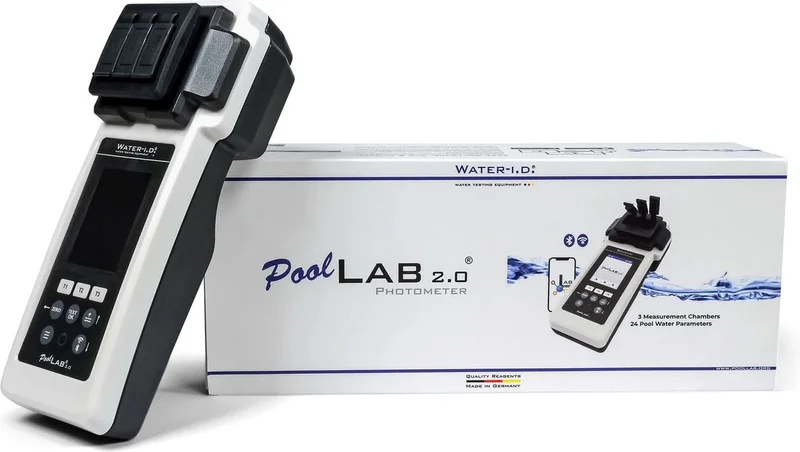
Water-I.D. PoolLab 2.0 Digital Photometer (Complete Set)
Best premium choice for accurate multi-parameter testing
~€149.00
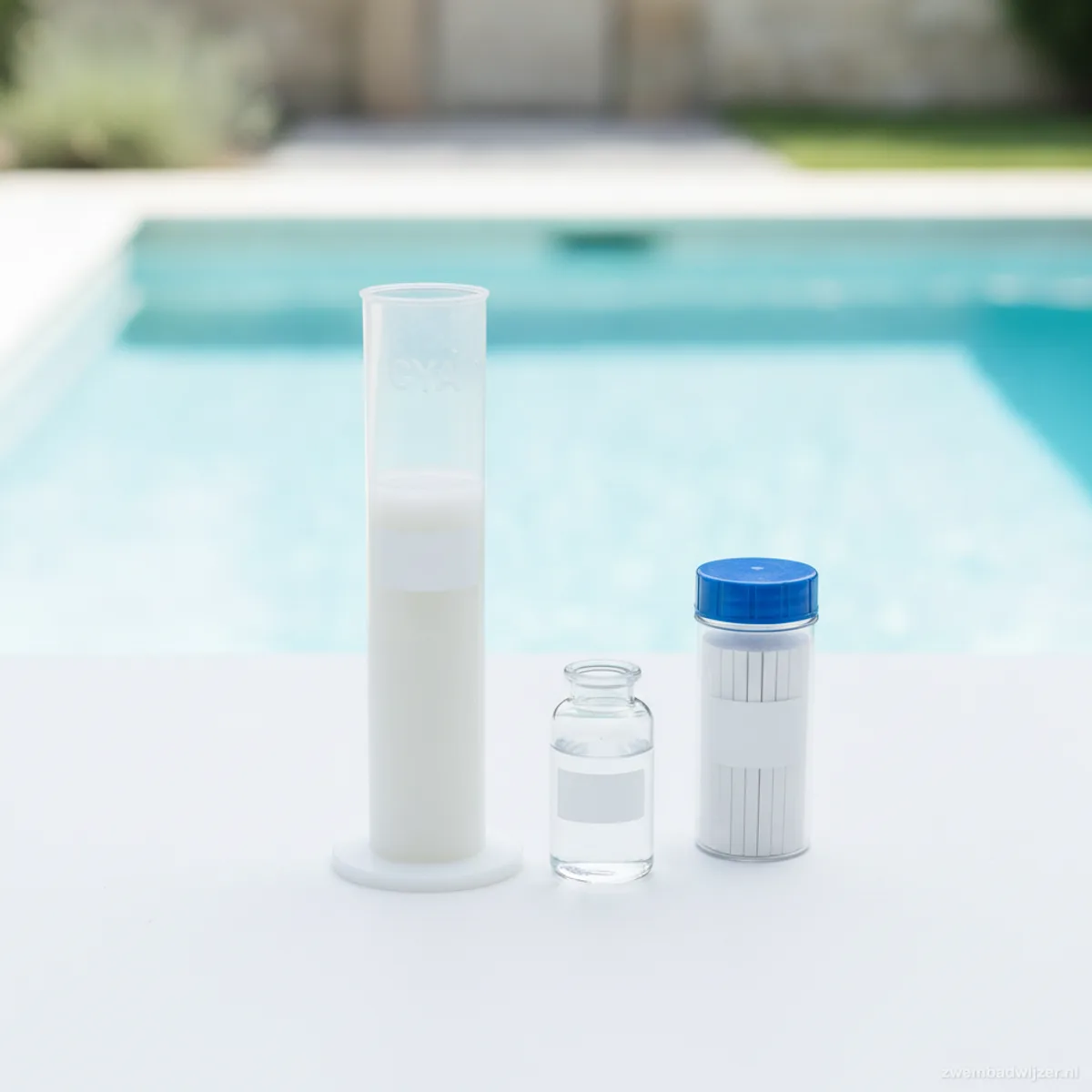
Test your CYA level using:
Visual CYA test kit (turbidimetric method): The most reliable consumer method. You mix pool water with a reagent and look through a tube until a black dot disappears. The level at which the dot becomes invisible corresponds to your CYA reading. Accurate to around 10 ppm.
Test strips: Some 6-in-1 or 7-in-1 test strips also measure CYA. Less accurate than the turbidimetric method but fine for routine monitoring.
Lab or pool service: If you’ve never checked CYA, consider sending a water sample to a pool lab. A reading above 80 ppm means action is needed.
How often to test:
- Start of season: always check
- Mid-season: every 4 to 6 weeks
- Whenever chlorine stays low despite regular top-ups: test immediately
CYA too high: recognizing chlorine lock
Chlorine lock is the condition where CYA exceeds 80 ppm and the chlorine present in your water is no longer able to disinfect effectively. Your test strip shows a chlorine reading of 1–3 ppm, but the water turns green or cloudy anyway.
Why test strips can mislead you at high CYA: Cheap test strips measure total or combined chlorine, not purely the free active fraction. At high CYA, you detect combined chlorine, but the actual hypochlorous acid — the active disinfectant — is only a fraction of that.
Signs of CYA lock:
- Chlorine drops fast despite regular dosing
- Green or cloudy water despite “normal” strip readings
- Shock treatment seems not to work or only works briefly
- Water hasn’t been refreshed or refilled in multiple seasons
For more on algae and chlorine that doesn’t work, read green pool water and algae: how to fix it .
Lowering CYA: a partial water change is the only fix
No chemical product breaks down CYA. The only way to lower CYA is dilution with fresh water.
Step by step:
- Test your current CYA level (e.g. 120 ppm)
- Calculate how much water to replace to reach under 50 ppm
- To go from 120 to 50: drain approximately 58% (120 × 0.42 ≈ 50)
- In practice: drain 40–50% and retest
- Drain via the drain valve or a pump
- Refill with fresh tap water while the pump runs
- Circulate for 12 to 24 hours
- Retest and repeat if needed
Rule of thumb: each 50% water change roughly halves your CYA level.
| CYA before | After 30% change | After 50% change |
|---|---|---|
| 100 ppm | 70 ppm | 50 ppm |
| 150 ppm | 105 ppm | 75 ppm |
| 200 ppm | 140 ppm | 100 ppm |
After refilling, recheck pH, alkalinity, and calcium hardness. Fresh tap water can temporarily throw these off.
CYA and shock treatment: why shocking fails at high CYA
A shock treatment raises free chlorine temporarily to 10–30 ppm. When CYA exceeds 80 ppm, a large portion of that chlorine is immediately bound and unavailable for disinfection. You can shock to 50 ppm and see no result.
If a shock treatment doesn’t work despite correct dosing, high CYA is the most likely cause. Change out some water first, bring CYA back below 50 ppm, and then perform the shock.
Learn more about shock treatment in chlorine shock for pools: dosage and steps .
CYA in saltwater pools
Saltwater chlorinators produce sodium hypochlorite, which contains no CYA. If you rely entirely on a salt chlorinator, CYA doesn’t build up automatically. But UV still breaks down electrolytically produced chlorine in outdoor pools, so CYA is still needed.
Add CYA as stabilizer powder at the start of the season: target 30–40 ppm. Retest mid-season. Learn more about saltwater pool management in saltwater pool: water values, startup and maintenance .