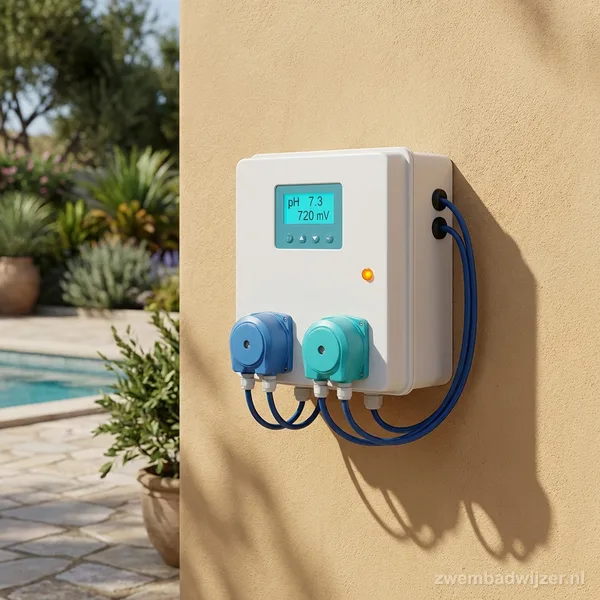
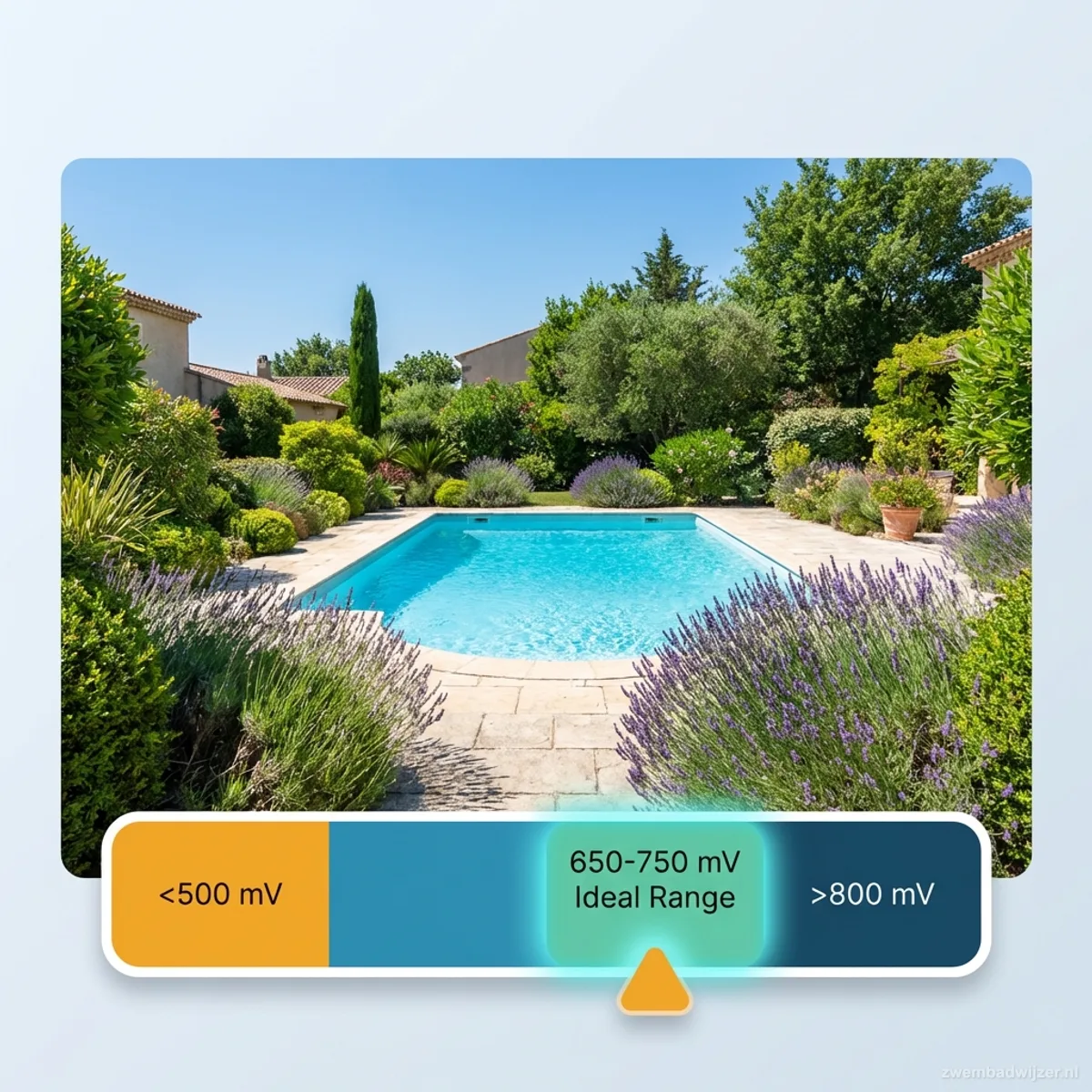
The redox value (also called ORP) of your pool indicates how effectively the water can disinfect itself. The ideal redox value is between 650 and 750 mV. Below 650 mV, disinfection is insufficient; above 800 mV, the water can become irritating. ORP is therefore a more accurate indicator of safety than the chlorine level in ppm alone.
What does ORP actually measure?
ORP stands for Oxidation-Reduction Potential. The unit is millivolts (mV). The measurement indicates how strongly the water has oxidising particles relative to reducing particles.
In practical terms: a high ORP (650 to 800 mV) means the water has plenty of free oxidants and can quickly inactivate bacteria, viruses, and algae. A low ORP (below 600 mV) means the oxidising capacity is exhausted and the water is not disinfecting effectively.
The sensor consists of a platinum electrode and a reference electrode (typically silver/silver chloride). The potential difference between the two in mV is the ORP reading. It is a passive measurement: the sensor consumes no chemicals and responds instantly to the current state of the water.
Important: ORP measures the water’s capacity to oxidise, not the concentration of a specific substance. Chlorine, ozone, hydrogen peroxide, and other oxidants all contribute to the measured ORP value.
The difference between ORP and measuring free chlorine
ORP and free chlorine are related but definitely not the same thing. This is the most common misunderstanding among pool owners who are new to automation.
The core issue: the disinfecting effectiveness of chlorine depends heavily on pH. At pH 7.0, about 85% of total chlorine is present as HOCl, the active form. At pH 7.8, that drops to just 33%. The ppm figure stays the same, but the active fraction nearly halves.
ORP measures the net result of all these factors together. The same pool at pH 6.8 with 0.5 ppm chlorine might show 750 mV ORP, while the same pool at pH 7.8 with 1.5 ppm chlorine shows only 550 mV ORP. The water with the higher chlorine concentration is actually less well disinfected.
Cyanuric acid (CYA, the stabiliser in chlorine tablets) complicates the relationship further. At a CYA level of 80 mg/L, effective chlorine is 4 to 6 times less active at the same ppm value. ORP reflects this: the same chlorine level produces a lower ORP when CYA is high.
Why ORP tells you more than measuring chlorine alone
ORP is a combined measure that captures all relevant factors at once: chlorine concentration, pH, CYA level, water temperature, and the presence of organic material. A single ORP reading in mV tells you more about the bacteriological safety of the water than three separate ppm measurements.
This is why professional pool automation systems measure ORP by default rather than ppm chlorine alone. The WHO explicitly states in its pool water guidelines that an ORP above 650 mV is the best indicator for microbiologically safe water.
Temperature also matters: at 30°C, chlorine is chemically more active than at 15°C, which raises ORP at the same concentration. Automation that measures ORP compensates for this automatically by dosing less at warmer temperatures.
Ideal ORP values by pool type
Target values vary by situation. Here are the most widely used standards:
| Pool type | Ideal ORP range | Minimum value | Source |
|---|---|---|---|
| Private in-ground pool | 650 to 850 mV | 650 mV | WHO guidelines |
| Public pool (EU standards) | 700 to 800 mV | 700 mV | WHO/national guidelines |
| Natural swimming pond | 400 to 500 mV | N/A (chlorine-free) | Industry guidelines |
| Spa / hot tub | 800 to 900 mV | 750 mV | WHO Spa guidelines |
| Salt electrolysis pool | 700 to 750 mV | 650 mV | Manufacturer + WHO |
For spas and hot tubs, a higher minimum applies because the warmer water temperature (35 to 40°C) accelerates bacterial growth and the mechanical agitation depletes oxidising capacity faster.
Causes of an ORP value that is too low
An ORP below 600 mV requires immediate action. Here are the most common causes:
Too little chlorine (free chlorine below 0.5 ppm): The most obvious cause. Confirm this by measuring free chlorine separately with test strips or a DPD tablet tester.
pH too high (above 7.6): At pH 7.6, only 48% of chlorine is active as HOCl. The ppm reading looks fine, but ORP is low. Lower the pH to 7.2 to 7.4 and ORP will rise without adding any extra chlorine.
High cyanuric acid (CYA above 50 mg/L): CYA forms a complex with chlorine that has no disinfecting activity. This explains why pools relying heavily on tablets can have low ORP despite an apparently good chlorine level. The only solution is a partial water change.
Heavy bather load: Ten or more swimmers in a 50,000-litre pool can exhaust the oxidising capacity within a few hours. ORP can drop by 100 to 200 mV after a busy afternoon. Increase chlorine production or perform a chlorine shock.
Organic contamination or algae growth: Algae and organic material consume chlorine rapidly. A greenish tinge or slimy walls are a sign that ORP has been too low for an extended period.
Low water temperature: Below 16°C, chemical reactions slow down, including disinfection. ORP can read lower at the same chlorine concentration than it would in summer.
Causes of an ORP value that is too high
An ORP above 800 to 850 mV is rare with normal management, but it can happen:
Overdosing after chlorine shock: Immediately after a shock treatment (2 to 5 ppm chlorine), ORP can spike to 850 mV or higher. Wait for the value to fall naturally toward 700 mV before swimming.
Electrolysis cell at maximum output: With a very low salt level, some controllers compensate by running the cell at 100%, temporarily producing high ORP.
Very low pH: Below pH 7.0, almost all chlorine is active as HOCl, sharply raising ORP. This also damages rubber fittings and irritates eyes. Correct pH immediately.
How an ORP sensor works
The ORP sensor consists of two electrodes in a housing that is mounted inline in the pool’s pipe circuit. The sensor is best installed in a separate bypass pipe of 50 mm diameter, which allows the flow rate to be controlled. Water flowing too fast or too slowly disturbs the reading.
The platinum electrode (measuring electrode) together with the reference electrode (silver/silver chloride) generates a voltage difference. This voltage, ranging from -2,000 to +2,000 mV, feeds the control unit. For pool water, values of 400 to 900 mV are normal.
The BNC connector is the standard connection plug for ORP sensors. Virtually all controllers from manufacturers such as Siemens, ProMinent, Bayrol, and Behncke accept this universal type.
Reading and setting ORP on your automation system
On the control unit display you see two values side by side: the set point (what you have programmed) and the measured value (current reading). The hysteresis defines the tolerance band:
- Set point 700 mV, hysteresis 50 mV: the controller tolerates values from 675 to 725 mV. Outside this band, the dosing pump starts or the electrolysis cell increases output.
- OXD mode: the controller doses when ORP falls below the set point minus hysteresis. This is the standard operating mode for chlorine dosing.
- RED mode: the controller doses a reductant when ORP rises above an upper limit. Rarely used in residential pools.
Read everything about how the controller works on the automatic pH and chlorine control page.
ORP sensor maintenance
A well-maintained ORP sensor delivers reliable measurements for 12 to 18 months. After that, the platinum electrode becomes too fouled or aged for accurate readings.
Monthly cleaning: Remove the sensor from the bypass housing and rinse it with tap water. Gently wipe the platinum tip clean with a soft cloth or a cotton swab. Do not use abrasive cleaners.
Annual calibration check: Submerge the sensor in a certified ORP reference solution of 468 mV (quinhydrone reference, available from most pool supply distributors). The reading should not deviate by more than 30 mV. A larger deviation means it is time to replace the sensor.
Replace every 12 to 18 months: Schedule this as a fixed winterising task. An ORP sensor costs 30 to 80 euros depending on brand and type. Replace the pH sensor at the same time for maximum reliability.
When to check manually even when you have automation
Automation does not replace all manual checks. Always measure manually in these situations:
- After a busy day with more than 10 swimmers: ORP drops quickly under high organic load. A manual reading confirms that the value has recovered.
- After heavy rainfall: rain dilutes the pool water and washes garden debris and fertiliser from the surroundings into the water. ORP can drop quickly.
- After chemical additions: wait 2 hours after adding chlorine or pH correction chemicals before trusting sensor readings. Distribution of chemicals takes time.
- When the sensor shows a suspiciously constant value: a sensor that holds exactly the same reading for days with no fluctuation is likely fouled or faulty. Verify manually.
When in doubt, always check your water with test strips or a digital tester . A 6-in-1 test strip measures pH, chlorine, alkalinity, hardness, and stabiliser in one dip.
Comparison table: ORP, free chlorine, and DPD test
| Method | What it measures | Frequency | Cost | Automation-compatible |
|---|---|---|---|---|
| Inline ORP sensor | Total oxidising capacity (mV) | Continuous | 30 to 80 euros/year (sensor) | Yes, fully |
| Free chlorine sensor (amperometric) | Free chlorine (ppm) | Continuous | 60 to 150 euros/year | Yes |
| DPD tablet tester | Free + combined chlorine (ppm) | Manual 2x/week | 15 to 30 euros/season | No |
| Test strips (6-in-1) | pH, chlorine, alkalinity and more | Manual 3x/week | 8 to 15 euros/season | No |
For private pool owners, the combination of an inline ORP sensor for continuous monitoring plus weekly verification with test strips is the most cost-effective approach.
Frequently asked questions
What is the ideal ORP value for a private pool?
The ideal ORP for a private pool is between 650 and 750 mV. The WHO uses a minimum of 650 mV as the threshold for safe disinfection. Above 800 mV the water can become irritating to eyes and mucous membranes. For salt electrolysis systems, 700 to 750 mV is the recommended target.
Why does ORP drop after heavy swimming use?
Swimmers introduce organic material into the water: skin cells, sweat, sunscreen, and urine. These substances quickly exhaust the water’s oxidising capacity. A drop of 100 to 150 mV after a day with 10 or more swimmers is normal. The value recovers within 4 to 8 hours of filtration, faster if you temporarily increase chlorine production.
Can I measure ORP without automation?
Yes, with a portable handheld ORP meter (30 to 80 euros) you can measure ORP manually. Submerge the electrode 30 seconds in the water at 30 cm depth, away from return jets. Read the stable value. A portable meter gives a useful snapshot but does not monitor continuously. For ongoing monitoring, an inline sensor in the pipe circuit is better.
How do I raise the ORP value quickly?
The fastest method is chlorine shocking: add sodium hypochlorite (liquid chlorine 12 to 15%), 200 to 300 ml per 10,000 litres. ORP rises by 100 to 200 mV within 1 to 2 hours. Also lower the pH toward 7.2 if it is above 7.6: at a lower pH, HOCl is far more active and ORP rises without adding extra chlorine.
Is ORP the same as measuring chlorine?
No. ORP measures the total oxidising capacity of the water in mV; chlorine measures the concentration of the disinfecting substance in ppm. They are related but not interchangeable. The same chlorine level gives an ORP of 750 mV at pH 7.0 but only 550 mV at pH 7.8. ORP is a better indicator of actual disinfecting effectiveness than ppm chlorine alone.
Conclusion
The ORP value gives you the bacteriological safety of your pool water in a single number. A value between 650 and 750 mV means effective disinfection, regardless of which disinfectant you use or the exact pH. This makes ORP superior to measuring chlorine in ppm alone.
Want to monitor ORP automatically and adjust dosing in real time? Read everything about automatic pH and chlorine control . When using salt electrolysis, the ORP sensor is the most direct way to regulate the cell’s output; learn more at salt electrolysis pool .