The ideal calcium hardness for your pool is between 200 and 400 mg/l. Too low and the water becomes aggressive, literally dissolving calcium from your pool surfaces. Too high and white scale forms on the waterline, fittings and inside the heater. Test calcium hardness once per month.
Why does calcium hardness matter?
Water with too little calcium is aggressive. It seeks calcium from the nearest available source: your concrete walls, plaster, tile grout or metal fittings. This is called corrosive water.
Water with too much calcium precipitates calcium as white calcium carbonate, particularly where water evaporates or heats up: the waterline, the heating element and the filter media.
Ideal values by pool type
| Pool type | Ideal calcium hardness |
|---|---|
| Concrete / gunite | 200 to 400 mg/l |
| Vinyl liner | 175 to 225 mg/l |
| Fibreglass (polyester) | 175 to 225 mg/l |
| Above-ground (steel/frame) | 175 to 275 mg/l |
Calcium hardness too low: identify and fix
Symptoms: pitting in concrete walls, rough wall texture, rust on metal fittings, etched grout lines.
Solution: add calcium chloride (CaCl2), available as granules or flakes.
Dosage: 15 grams of calcium chloride per 10,000 litres raises hardness by approximately 10 mg/l.
Always dissolve in a bucket of water before adding to the pool. Calcium chloride reacts exothermically: the water in the bucket heats up significantly. Add the granules slowly and stir continuously.
Warning
Never pour undissolved calcium chloride directly onto vinyl liner or fibreglass. The heat from the exothermic reaction can damage or discolour the surface.
Calcium hardness too high: identify and fix
Symptoms: white crusty deposits at the waterline, cloudy water, white film on pump and filter housings.
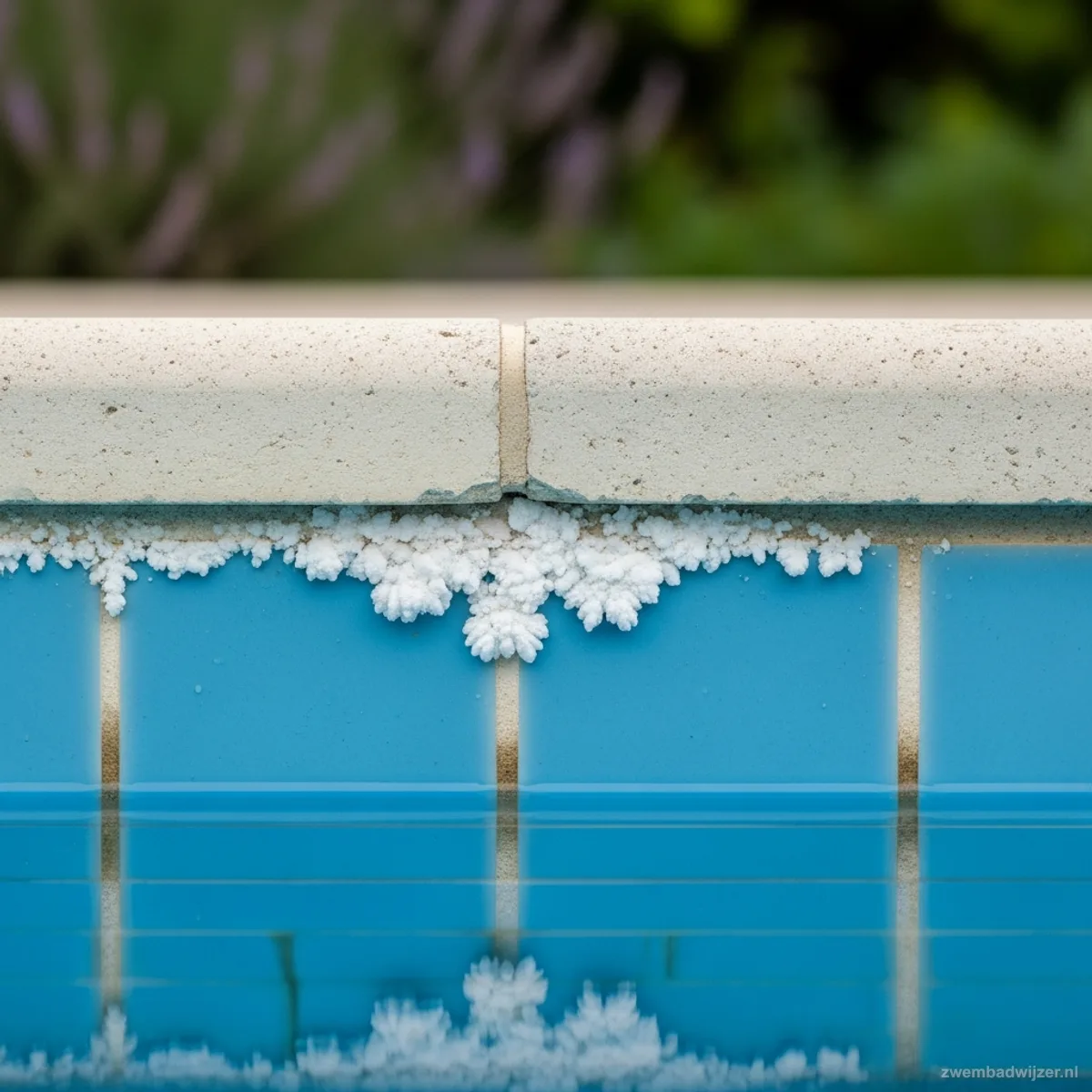
Solution: partial water replacement. Drain 20 to 30% of the pool water and refill with softer water, then retest.
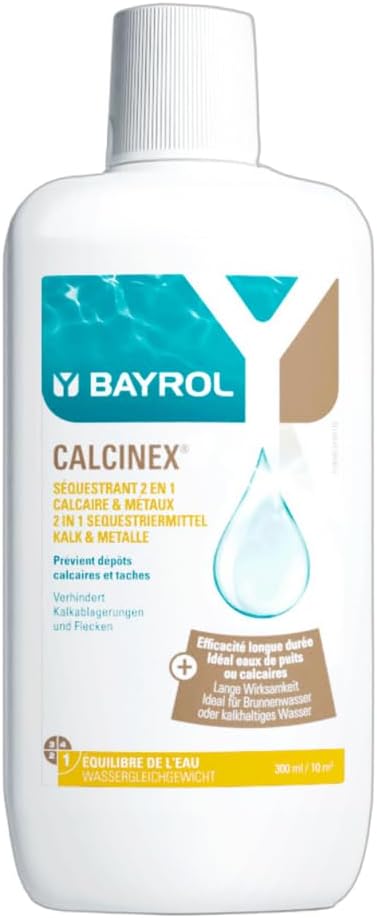
Commercial scale inhibitors (sequestrants) can temporarily hold calcium in solution and reduce scale formation, but they do not remove calcium permanently. For persistent problems, partial draining remains the most effective solution.
Calcium hardness and the Langelier Saturation Index
Pool professionals use the Langelier Saturation Index (LSI) to calculate overall water balance. The LSI combines pH, alkalinity, calcium hardness, temperature and TDS. An LSI of 0 is perfectly balanced. A positive LSI causes scale; a negative LSI causes corrosion.
For private pool owners, keeping all four parameters within range is sufficient:
- pH: 7.2 to 7.6
- Alkalinity: 80 to 120 mg/l
- Calcium hardness: 200 to 400 mg/l
- Chlorine: 1.0 to 3.0 mg/l
When all four are in range the LSI is automatically close to zero for most pools.
Water hardness varies by region
Tap water hardness varies considerably across Europe depending on the local water source. This directly affects the starting calcium hardness when you fill or top up your pool.
| Region | Typical hardness (mg/l CaCO3) | Notes |
|---|---|---|
| Coastal or delta areas | 80 to 150 | Generally soft, may need calcium addition |
| Limestone regions | 200 to 350 | Close to ideal, monitor carefully |
| Chalk aquifer areas | 300 to 450 | Often above ideal for pools |
| Mountain/granite areas | 30 to 80 | Very soft, always needs calcium addition |
If you are in a hard water area (limestone or chalk geology), your pool may already be at or above the ideal range when freshly filled. Test on day one of the new season before adding any calcium chloride.
The conversion: 1 degree of German hardness (dH) = 17.8 mg/l CaCO3. If your utility reports hardness in French degrees (fH), multiply by 10 to get mg/l CaCO3.
Calcium hardness vs. total hardness
Total hardness includes both calcium and magnesium. In pool water management, the focus is exclusively on calcium hardness (CH), because magnesium does not precipitate in the same way and plays no role in the Langelier index. If your test strips measure total hardness, that is a useful indicator but not a substitute for a targeted calcium hardness test.
Rough conversion: total hardness in mg/l CaCO3 divided by 1.67 gives an approximate calcium hardness figure. For accurate readings use a specific calcium hardness test or have the water professionally analysed.
Adding calcium chloride safely
Raise calcium hardness in steps of no more than 50 mg/l per day. The exothermic reaction generates significant heat in the bucket; always dissolve the product in the bucket fully before pouring it into the pool.
Add the dissolved solution with the pump running and wait 4 hours before taking the next measurement. This allows full mixing before you evaluate whether a second addition is needed.
For a standard above-ground pool of 20,000 litres with calcium hardness at 150 mg/l (target: 225 mg/l), you need a rise of 75 mg/l. Calculation: (75 / 10) x 15 grams x 2 = 225 grams of calcium chloride, added in two batches of 112 grams on successive days.
What happens when calcium hardness exceeds 400 mg/l?
Calcium carbonate begins to precipitate when the calcium concentration exceeds the solubility threshold for the given pH and temperature. You see this as white flakes at the waterline, a milky haze in the water and white deposit on the heating element.
Scale on a heating element is particularly damaging. Each millimetre of calcium build-up reduces heat transfer efficiency by approximately 10 to 15%. At 5 mm of scale the heater is 50 to 75% less efficient and risks overheating.
The only effective solution is partial water replacement: drain 20 to 30% and refill with softer water. No chemical product removes calcium permanently from pool water.
When to have water professionally tested
If you are in a hard water area, it is worthwhile having the water professionally analysed at the start of each season. A full test (including CH, TA, pH, free chlorine, combined chlorine, cyanuric acid and TDS) costs EUR 15 to EUR 30 and gives a complete picture of the water balance.
For more information on the full range of water tests and what to measure when, see our pool water testing guide . For the relationship between alkalinity and pH stability, see our pool alkalinity article .