A saltwater pool works differently from a traditional chlorine pool: the electrolysis cell generates chlorine from dissolved salt automatically. But the pH rises faster, the cell needs seasonal maintenance, and algae can still appear when the balance slips. Here is how to start up your system correctly and keep the water in balance.
Saltwater pool start-up: step by step
Whether you have a new system or are opening for a new season, follow this order:
Start-up checklist
- Add salt: calculate the amount needed — Litres × target ppm ÷ 1,000,000 × 1,000. Example: 40,000 litres to 3,500 ppm = 140 kg salt. Scatter salt along the walls (never into the skimmer or directly onto the cell).
- Circulate for 24 hours: run the pump before switching the cell on. The salt must be fully dissolved.
- Set pH to 7.2–7.4: do this before you switch the cell on. Electrolysis automatically raises pH — starting high quickly pushes it above 8.0.
- Check alkalinity: target 80–100 mg/L. Below 60 the pH becomes unstable.
- Add CYA stabilizer: add 30–40 ppm cyanuric acid for outdoor pools. UV degrades electrolytically produced chlorine just as it does tablet chlorine. See pool cyanuric acid guide .
- Switch the cell on at 50%: enable the cell at 50% output. Measure free chlorine after 24 hours (target: 1.0–1.5 mg/L) and adjust.
- Full check at 48 hours: test salt level, free chlorine, pH, alkalinity and calcium hardness (target 200–300 mg/L).
If you wintered with the cover on and left the water in, you only need to top up the water level, check the salt reading and adjust pH before restarting.
How does a saltwater pool system work?
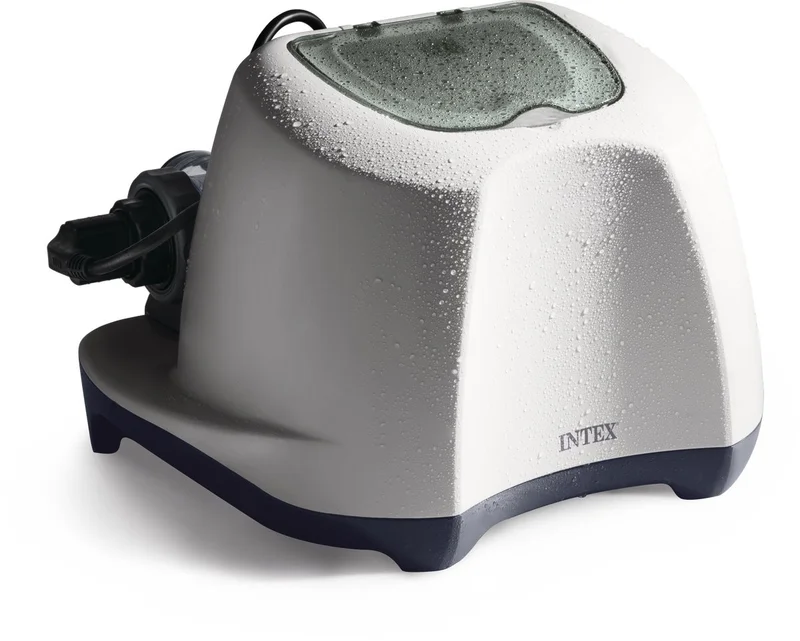
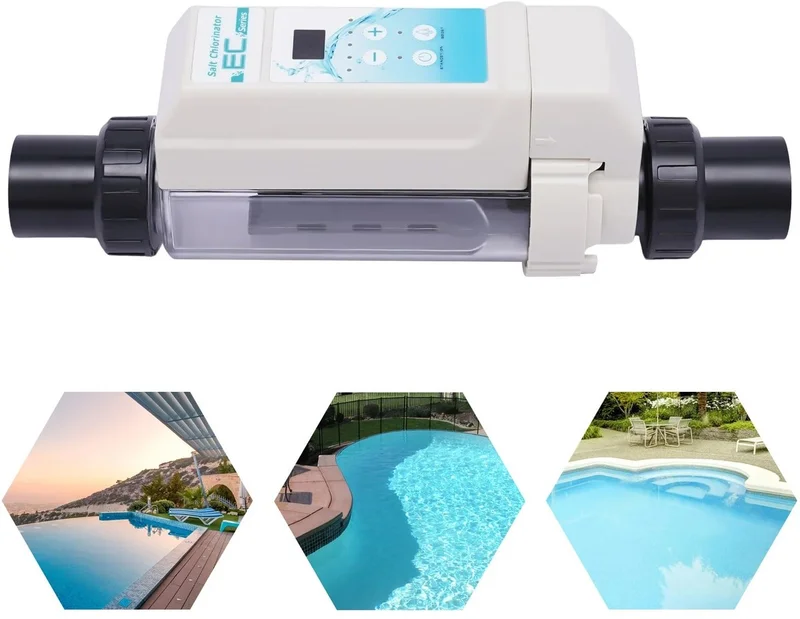
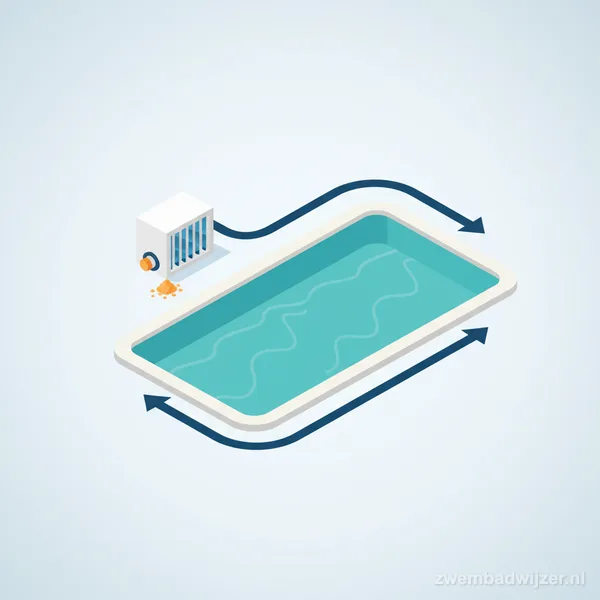
Water containing dissolved sodium chloride flows past titanium plates inside the electrolysis cell. A DC current splits the salt molecules into sodium ions and chlorine gas. That chlorine gas dissolves instantly into hypochlorous acid — the same active disinfectant you get from chlorine tablets.
After disinfecting, the chlorine breaks down back into salt ions, which cycle through the cell again. In theory you use no salt. In practice you lose 10 to 20 percent per year through splashing, backwashing and dilution. An average 50,000-litre pool needs 15 to 30 kg of top-up salt each season.
The cell has an output setting expressed as a percentage (for example 40%, 70%, 100%). Increase output during hot weather, high bather load or after rain; reduce it during quiet periods. Smart systems adjust output automatically via an ORP sensor.
For technical details, see salt electrolysis pool: complete guide and saltwater chlorinator: how it works .
Water values for a saltwater pool
| Parameter | Target range | Action threshold |
|---|---|---|
| Salt level | 3,000–4,500 ppm | Outside range: cell shuts off |
| Free chlorine | 0.5–1.5 mg/L | Below 0.3: correct immediately |
| pH | 7.2–7.6 | Above 7.8: chlorine 80% less effective |
| Total alkalinity | 80–120 mg/L | Below 60: pH becomes unstable |
| Calcium hardness | 200–400 mg/L | Below 150: cell corrodes faster |
| CYA (stabiliser) | 30–50 mg/L | Above 80: chlorine blocked |
Why pH control matters more in saltwater pools
Electrolysis raises pH automatically because it produces sodium hydroxide as a by-product. Without correction the pH climbs toward 8.0. At pH 8.0 only 3 percent of chlorine is active as hypochlorous acid; at pH 7.2 that figure is 66 percent.
Check pH daily for the first few weeks after start-up. Most saltwater pools consume 2 to 4 litres of pH decreaser per month. An automatic pH and chlorine controller removes the daily chore.
Measuring and adjusting salt level
Test salt level weekly with a digital salt meter or every two weeks with test strips. Most chlorine cells also display salt level on the control panel.
Salt too low (below the cell’s minimum): The cell produces insufficient chlorine and triggers an alarm. Add salt: dissolve it in a bucket of warm water and pour it near the return jets. Run the pump for 12 to 24 hours for even distribution. Restart the cell only after the level has stabilised.
Salt too high (above the cell’s maximum): Dilute by draining 10 to 20 percent of the water and refilling with fresh water. Do not drain more than 20 percent at once.
Algae in a saltwater pool
Green water is the most common complaint from saltwater pool owners. The cause is nearly always a combination of:
- pH above 7.8 (chlorine only 3–10% effective)
- Cell output set too low or cell due for cleaning
- Circulation time too short (less than 6 to 8 hours per day)
- CYA above 80 ppm (chlorine blocked)
Algae treatment:
- Bring pH down to 7.2
- Set cell to 100% output
- Shock with sodium hypochlorite to reach 10 mg/L free chlorine
- Brush all walls and the floor
- Run the pump continuously for 24 hours
- Add flocculant and backwash the filter after 48 hours
More on solving green water and algae and performing a chlorine shock .
Advantages and disadvantages of a saltwater system
| Advantages | Disadvantages |
|---|---|
| No manual chlorine dosing day to day | Higher upfront cost (€500–€1,500 for the cell) |
| Softer, less irritating water | pH rises automatically: needs daily monitoring |
| Lower chlorine costs over time | Salt is mildly corrosive to metal and natural stone |
| Less chlorine odour and red eyes | Cell must be cleaned each season |
| Automatic overnight chlorine production | Power draw: 50–200 W continuously |
Saltwater versus chlorine tablets: costs
| Item | Saltwater (year 1) | Chlorine tablets (year 1) |
|---|---|---|
| Disinfection equipment | €600–€1,500 (cell) | €0 |
| Annual consumables | €30–€70 (salt + electricity) | €150–€400 (tablets, shock) |
| Break-even point | After roughly 3–5 years | — |
Electrolysis cell maintenance
The cell accumulates calcium deposits on the titanium plates. Clean it at the start and end of each season:
- Switch the cell off and remove it from the plumbing
- Soak the plates for 10 to 15 minutes in a solution of 1 part muriatic acid to 10 parts water
- Rinse thoroughly with clean water
- Refit the cell and inspect the O-rings for wear
Many systems include a self-cleaning (reverse polarity) function that flips the current direction every few hours to prevent scale build-up. With these cells, one manual clean per season is enough.
Full details on cell maintenance are in the saltwater chlorinator guide .
Winterising a saltwater pool
Remove the electrolysis cell before the first frost — it is sensitive to freezing and must be stored above 5°C. If the pool water freezes, the cell, plumbing and skimmer can crack.
Drain the cell and store it indoors. The pool itself can be covered with a winter sheet or partially drained, depending on your installation. Turn the cell off at least four weeks before the first expected frost and follow the standard pool winterising steps.