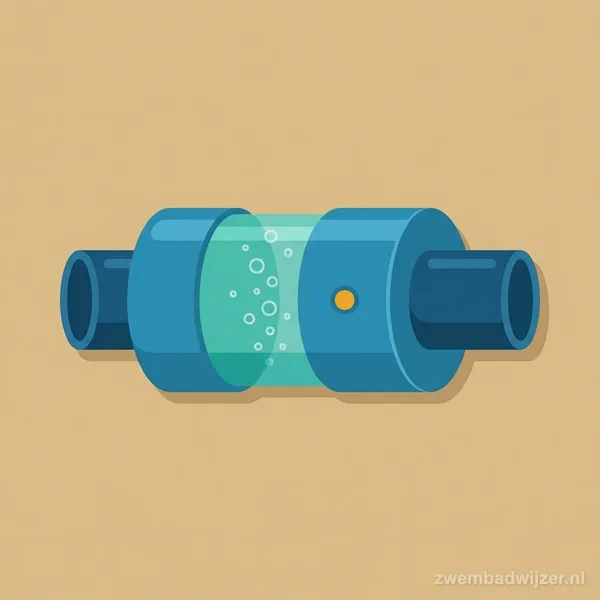
A swimming pool is a closed loop with five systems: circulation, filtration, disinfection, heating and cleaning. Water leaves the pool through the skimmer and main drain, passes through the pump and filter, gets treated and heated, and returns clean through the return jets. Once you understand this loop, you immediately see why cloudy water develops, where a leak might originate and which component to check first.
Tip
Click any component in the diagram above to jump to its dedicated page. Follow the water from the skimmer, through the pump and filter, back to the return jets. The blue dashed line shows unfiltered water, the green line shows filtered water.
How water flows through a swimming pool
The water in your pool makes the same continuous loop. It only stops when the pump is off. Here is the sequence:
- Skimmer (waterline) and main drain (deepest point) draw water in.
- The filter pump creates suction and pushes the water onward.
- The strainer basket inside the pump catches coarse debris (hair, leaves, insects).
- The sand filter or cartridge filter removes fine particles down to 20 microns.
- Optionally, the water passes through a heater, salt chlorinator or UV system.
- Through the return jets in the walls, clean water re-enters the pool.
With a correctly sized pump, one full turnover takes 6 to 8 hours. That means every drop of water passes through the filter at least once per day.
| Component | Function | Location |
|---|---|---|
| Skimmer | Draws surface water and floating debris | Wall, at waterline |
| Main drain | Draws bottom water for full circulation | Floor, deepest point |
| Filter pump | Drives water movement through the system | Equipment area |
| Strainer basket | Catches coarse debris before the impeller | Built into the pump |
| Sand or cartridge filter | Removes fine particles and algae | After the pump |
| Heater / heat pump | Warms water to the desired temperature | After the filter |
| Return jets | Returns filtered water to the pool | Walls, below waterline |
System 1: Circulation, the engine of your pool
Circulation is the foundation. Without water movement, water never reaches the filter, chemicals are not distributed and dead zones form where algae and bacteria grow undisturbed. The pump is the heart of circulation.
Water is drawn from the pool at two points. The skimmer sits at waterline level and pulls in surface water, including leaves, insects and sunscreen film. This accounts for 70 to 80% of the total flow. The main drain draws the remaining 20 to 30% from the deepest point, where the coolest and most contaminated water collects.
The circulation pattern inside your pool is determined by the return jet alignment. By angling the eyeball fittings slightly downward and sideways, you create a rotating flow that pushes debris toward the skimmer and eliminates dead corners. Check this at the start of each season by watching whether floating material naturally drifts toward the skimmer.
Want to learn more about the individual circulation components?
- Pool skimmer: how it works and what types exist
- Main drain: function, safety and circulation
- Return jets: alignment and optimal circulation
- Pool plumbing and hydraulics
System 2: Filtration, removing debris from the water
The filtration system consists of the filter pump and the filter itself. The pump draws water in and pushes it under pressure through the filter media. The filter catches suspended particles: algae remnants, fine dust, skin cells and mineral deposits.
How does the filter pump work?
The filter pump is the single biggest energy consumer in your pool system. A standard single-speed 750 W pump running 8 hours per day uses about 1,080 kWh per season (180 days), which costs EUR 378 at EUR 0.35/kWh. A variable-speed pump saves 40 to 60% on those costs by running at lower speeds when maximum flow is not needed.
The pump contains a strainer basket: a small cage that catches coarse debris before it reaches the impeller. A full strainer basket reduces flow by 30 to 50% and causes the pump to draw air. Empty it weekly.
How does a sand filter clean the water?
The most common type in residential pools is the sand filter: a pressure vessel filled with silica sand (0.4 to 0.8 mm grain size). Water flows top-down through the sand bed and particles of 20 to 40 microns are trapped. When filter pressure rises 0.5 bar above the clean starting pressure, it is time to backwash.
A cartridge filter filters finer (10 to 15 microns), requires no backwashing but needs rinsing every 2 to 4 weeks. For a detailed comparison, read sand filter vs cartridge filter .
Want to learn more about filtration?
- Filter pump: technical operation, sizing and energy consumption
- Sand filter: operation, multiport valve and filter media
- How to choose a filter pump
- How to backwash a sand filter: step by step
System 3: Disinfection, fighting bacteria and algae
Filtration removes visible particles, but bacteria and viruses are too small for the filter. You need a sanitiser. In most residential pools, that means chlorine.
Chlorine can be added in several ways:
- Chlorine tablets in a floating dispenser: delivers a continuous low dose.
- Direct dosing: granular or liquid chlorine added directly to the water.
- Salt chlorinator: electrolysis of dissolved salt (NaCl) produces chlorine on site. The water still contains chlorine, but it is generated automatically and evenly.
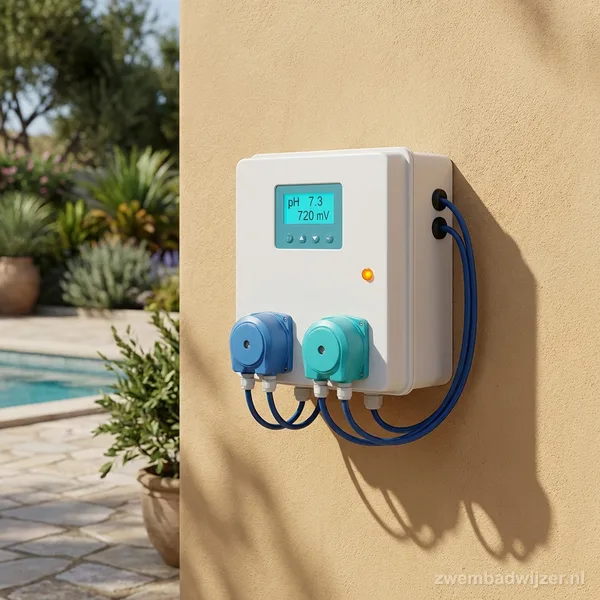
- Automatic dosing system: measures pH and chlorine continuously and doses exactly the right amount.
Chlorine effectiveness depends heavily on pH. At pH 7.2, 63% of the chlorine is in its active form (HOCl). At pH 8.0, only 21% is active. That is why pH control is at least as important as adding chlorine.
Want to learn more about disinfection?
- Pool chlorine: everything you need to know
- Saltwater chlorinator: technical operation and maintenance
- Pool without chlorine: alternatives compared
Disinfection essentials
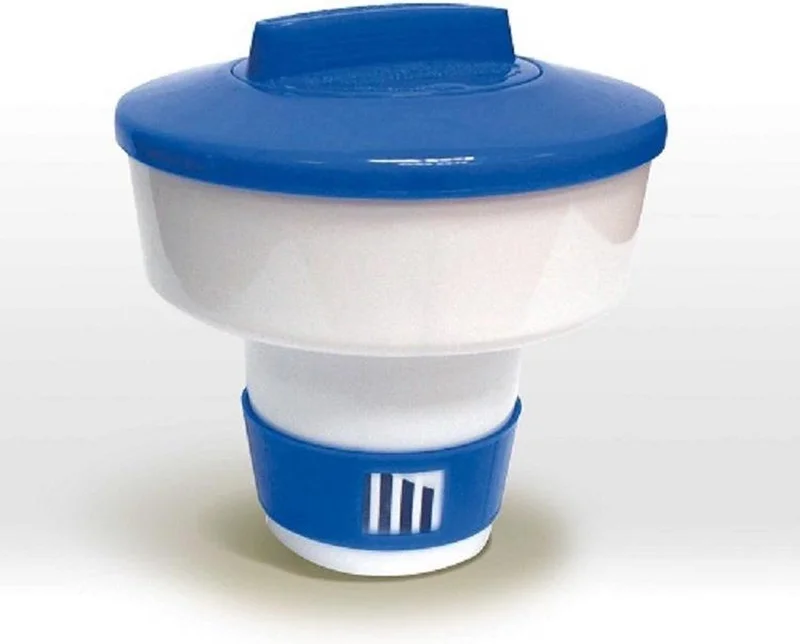
BSI floating chlorine dispenser for 200g tablets
Weekly chlorine release workhorse
~€12.50
System 4: Heating, controlling water temperature
Without heating, an outdoor pool in a temperate climate reaches at most 20 to 22 degrees in summer. Most swimmers prefer 26 to 28 degrees. Heating extends the season from May through September.
The most efficient option is a heat pump. It extracts heat from the outdoor air and transfers it to the pool water. At a COP of 5, 1 kWh of electricity delivers 5 kWh of heat, which works out to about EUR 0.07 per kWh of heat at an electricity price of EUR 0.35/kWh. Seasonal cost: EUR 150 to EUR 300 for a 30,000 litre pool.
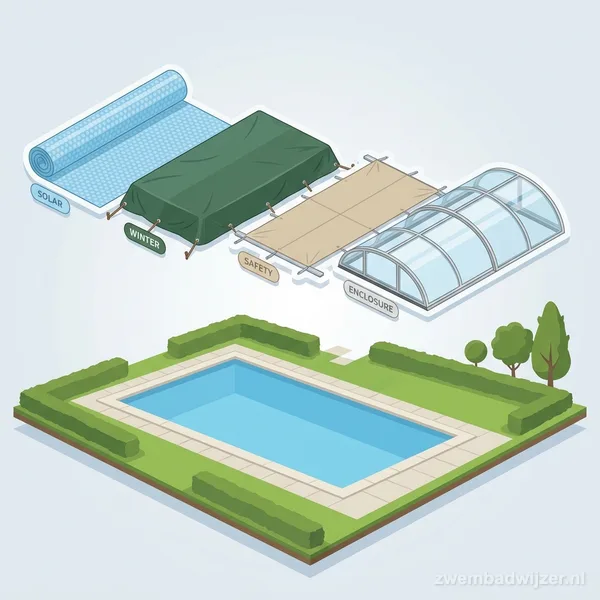
A solar cover is the cheapest addition: it prevents 70 to 80% of heat loss through evaporation and passively heats by 2 to 4 degrees on a sunny day. Always combine with an active heating system for reliable temperature control.
Want to learn more about heating?
- Heat pump: technical operation, COP and sizing
- Pool heating: all methods compared
- Choosing a pool cover: solar cover and winter cover
System 5: Cleaning, keeping the floor and walls clean
The filter system removes suspended particles from the water, but debris that settles on the floor or sticks to the walls requires mechanical cleaning. There are three options.
A manual pool vacuum is the basic tool: a vacuum head on a telescopic pole connected to the skimmer or a dedicated suction port. You move it manually across the floor. Suitable for small pools and targeted cleaning.
An automatic suction cleaner (also called a Kreepy Krauly-type) runs on suction from the filter pump. It moves randomly across the floor and draws debris into the filter via the skimmer. Simple and affordable but adds load to the filtration system.
A pool robot is fully independent: its own motor, its own filter, no load on the filtration system. It cleans the floor and in many models also the walls. The most thorough but also the most expensive option (EUR 300 to EUR 1,500).
Want to learn more about cleaning?
- Pool vacuum: types, operation and when to use which
- Best pool robot: comparison and buying guide
- How to clean a pool skimmer
Water balance: how circulation, filtration and chemistry work together
Circulation, filtration and disinfection continuously affect each other. Cloudy water can result from a blocked filter, insufficient pump run time, incorrect chemistry or a combination. You can only solve it if you know where in the system the problem lies.
| Parameter | Ideal value | Affects |
|---|---|---|
| pH | 7.2 to 7.6 | Chlorine effectiveness, swimmer comfort |
| Free chlorine | 1 to 3 mg/l | Disinfection, algae control |
| Alkalinity | 80 to 120 mg/l | pH stability |
| Calcium hardness | 200 to 400 mg/l | Corrosion or scale formation |
| Cyanuric acid | 30 to 50 mg/l | UV protection for chlorine |
Test these five parameters at least twice per week. Always correct in this order: alkalinity first, then pH, then chlorine. Read more in our guide to pH and chlorine .
Where to start? A logical reading order for beginners
If you have just got a pool or are thinking about buying one, read in this order:
- This article - you now understand the system as a whole.
- How to choose a filter pump - determine the right pump.
- Sand filter vs cartridge filter - choose the right filter type.
- How to test pool water - learn your water parameters.
- Pool maintenance schedule - set up a weekly routine.
- Opening your pool in spring - seasonal start-up step by step.
Tip
Most beginners focus on chlorine and pH first. But if circulation and filtration are not right, no amount of chemistry will help. First make sure the pump runs the correct hours, the filter is clean and the return jets are properly aligned. Only then will chemistry have the desired effect.